Quick Summary:
Conventional security testing often fails to verify whether identified vulnerabilities are genuinely exploitable, creating alert fatigue and slowing remediation efforts. Agentic AI overcomes these limitations by autonomously analyzing code changes, validating attack paths, discovering undocumented APIs, performing runtime mobile security assessments, and correlating emerging threat intelligence with enterprise applications. This blog examines how autonomous AI agents transform security testing into a continuous, context-aware process that improves vulnerability detection and threat analysis.
Table of Contents:
- Introduction
- How Agentic AI Is Changing Security Testing
- How AI Agents Secure APIs and Mobile Applications
- How AI Helps Detect Vulnerabilities and Analyze Threats
- How to Deploy AI in Security Testing
- The Future of Autonomous Security Testing
The paradigm of modern software deployment demands continuous verification, yet traditional security methodologies remain heavily constrained by manual intervention. According to recent Gartner forecasts, end-user spending on information security is projected to surge to approximately $244 billion globally, with security software leading the charge as organizations confront increasingly sophisticated, machine-driven threat vectors. This escalation underscores an urgent requirement for adaptive, autonomous validation systems capable of keeping pace with rapid developer deployment velocities. The emerging discipline of agentic artificial intelligence represents the latest shift in this space, migrating from simple assistive models to independent, goal-oriented digital entities.
This technological evolution establishes a foundation for highly resilient, self-healing software development life cycles. By shifting focus from reactive scanning to continuous, autonomous reasoning, organizations can successfully identify vulnerabilities before malicious entities exploit them. This transition requires a deeper exploration of how agentic models can actively restructure contemporary validation workflows.
ImpactQA delivers continuous, AI-driven security testing across web, mobile, APIs, and cloud applications.
How Agentic AI Is Changing Security Testing
Traditional static and dynamic analysis platforms frequently struggle with high false-positive rates and a complete lack of contextual awareness. By contrast, agentic security systems leverage goal-oriented decision-making to autonomously execute application security testing processes without human-in-the-loop dependencies. These intelligent agents can explore an application’s architecture, understand user pathways, and run targeted exploits based on real-time feedback. Additionally, they do not simply run static rule-checks; they actively interpret results, modify their payloads, and execute multi-stage attacks to verify if a vulnerability is genuinely exploitable.
To achieve this level of operational autonomy, organizations are increasingly turning to advanced AI security testing architectures. These frameworks allow agents to construct logical assumptions about application behavior, continuously adjusting their validation methodologies as the code changes. For instance, when a developer pushes a new code to commit, an autonomous agent can instantly analyze the delta, determine which parts of the system are susceptible, and deploy custom validation routines. Through continuous learning, these agents minimize analytical noise, enabling development teams to prioritize real, high-severity bugs over false positives.
How AI Agents Secure APIs and Mobile Applications
The widespread adoption of microservices and mobile platforms has significantly expanded the modern attack surface, creating complex endpoints that are incredibly difficult to secure manually. Implementing autonomous API security testing ensures that invisible endpoints, parameters, and shadow APIs are constantly mapped and validated. Intelligent agents are capable of parsing API documentation, generating real-time test cases, and actively executing logical fuzzing to uncover authorization bypasses. Consequently, the reliance on outdated, pre-configured test scripts is eliminated in favor of continuous, adaptive assessment.
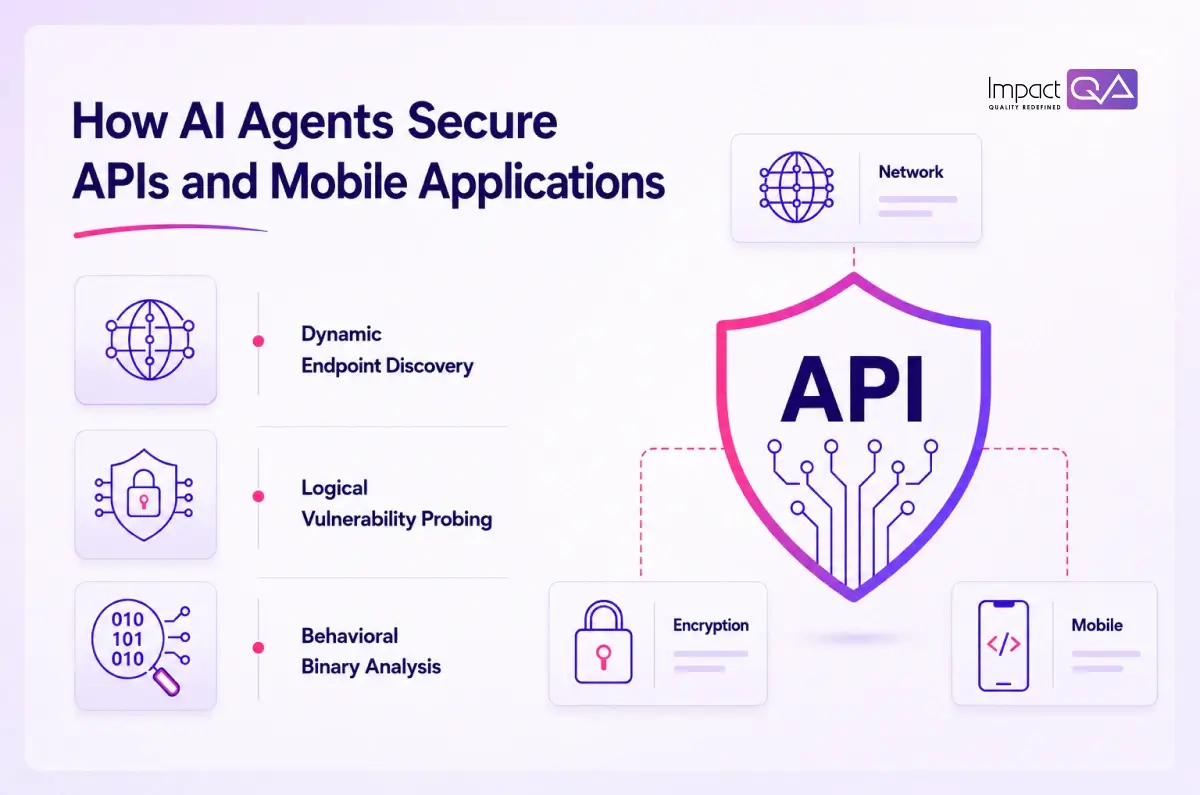
Similarly, executing comprehensive mobile application security testing poses unique challenges due to diverse device operating systems, binary compilations, and complex client-side storage mechanisms. Agentic platforms address these complexities by mimicking real-world user interactions on virtualized devices, analyzing how the application handles sensitive data dynamically. These agents can isolate insecure data storage, identify improper platform usage, and intercept network traffic in real time. Through this autonomous depth, organizations can identify critical vulnerabilities across both Android and iOS ecosystems rapidly.
- Dynamic Endpoint Discovery: Automatically maps undocumented APIs and hidden endpoints by analyzing operational traffic.
- Logical Vulnerability Probing: Simulates complex multi-step user scenarios to uncover broken object-level authorization (BOLA) issues.
- Behavioral Binary Analysis: Evaluates mobile applications during runtime to detect memory leaks, reverse-engineering weaknesses, and cryptographic flaws.
How AI Helps Detect Vulnerabilities and Analyze Threats
The integration of LLMs with goal-oriented agentic architectures has ushered in a new era of AI & LLM security testing capabilities. These advanced agents can read, comprehend, and reason through vast repositories of unstructured threat intelligence, mapping new exploits to existing corporate codebases. When a new zero-day vulnerability is disclosed globally, an intelligent agent can autonomously analyze the threat, scan internal repositories, and determine if the enterprise is vulnerable. This proactive approach drastically reduces the time-to-remediate from weeks to mere minutes.
Furthermore, deploying purpose-built AI security testing tools empowers organizations to conduct continuous threat simulation at scale. These specialized tools run autonomous red-teaming exercises, constantly testing defensive controls against advanced tactics. By utilizing agentic AI security testing models, the testing process transitions from a periodic compliance checklist to a continuous, self-improving feedback loop. These agents document their findings, write targeted regression tests, and even draft secure code patches to resolve the identified weaknesses.
Testing Dimension |
Traditional Automation |
Agentic AI Approach |
| Execution Trigger | Manual or scheduled pipelines | Continuous, event-driven, and adaptive |
| Scope of Analysis | Pre-defined rules and signatures | Dynamic reasoning and context-aware probing |
| Exploitation Verification | Absent (high false-positive rates) | Autonomous confirmation via safe payload delivery |
| Remediation Support | Static documentation links | Automatically generated code patches and regression tests |
How to Deploy AI in Security Testing
Successfully adopting AI in security testing requires a methodical framework that balances rapid automation with robust operational guardrails. Organizations must first establish comprehensive sandbox environments where autonomous agents can execute testing payloads without disrupting production workloads. Additionally, integrating these agents directly into the CI/CD pipeline ensures that security checks are executed asynchronously, preventing any bottlenecks in the development lifecycle.
Furthermore, selecting the right security testing services provider is crucial for organizations looking to integrate these advanced technologies safely. Experienced service partners help set precise boundaries for autonomous agents, ensuring they operate within designated compliance and operational limits. By establishing clear feedback loops, security teams can oversee agentic decisions, gradually increasing their autonomy as the models prove their reliability and accuracy over time.
ImpactQA enables autonomous security validation that identifies exploitable risks faster and more accurately.
The Future of Autonomous Security Testing
The emergence of agentic systems represents a fundamental shift in how digital assets are defended. By transitioning from static analysis to autonomous, goal-directed reasoning, organizations can successfully address vulnerabilities at machine speed. As we look to the future, the successful integration of autonomous agents into the software development life cycle will distinguish highly resilient enterprises from those remaining susceptible to rapidly evolving cyber threats.
At ImpactQA, we are actively at the forefront of this technological shift, pioneering the integration of agentic validation frameworks within contemporary enterprise environments. Our comprehensive suite of security testing services leverages state-of-the-art AI security testing tools to deliver continuous, context-aware protection across web, mobile, and API ecosystems. By partnering with us, organizations can seamlessly transition from manual validation workflows to fully autonomous, self-healing security operations.
Share this post


Related Posts
Our Case Studies