Quick Summary:
Traditional security testing does not provide complete protection to autonomous AI systems that think, act, and perform tasks independently. This blog describes how agentic AI security testing addresses new threats, including prompt injection, data leakage, unsafe tool use, and unauthorized actions. The blog also covers the key components of testing, enterprise use cases, ways to implement it, and the approaches to keeping AI applications secure.
Table of Contents:
- Introduction
- Why Agentic AI Requires a New Approach to Security Testing
- Core Components of Agentic AI Security Testing
- Enterprise Use Cases for Agentic AI Security Testing
- Building a Reliable Agentic AI Security Testing Strategy
- Final Thoughts
Artificial intelligence is progressing from assistive automation to autonomous decision-making, enabling systems to reason through objectives, interact with enterprise applications, and execute tasks independently. This advancement is expanding enterprise capabilities while introducing security risks that conventional testing approaches cannot fully address. According to Statista estimates, the AI market for cybersecurity will exceed 134 billion dollars by 2030, which indicates that companies are moving towards the application of intelligent cybersecurity and automated operations.
However, software testing alone is not enough when companies employ AI in their applications. Security specialists have to monitor how the AI system executes commands, gains access to enterprise resources, and acts under the influence of competitors. It was the background that made the necessity of agentic AI security testing apparent.
ImpactQA helps secure AI applications with expert-led testing services.
Why Agentic AI Requires a New Approach to Security Testing
The conventional approach to security testing focuses on detecting weaknesses in applications, APIs, cloud infrastructure, and underlying systems prior to deployment. While these processes remain valid, the advent of autonomous AI adds a new dimension to the security problem. In contrast to traditional technologies, AI systems assess the surrounding context, draw conclusions, use alternative solutions, and modify their actions during the decision-making process. Such behavior poses risks that may go undetected by standard vulnerability assessments.
Consequently, the field of application security testing continues to evolve, going beyond code assessment. Security specialists must be aware of possible unauthorized access to confidential data, unauthorized actions by AI systems when facing manipulated prompts, and the risks and threats posed by API consumption, and not only check whether endpoints are effectively protected.
The study of AI security assessment also includes an evaluation of threats and risks specific to intelligent systems, such as prompt injection, jailbreaks, hallucination-based decisions, unsafe tools, and data leaks. Besides, AI & LLM security assurance goes even further by confirming the ability of language models to comply with corporate policies in potentially difficult situations. Additionally, it is important that companies implementing AI-enabled applications also test mobile applications for security concerns.
In fact, agentic AI security assessment is improving traditional testing methods rather than replacing them, as it investigates how independent machines behave in the real world. The combination of innovative AI safety tools and unique security testing services allows companies to discover new AI threats even before they penetrate their processes.
Core Components of Agentic AI Security Testing
Effective agentic AI security testing integrates different validation methods to examine how autonomous systems think, interact, and perform tasks in business environments. In contrast to conventional security testing, which primarily addresses software vulnerabilities, this method examines the entire AI execution cycle. Each interaction, whether via an application, API, or outside services, must be tested to ensure that the AI agent acts securely and legally.
The following components form the foundation of a comprehensive testing strategy:
1. Behaviour and Prompt Validation: AI agents should respond consistently to legitimate instructions while resisting prompt injection, jailbreak attempts, and malicious context manipulation. AI security testing verifies whether the agent can distinguish between valid requests and adversarial inputs without deviating from organizational policies.
2. Application and API Protection: Application security testing ensures AI-enabled applications enforce authentication, authorization, and business rules throughout every workflow. Additionally, API security testing validates secure communication between AI agents and enterprise services, preventing excessive privileges, unauthorized data access, and insecure API consumption.
3. Model and Data Integrity: AI & LLM security testing evaluates how language models process enterprise knowledge, generate responses, and access external data sources. It also assesses the risks of hallucinations, retrieval errors, sensitive data exposure, and model manipulation that could affect business decisions.
4. Continuous Security Monitoring: Modern AI security testing tools continuously analyze AI interactions and identify emerging vulnerabilities throughout deployment. Combined with specialized security testing services, continuous monitoring enables organizations to respond to evolving threats while maintaining the reliability and security of autonomous AI systems.
Enterprise Use Cases for Agentic AI Security Testing
Many businesses and institutions are deploying autonomous AI to manage their customer communications and operations, as well as the software delivery processes. The improvements in efficiency will also mean new security issues for companies to contend with that need to be continuously validated. Agentic AI security testing will enable companies to find AI vulnerabilities before they can affect their processes.
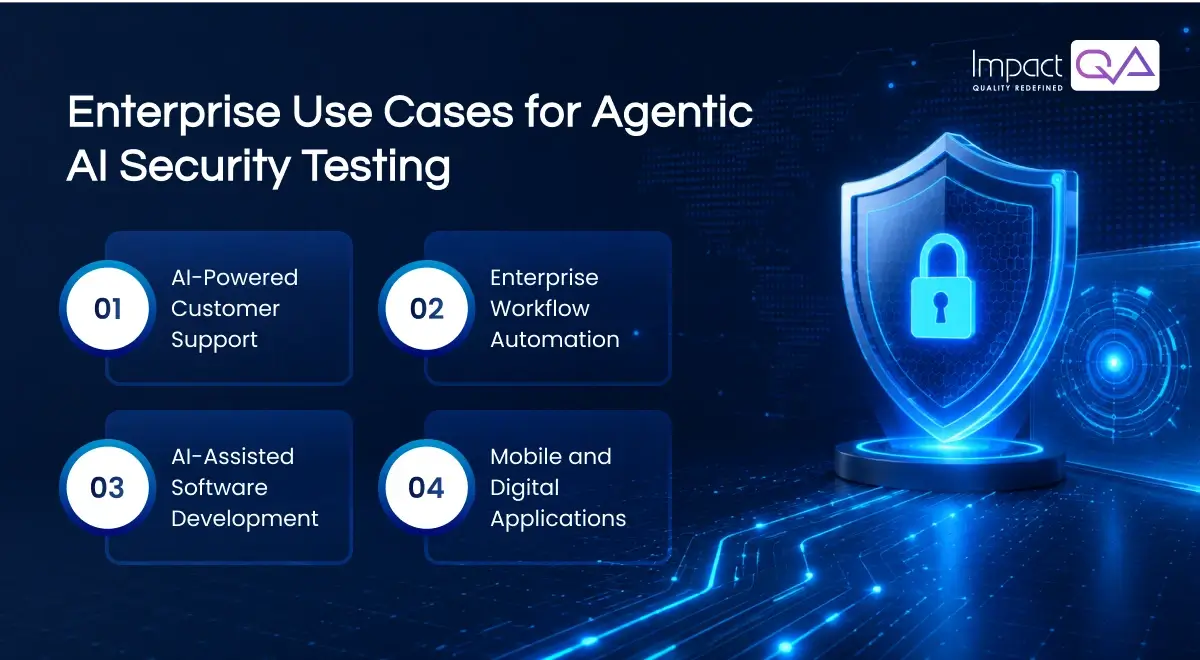
Some of the most common enterprise use cases include:
1. AI-Powered Customer Support: Virtual assistants and AI agents frequently access customer records, knowledge bases, and transactional systems. Security testing verifies secure data access, while AI security testing evaluates resistance to prompt injection, data extraction attempts, and unauthorized actions during customer interactions.
2. Enterprise Workflow Automation: AI agents increasingly automate approvals, reporting, procurement, and operational workflows. Application security testing validates business rules, whereas API security testing confirms secure communication with ERP, CRM, and third-party platforms throughout automated processes.
3. AI-Assisted Software Development: Development teams use AI to generate code, review applications, and automate testing activities. AI & LLM security testing helps validate generated code, detect insecure recommendations, and identify vulnerabilities before software progresses through the delivery pipeline.
4. Mobile and Digital Applications: AI-powered banking, healthcare, and retail applications require dedicated mobile application security testing to secure user authentication, sensitive data storage, and AI-driven features across different devices and operating systems.
Building a Reliable Agentic AI Security Testing Strategy
Implementing agentic AI security testing requires more than introducing new testing tools. Organizations need a structured validation framework that addresses AI behaviour, governance, and continuous risk management throughout the software lifecycle.
A reliable strategy should include the following practices:
1. Integrate AI Validation into DevSecOps: Embed security testing, application security testing, and AI security testing within CI/CD pipelines to identify vulnerabilities early and support secure AI deployments.
2. Test Real World Attack Scenarios: Simulate prompt injection, jailbreak attempts, malicious API requests, privilege escalation, and data poisoning to evaluate how autonomous AI systems respond under realistic conditions.
3. Strengthen API and Access Controls: Since AI agents depend heavily on interconnected services, API security testing should validate authentication mechanisms, token management, rate limiting, and least-privilege access across all integrations.
4. Adopt Continuous Monitoring: AI behaviour changes with evolving data, models, and integrations. Modern AI security testing tools should continuously monitor AI activities and generate actionable insights for security teams.
5. Partner with Specialized Experts: Experienced security testing services provide domain expertise, AI-specific testing methodologies, and industry best practices that help organizations secure complex AI ecosystems while meeting regulatory and business requirements.
Secure every AI interaction with ImpactQA's testing expertise.
Final Thoughts
As autonomous AI is increasingly used in businesses, it is important for security validation to adapt and improve with development. Organizations can no longer rely solely on traditional security testing methods to ensure the safety of smart applications. To successfully reduce new AI risks and enable safe use of the technology, organizations need to take a combined approach to application, API, AI security, and LLM testing, as well as continuous monitoring.
ImpactQA provides security testing solutions for traditional vulnerabilities as well as the specific challenges associated with autonomous AI systems. By leveraging its expertise in the field and advanced AI testing tools, the company ensures that organizations can confidently create trustworthy, secure AI applications.
Share this post


Related Posts
Our Case Studies