Quick Summary:
Many organizations struggle to keep pace with application changes because creating and maintaining test cases remains labor-intensive. Manual test design often leads to inconsistent coverage, missed business scenarios, and delayed releases. This blog explores how AI-powered test case generation addresses these challenges by accelerating test design, improving coverage accuracy, and supporting intelligent automation strategies for modern enterprise applications.
Table of Contents:
- Introduction
- Why Traditional Test Case Creation Is Reaching Its Limits
- AI-Powered Test Case Generation: How It Works
- Business Advantages of Intelligent Test Design
- Building an Effective AI-Driven Functional Testing Strategy
- Practical Considerations for Enterprise Adoption
- Bottom Line
Enterprise applications continue to grow in complexity as organizations expand cloud adoption, integrate multiple business systems, and release updates at a much faster pace than before. While development practices have become increasingly automated, test design remains a major bottleneck in many quality assurance programs. Teams often spend significant effort analyzing requirements, identifying business scenarios, and creating test cases that accurately validate expected outcomes. As applications scale, maintaining comprehensive coverage becomes difficult, particularly when requirements change frequently.
Artificial intelligence is changing this process by introducing intelligent test generation capabilities that can analyze requirements, user stories, workflows, and historical test assets to automatically create meaningful test scenarios. Instead of relying entirely on manual effort, organizations can use AI to accelerate functional testing activities while improving consistency across releases. This shift is transforming how enterprises approach software functional testing by making test creation faster, more adaptive, and better aligned with business objectives.
We leverage AI-driven automation and quality engineering practices to reduce maintenance effort.
Why Traditional Test Case Creation Is Reaching Its Limits
The effectiveness of any testing initiative depends heavily on the quality of its test cases. Unfortunately, conventional approaches often struggle to keep pace with modern delivery demands. Test analysts must manually interpret requirements, identify possible user journeys, define expected outcomes, and update scripts whenever applications change. As systems become larger and more interconnected, this process consumes considerable time and resources.
Several factors contribute to these challenges:
Growing Application Complexity
Modern enterprise platforms include web applications, mobile interfaces, APIs, cloud services, and third-party integrations. Each component introduces additional business flows that must be validated through comprehensive functional testing. Managing this growing scope often results in coverage gaps.
Frequent Requirement Modifications
Business priorities change rapidly. Features are refined throughout development cycles, requiring corresponding updates to testing assets. Manual test design frequently lags behind these changes, creating inconsistencies between requirements and validation efforts.
Limited Test Coverage Visibility
Human-created test suites can overlook uncommon user journeys or edge cases. Even experienced testers may miss certain workflow combinations when dealing with thousands of requirements and business rules.
Resource Constraints
Testing teams are often expected to deliver greater coverage without proportional increases in staffing. This places pressure on quality engineering teams to find more efficient approaches to test creation and maintenance.
AI-Powered Test Case Generation: How It Works
AI-driven test generation applies machine learning, natural language processing, and pattern recognition techniques to transform business requirements into executable test assets. The objective is not simply automation, but intelligent analysis that improves the quality and completeness of test coverage.
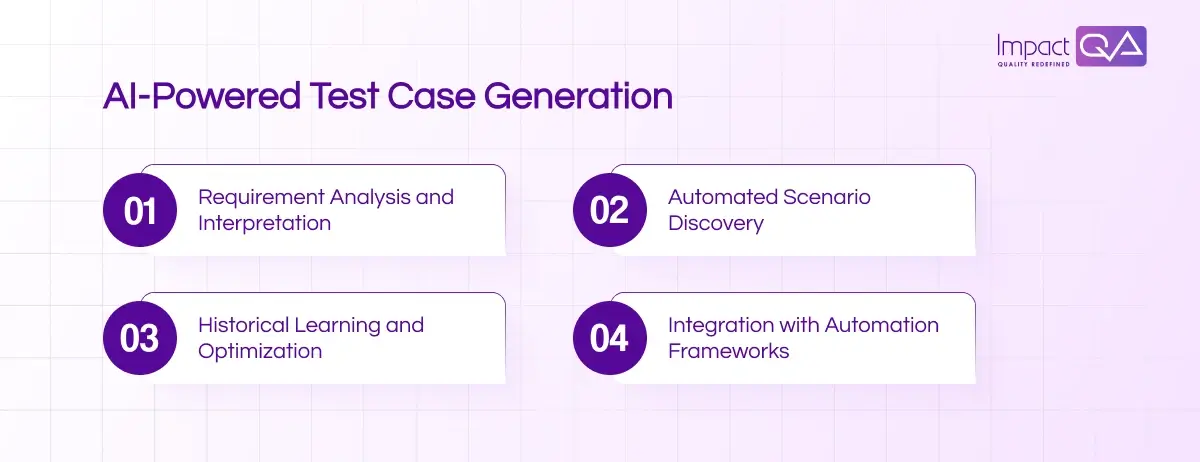
Requirement Analysis and Interpretation
AI systems can analyze user stories, business requirement documents, acceptance criteria, and process workflows. Through natural language processing, the system identifies actions, conditions, validations, and expected outcomes that should be tested.
For example, when a requirement describes an order approval process, the AI engine can automatically identify positive flows, exception paths, role-based validations, and boundary conditions that warrant testing.
Automated Scenario Discovery
Traditional test creation often focuses on expected business paths. AI expands coverage by identifying alternative workflows, unusual inputs, dependency conditions, and exception scenarios that may not be immediately obvious.
This capability significantly strengthens functional testing in software testing by reducing the likelihood of untested business logic reaching production environments.
Historical Learning and Optimization
AI platforms continuously learn from previous execution results, defect patterns, requirement changes, and user behavior. As the system accumulates data, generated test cases become increasingly relevant and targeted.
Instead of creating large volumes of redundant tests, AI prioritizes scenarios with higher business impact and greater defect detection value.
Integration with Automation Frameworks
Modern automated functional testing software can directly transform AI-generated scenarios into executable scripts. This reduces the gap between test design and automation implementation.
As a result, testing teams spend less time writing repetitive scripts and more time validating business-critical functionality and customer experience.
Business Advantages of Intelligent Test Design
Organizations implementing AI-powered test generation often report measurable improvements across quality engineering initiatives. These benefits extend beyond faster test creation and influence broader delivery outcomes.
Accelerated Test Development
AI significantly reduces the effort required to convert requirements into test assets. What previously required days of manual analysis can often be completed within hours, enabling earlier testing involvement during development.
Broader Functional Coverage
By examining multiple workflow combinations and business conditions, AI-generated tests help organizations achieve more comprehensive validation. This reduces the likelihood of defects escaping into production.
Improved Consistency Across Projects
Different testers may interpret requirements differently. AI introduces greater standardization by applying consistent analysis methods across applications, releases, and teams.
Higher Automation Readiness
AI-generated test scenarios are structured for rapid automation implementation. This shortens the path between test design and execution while supporting scalable quality assurance initiatives.
Data-Driven Decision Making
Advanced functional testing services increasingly incorporate AI insights to identify high-risk areas, prioritize testing activities, and optimize resource allocation. These insights support better release decisions and stronger quality governance.
Building an Effective AI-Driven Functional Testing Strategy
Successfully implementing AI-powered test generation requires more than selecting a tool. Organizations must establish a structured approach that combines technology with strong quality engineering practices.
Start with High-Value Business Processes
Initial adoption efforts should focus on workflows that experience frequent changes or involve substantial testing efforts. This creates visible value while allowing teams to gain confidence in AI-generated outputs.
Maintain Human Oversight
AI-generated tests should be reviewed by domain experts before execution. Human validation remains essential for confirming business relevance and ensuring alignment with organizational objectives.
Establish Quality Data Foundations
AI performance depends heavily on data quality. Well-defined requirements, accurate historical test assets, and documented business processes improve generation accuracy.
Integrate AI into Existing Pipelines
Organizations should connect AI capabilities with their existing testing frameworks, CI/CD processes, and reporting systems. This creates a seamless workflow rather than an isolated testing activity.
Practical Considerations for Enterprise Adoption
AI-powered test case generation delivers measurable efficiency gains, but successful adoption requires the right balance of technology, governance, and human expertise. Organizations should address the following considerations to maximize long-term value.
1. Data Quality and Requirement Accuracy
The effectiveness of AI-generated test cases is directly tied to the quality of input data. Ambiguous requirements, incomplete specifications, and undocumented business logic can limit coverage and require additional expert review to validate testing outcomes.
2. Governance, Traceability, and Compliance
Regulated industries require clear traceability between business requirements, test cases, and execution results. AI-generated assets must support audit readiness, compliance reporting, and transparent quality assurance processes.
3. Team Readiness and Change Management
Testing teams need training to interpret AI-generated recommendations, validate test coverage, and integrate AI-driven workflows into existing quality engineering practices without disrupting delivery timelines.
We help organizations implement AI-powered testing frameworks that shorten validation cycles.
Bottom Line
AI-powered test case generation is redefining how organizations approach quality assurance. By transforming requirements into intelligent, reusable test assets, AI reduces manual effort while expanding coverage and accelerating delivery timelines. The technology allows teams to focus more attention on risk analysis, business validation, and strategic quality objectives rather than repetitive test design activities.
As enterprise systems continue to increase in complexity, organizations require smarter approaches to functional testing that can adapt to rapid change without compromising reliability. At ImpactQA, we combine advanced automation frameworks, AI-driven quality engineering practices, and domain expertise to help organizations modernize their testing operations. Through our functional testing services and intelligent automation capabilities, we enable businesses to reduce testing effort and deliver high-quality software with greater confidence.
Share this post


Related Posts
Our Case Studies