Quick Summary:
AI-powered functional testing solutions employ artificial intelligence in generating test cases, updating them, and providing reasons for the failure of tests. The traditional QA process requires testers to perform all three activities and is more suitable for smaller releases. Manual testers continue to lead exploratory testing and user acceptance testing. In 2027, you will be looking for a functional testing company that correlates each test with its requirements.
Table of Contents:
- Introduction
- What Is Functional Testing in Software Testing?
- 5 Ways AI-Powered Functional Testing Services Differ from Traditional QA
- Traditional QA and AI-Powered Testing at a Glance
- What to Look for in a Functional Testing Company in 2027
- Final Say
- FAQs
Picture a QA lead on a Thursday evening, three hours before a release, scrolling through a spreadsheet of four hundred test cases and quietly working out which ones the team can still run before the build goes live.
For years, that was simply how functional testing worked.
The picture is changing now. Remember back in 2023, when about seven in ten organizations were using or exploring Gen AI in quality engineering? According to the World Quality Report 2025-26, that figure has reached 89%. AI-powered functional testing services are a big part of that shift.
So what actually changes when AI joins the testing team? Let’s walk through five clear differences, and then look at what to expect from a testing partner in 2027.
Share your current test suite with our experts. We will show you how much of it AI can generate and maintain for your next release.
What Is Functional Testing in Software Testing?
Functional testing in software testing ensures that each feature does what the business expects. A tester provides an input, such as login or transaction and verifies it against the requirement. If both match, then that functionality passes the test.
Software functional testing works in layers. Smoke tests ensure that a newly built code is stable. On the other hand, regression tests ensure that previously existing functionalities are working fine after any changes. This is how functional testing drives system integrity in Agile teams.
5 Ways AI-Powered Functional Testing Services Differ from Traditional QA
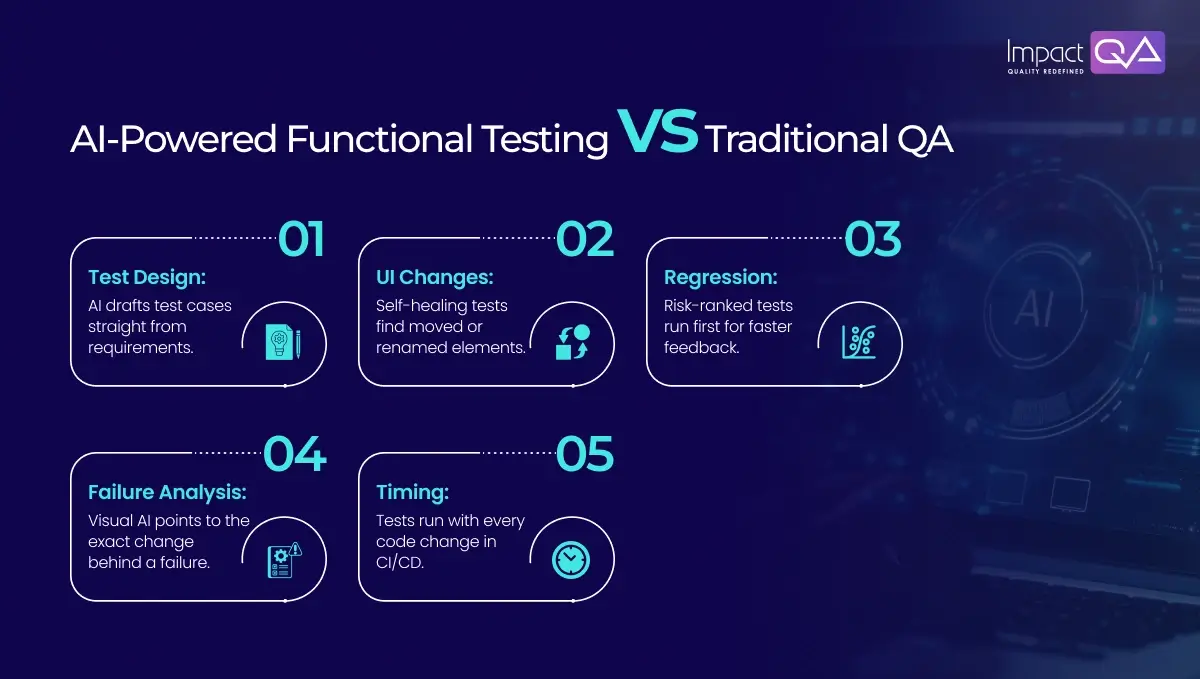
1. Test Cases Come Straight from Requirements
In traditional QA, a tester goes through each user story and develops test cases manually. This takes time, and the quality depends on how well the tester understood the story.
With AI, the process is shifted. The tool scans requirements and generates test cases. After that, the test engineer only edits them. As a result, more time is spent on verification of test case logic instead of typing into a spreadsheet.
2. Tests Keep Pace with Interface Changes
Each automated functional test requires locators – a set of information which allows finding the corresponding elements of the UI, including the buttons and fields. Older scripts keep technical addresses of all those items and, therefore, require updates each time a page is redone.
Automated functional testing software with self-healing retains a number of information about each element including name and role on the page. Any change in the one piece of data enables matching the elements via others and continuing the test. The concept works the same with agentic tools, where a no-code automation platform simplifies test creation for everyone
3. Regression Runs Focus on Risk
The larger the regression suite, the more time it takes to execute. Traditional teams tend to execute the entire suite before each release as a safety measure.
AI-driven test selection analyzes the changes made to the code and the failed zones and prioritizes tests according to their importance and risks. This means that while the full suite continues in the background, developers receive feedback about the riskiest sections of the new release.
4. Failures Arrive with a Diagnosis
A failed test used to start a long investigation. The tester had to reproduce the issue and write a detailed bug report.
AI-powered root-cause analysis shortens this step. Visual AI compares the page with its last passing version and checks what changed in the code and the styling. The report then points to the exact change behind the failure.
5. Testing Runs with Every Code Change
Traditional QA is often done during a separate phase towards the end of a release cycle. With AI-driven testing embedded into the CI/CD pipeline, the tests run each time a developer pushes code.
This allows for testing to be closer to development. According to the World Quality Report 2025-26, the use of generative AI in quality engineering contributes to a 19% productivity increase, and quicker feedback loops are one of the key contributors to this productivity boost.
Where Manual Functional Testing Services Fit
AI covers repetitive work very well. People lead the work that depends on judgment. Manual functional testing services remain central to exploratory testing and user acceptance testing, which is why manual testing still matters in an AI world.
Traditional QA and AI-Powered Testing at a Glance
Area |
Traditional QA |
AI-Powered Functional Testing |
| Test design | Written by hand | Drafted by AI, reviewed by testers |
| UI changes | Scripts updated manually | Self-healing locators |
| Regression | Full suite before release | Risk-ranked test selection |
| Failure Analysis | Manual reproduction | Visual AI root-cause reports |
| Timing | Separate test phase | Every code change in CI/CD |
What to Look for in a Functional Testing Company in 2027
In the future, Gartner forecasts that 70% of enterprises will adopt AI-augmented testing tools by 2028 compared to just 20% at the beginning of 2025. With the increasing number of vendors incorporating artificial intelligence into their products, those tests will help select an appropriate functional testing solutions provider.
Checklist #1: Every Test Links to a Requirement
Ask how the team traces each test back to a user story. Clear traceability shows you which features are covered before each release.
Checklist #2: A Clear Balance of Manual and Automated Work
A good partner explains which tests suit automated functional testing services and which need human testers. Retailers moving from manual to automated functional testing show how much this balance matters.
Checklist #3: Self-Healing You Can See in Action
Ask for a live demo on a redesigned page, and watch how the tool finds moved or renamed elements.
Checklist #4: Reports Developers Can Act On
Look for reports that pair screenshots with a clear root cause. These help developers move from a failure to a fix in minutes.
Our ISTQB-certified testers pair AI-led automation with expert manual testing, so each release goes out fully validated, on schedule.
Final Say
Functional testing is moving closer to the code. Test cases now come from requirements, and failures arrive with a diagnosis attached. Enterprise QA budgets are following this direction, toward services that pair AI-led automation with skilled human judgment.
ImpactQA’s functional testing services support that model through AI-powered test case generation from business requirements and smart root-cause analysis with visual AI that inspects every UI change. Its 350+ ISTQB-certified functional testers work across 30+ domain-specific frameworks, an approach that has helped clients shorten release time by 25%.
Frequently Asked Questions (FAQs)
Share this post


Related Posts
Our Case Studies