Why Is Automated Functional Testing Important for Assured Software Quality

Quick Summary:
Frequent release cycles often expose software to defects that slip past manual validation, damaging user trust and outcomes. Automated functional testing addresses this challenge by ensuring reliability, speed, and coverage across systems. In this blog, we’ll break down functional testing in software testing, explore automation’s significance, outline challenges, and examine practices that help enterprises maintain consistency amid bourgeoning digital demands.
Table of Contents:
- Introduction
- What Is Functional Testing in Software Testing?
- The Role of Automated Functional Testing
- Benefits of Automated Functional Testing
- Challenges in Automated Functional Testing
- Best Practices for Implementing Automated Functional Testing
- Conclusion
Modern applications have grown increasingly complex, catering to dynamic user demands and business-critical requirements. This complexity has made them more susceptible to functional errors, system incompatibilities, and reliability issues. To safeguard against these risks, functional testing plays a decisive role by ensuring that every feature works as intended. It validates not just individual components but also interactions across modules, bringing confidence to both development teams and stakeholders.
However, as applications scale in size and frequency of releases, traditional approaches to validation face serious inefficiencies. This is where automated functional testing becomes indispensable. It reduces dependency on repetitive manual checks while delivering faster, consistent, and broader coverage.
Explore how ImpactQA's tailored solutions can meet your needs.
What Is Functional Testing in Software Testing?
Functional testing in software testing is a structured approach that verifies whether an application’s operations comply with specified requirements. Instead of focusing on the system’s internal code structure, it emphasizes the output generated for given inputs.
Key Characteristics
- Requirement-Driven: Test cases are derived from documented specifications and user stories.
- Black-Box Nature: It ignores internal code logic and validates only end-user outcomes.
- Scenario Coverage: Includes both expected workflows and edge cases.
Type of Functional Testing in Software Engineering |
Purpose |
Example |
| Unit Testing | Validates smallest code modules | Checking a function’s output |
| Integration Testing | Tests interactions between modules | API communication |
| System Testing | Verifies complete application behavior | Payment gateway execution |
| Regression Testing | Confirms updates don’t break old features | Retesting after patch release |
| User Acceptance Testing (UAT) | Validates business alignment | Final pre-production validation |
Historically, testers executed these processes manually. While effective, manual testing often slowed delivery timelines and was susceptible to human oversight. With market competition demanding agility, organizations are now moving towards functional testing services that integrate automation for improved scalability and precision.
The Role of Automated Functional Testing
Automated functional testing replaces repetitive manual actions with scripts and specialized tools that simulate user behavior. These tools execute input-output validations, run across configurations, and provide consistent reporting.
Why It Matters in Modern Pipelines
- CI/CD Integration: Automated scripts can run alongside builds, ensuring rapid feedback loops.
- Early Defect Detection: Bugs caught earlier reduce fixing costs significantly.
- Multi-Platform Validation: Applications work seamlessly across devices, browsers, and operating systems.
- Consistency: Identical execution ensures repeatable accuracy.
Unlike manual methods, automation is not constrained by tester fatigue or time limits. It allows parallel test executions, which directly shortens release cycles. Additionally, when integrated with DevOps practices, it ensures that every code change undergoes immediate validation, reducing production risks.
By leveraging software functional testing within automated setups, organizations secure continuous reliability. They not only meet user expectations but also align product releases with business goals. This transition from traditional manual models to automation has now become a necessity in large-scale engineering.
Benefits of Automated Functional Testing
The decision to implement automation in functional testing delivers measurable advantages:
- Efficiency & Speed: Automated scripts execute faster than manual cycles.
- Reliability: Removes inconsistencies introduced by human error.
- Scalability: Accommodates the bourgeoning size of enterprise applications.
- Cost-Savings: Reduces long-term QA overhead despite initial setup.
- Continuous Validation: Fits seamlessly into iterative delivery models.
For organizations relying heavily on functional testing services, these benefits redefine their testing approach. Instead of allocating large teams to repetitive verification, businesses can focus resources on exploratory and complex testing. With automation’s reach, both frequent builds and complex architectures are validated thoroughly.
In sectors like finance, healthcare, and retail, where compliance and accuracy are non-negotiable, the value of automated functional testing software becomes even more significant. By reducing defect leakage and accelerating deployments, it directly contributes to business resilience.
Challenges in Automated Functional Testing
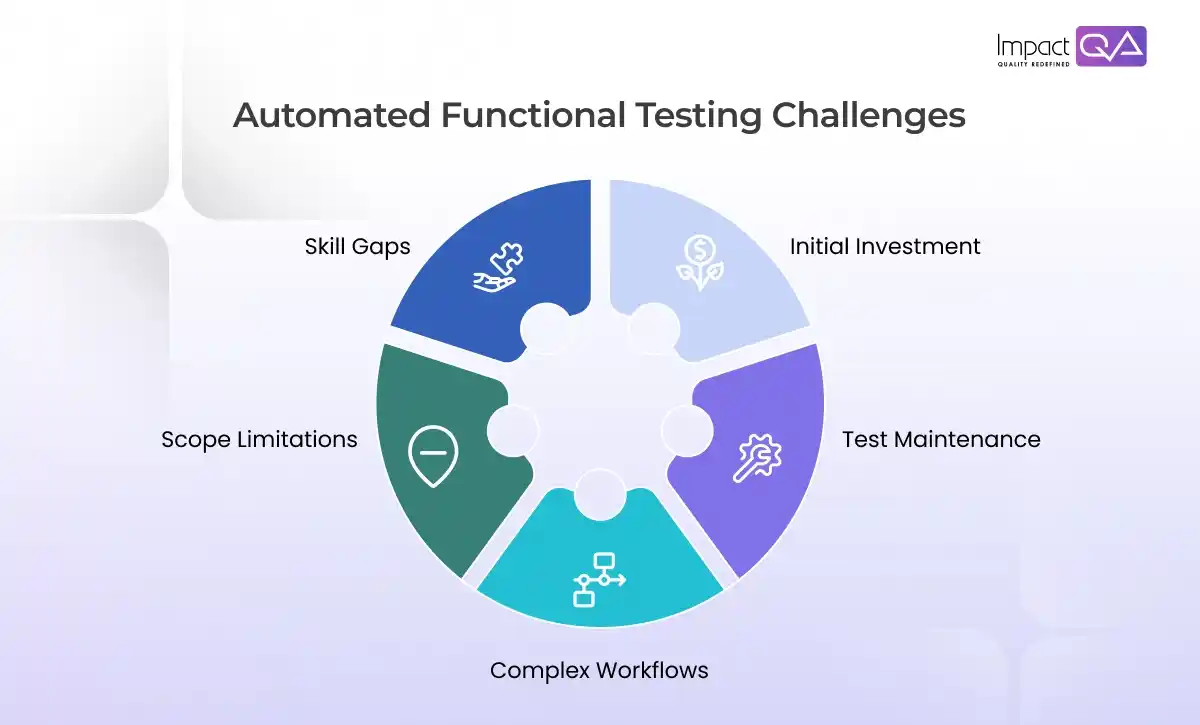
Despite its promise, automation comes with hurdles that require careful consideration. Addressing these challenges is essential to maximizing returns and ensuring reliable software quality.
- Initial Investment: Procuring automation tools and building scripts requires considerable upfront resources. Organizations without proper budget planning may struggle to justify costs before realizing benefits.
- Test Maintenance: Frequent software updates necessitate continuous script adjustments. Without dedicated ownership, maintenance overhead grows, slowing down release cycles and reducing automation’s overall value.
- Complex Workflows: Automating dynamic user interfaces or intricate workflows often requires advanced scripting expertise. These scenarios can stretch teams beyond their technical capabilities and delay validation.
- Scope Limitations: Automation validates functionality but cannot assess usability, design aesthetics, or user perception. Human judgment remains essential for evaluating these subjective yet critical areas.
- Skill Gaps: Effective automation depends on specialized knowledge. Teams lacking expertise may create ineffective scripts, undermining outcomes and reducing the reliability of functional testing processes.
These challenges don’t undermine automation but highlight the need for strategic planning. Adopting functional testing in software engineering requires balancing automated and manual coverage. Businesses that rush into automation without clear objectives often struggle with script redundancy or maintenance overload.
Organizations that plan carefully, choosing the right tools, structuring test cases, and establishing ownership are better positioned to maximize the return from software functional testing.
Best Practices for Implementing Automated Functional Testing

Automated functional testing empowers teams to validate complex workflows swiftly and accurately in order to minimize human error. Below are key best practices to implement effectively and ensure consistent, reliable software quality.
- Select Automation Candidates: Automate repetitive, high-risk, and regression-heavy cases. Prioritize scenarios with clear input-output behavior where automation reduces human error and supports consistent validation across multiple releases.
- CI/CD Integration: Integrate automation into CI/CD pipelines for continuous quality checks. Automated triggers after every code commit provide rapid feedback, which helps reduce defect propagation into later development stages.
- Regular Maintenance: Update scripts as applications evolve. Outdated automation leads to false positives. Maintenance preserves test reliability and ensures automation scales effectively with changing functional requirements.
- Collaboration: Align testers, developers, and DevOps engineers. Joint ownership enables better test design, ensures coverage of business workflows, and reduces misinterpretation of functional requirements during scripting.
- Monitoring Results: Review execution reports carefully. Identify genuine defects versus flaky scripts. This ensures precise fixes and builds stronger confidence in the reliability of automated tests.
Discover the services offered by ImpactQA.
Conclusion
Assuring quality in modern software engineering requires a blend of structured methodologies and automation. By shifting from error-prone manual testing to systematic automation, enterprises reinforce accuracy while improving agility. The role of software functional testing in this process extends beyond validation – it builds resilience into products that must withstand demanding operational environments.
This is where ImpactQA makes a difference. With its functional testing services, ImpactQA delivers tailored frameworks that integrate into client pipelines, ensuring reliability across platforms and configurations. Our expertise in automated functional testing software helps organizations accelerate releases without compromising precision. For enterprises navigating bourgeoning digital demands, ImpactQA provides not just services but a structured partnership that strengthens overall quality assurance.
Share this post


Related Posts
Our Case Studies