Quick Summary:
Functional software testing is entering a new era, driven by the growing complexity of digital applications, faster release cycles, and the increasing adoption of AI. As the market expands from $28 billion in 2024 to nearly $65 billion by 2034, organizations are moving beyond traditional testing approaches toward intelligent, continuous, and automation-led quality engineering. From AI-powered test design and self-healing automation to continuous testing within CI/CD pipelines and validation of API-driven ecosystems, the testing landscape is rapidly evolving. This article explores nine key trends shaping the future of functional software testing.
Table of Contents:
- Introduction
- What Is Functional Software Testing?
- 9 Key Areas Shaping the Future of Functional Testing
- Final Say
- Frequently Asked Questions
Software is evolving faster than traditional testing cycles can comfortably keep pace with. Frequent releases, interconnected applications, AI-powered features, and complex user journeys are changing how quality teams approach functional testing in software testing. Now, the process is moving to a more intelligent phase, where AI can generate test scenarios, automation can execute them, and self-healing capabilities can adapt scripts as applications change.
The functional testing market is estimated at $28 billion in 2024 and projected to reach nearly $65 billion by 2034, representing an approximately 8.7% CAGR. Gartner also expects 75% of enterprise software engineers to use AI code assistants by 2028, compared with less than 10% in early 2023. This growing AI adoption across software engineering will inevitably reshape testing.
So, what will functional software testing look like in the years ahead? Let’s peruse through some upcoming future trends.
ImpactQA combines functional expertise and automation to validate critical application workflows with precision.
What Is Functional Software Testing?
Functional software testing is a subset of software testing that verifies whether an application performs its intended functions according to defined requirements. It focuses on what the software does, validating inputs, outputs, workflows, business rules, and user interactions.
Functional testing services commonly covers:
- Requirements and business rules
- User interface and workflows
- Input validation and error handling
- API and system integrations
- Database and data flow validation
- Regression testing
- End-to-end business scenarios
9 Key Areas Shaping the Future of Functional Software Testing
The next phase of functional testing will be shaped by technologies that make test creation, execution, maintenance, and decision-making more adaptive. Here are nine areas likely to have the greatest impact.
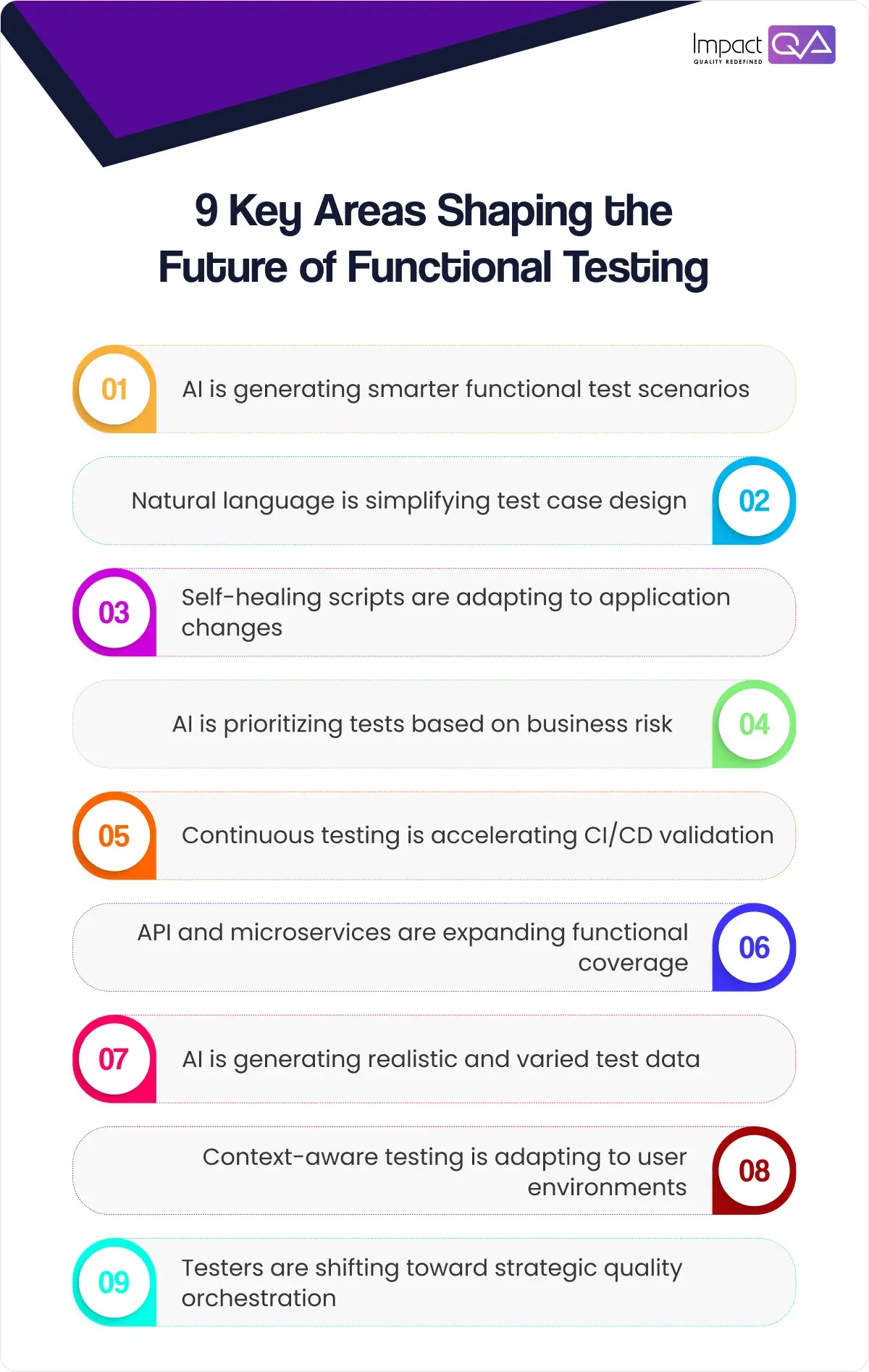
1. AI Will Turn Test Automation Into Intelligent Testing
Traditional automation executes predefined instructions. AI-augmented approaches instead learn from historical defect data, code churn, and past test outcomes to identify which parts of an application are statistically more likely to break with a given change. This is generally known as predictive test selection or risk-based test impact analysis.
Rather than re-running an entire regression suite on every build, these models can rank test cases by the probability they’ll catch a real defect, letting teams run a targeted subset with high confidence and save the full suite for scheduled or pre-release cycles.
The result is a shift from “run these tests” to “determine what’s actually worth testing right now.”
2. Natural Language Will Simplify Test Design
Writing detailed test cases may increasingly begin with a simple requirement or user story.
Natural language processing can translate human-readable requirements into executable test scenarios, allowing testers and business stakeholders to describe expected behavior without having to define every technical step manually.
This can shorten the distance between business intent and test execution, while making test design more accessible to non-technical stakeholders.
3. Self-Healing Test Scripts Will Reduce Maintenance
Application changes can quickly turn a reliable automation suite into a maintenance exercise. A changed button ID, relocated element, or restructured DOM can break existing scripts even when the underlying functionality still works correctly. This is one of the most common sources of false-positive failures in UI automation.
Self-healing frameworks address this through a few concrete mechanisms: multi-locator strategies that fall back to alternate identifiers (CSS selector, XPath, accessibility label) when the primary one fails, and visual AI comparison that matches elements by layout and appearance rather than by a brittle DOM reference.
For enterprises managing large regression suites, this could become one of the biggest productivity gains in functional testing.
4. AI Will Generate and Prioritize Tests Based on Risk
More tests do not necessarily mean better testing. As AI makes test generation easier, organizations could end up with enormous test suites that take longer to execute and analyze.
Risk-based intelligence will therefore become critical. AI can analyze historical failures, code complexity, execution data, and application changes to identify high-risk areas and prioritize testing accordingly.
Gartner has also highlighted test-impact analysis as increasingly important as AI-driven development can contribute to growing volumes of generated tests.
5. Continuous Functional Testing Will Move Into CI/CD
Functional testing is moving away from being a final checkpoint before release.
Automated functional tests can increasingly run within continuous integration and continuous delivery (CI/CD) pipelines, providing feedback as code changes move through development and deployment.
This means testing becomes an ongoing quality signal rather than a phase teams wait to complete at the end of a sprint.
6. APIs, Microservices, and End-to-End Workflows Will Expand Test Coverage
Modern applications rarely operate as isolated systems. A single business transaction can cross a user interface, API, microservice, database, payment platform, or third-party service.
Software functional testing will therefore increasingly validate connected business workflows, not just individual screens. API and microservices testing are already identified as increasingly important components of modern functional testing.
The future test case may look less like “Does this button work?” and more like “Does this entire business transaction work from start to finish?”
7. AI-Generated Test Data Will Expand Scenario Coverage
Testing every realistic combination of inputs manually is difficult, particularly for applications handling complex workflows and large datasets.
AI can help generate varied test data covering edge cases, boundary conditions, and different usage scenarios. Research also identifies synthetic data generation and anonymization as increasingly important as organizations balance broader testing with privacy requirements.
This can make functional testing more representative without requiring production data for every scenario.
8. Testing Will Become More Context-Aware
The same functionality may behave differently depending on the user, device, environment, permissions, or application state.
Context-aware testing frameworks can account for these variables and tailor test execution accordingly. This points toward functional testing that understands not only what is being tested, but also who is using it, where, and under what conditions.
9. Testers Will Shift From Execution to AI Oversight
The future of functional testing is changing where a tester’s expertise creates the most value. As AI handles repetitive execution, test generation, prioritization, and maintenance, testers can focus more on exploratory testing, risk assessment, strategic test design, AI supervision, and interpreting complex outcomes.
In other words, the tester’s role moves from executing every step to deciding which steps matter most and whether the results make business sense.
ImpactQA helps enterprises modernize the process with intelligent automation and scalable QA solutions.
Final Say
Functional testing is entering a new phase. Automation will continue to provide speed, but AI will increasingly add adaptability, prediction, prioritization, and self-healing capabilities to the process.
The future workflow could look like:
Requirement → AI-generated scenarios → automated execution → risk-based prioritization → self-healing → continuous validation → intelligent defect analysis → human quality decisions
The organizations that benefit most will not simply automate more tests. They will build testing ecosystems that can understand change and continuously validate business-critical functionality.
Want the full details? Download the case study below.
Frequently Asked Questions (FAQs)
Share this post


Related Posts
Our Case Studies