Quick Summary:
Maintaining automation should not consume more effort than creating it. Yet many enterprises struggle with script maintenance, framework complexity, and inconsistent execution. This blog explores how Falcon simplifies test creation through AI driven reasoning, autonomous execution, and unified enterprise automation. It also explains practical adoption strategies that help QA teams build scalable, reliable, and maintenance free automation.
Table of Contents:
- Introduction
- Why Traditional Automation Creates More Problems Than It Solves
- How Falcon Simplifies Intelligent Test Creation
- Building Enterprise Automation That Scales with Business Growth
- Adopting Falcon Successfully Across Enterprise QA Teams
- Bottom Line
- FAQs
Enterprise automation has progressed significantly over the past decade, yet test creation continues to consume considerable engineering effort. Conventional automation depends on programming expertise, framework maintenance, locator management, and frequent script revisions whenever applications evolve. Consequently, organizations spend substantial time maintaining automation instead of expanding business coverage. This shift has encouraged enterprises to adopt a no-code test automation platform that allows quality teams to create reliable automation through business-driven workflows rather than code intensive development.
Falcon changes this approach by introducing autonomous AI agents that understand natural language instructions and execute tests like an experienced QA engineer. Instead of scripting every interaction, users simply describe the intended workflow, while the platform reasons through each step independently. As a result, enterprises can reduce maintenance and standardize automation across multiple technologies using a codeless QA automation software designed for modern software ecosystems.
At ImpactQA, we enable enterprises to build, run, and scale tests effortlessly using Falcon’s no-code automation.
Why Traditional Automation Creates More Problems Than It Solves
Although automation promises faster releases and broader regression coverage, many organizations struggle to achieve sustainable results because conventional frameworks introduce continuous maintenance responsibilities. Test engineers frequently dedicate more effort to repairing automation than validating new business functionality. A scriptless automation testing framework addresses these recurring obstacles by replacing static scripts with intelligent execution that adapts to changing applications.
Several operational challenges explain why enterprise automation becomes difficult to sustain.
Script Maintenance Never Truly Ends
Every user interface modification affects existing automation scripts. Renamed elements, redesigned pages, or updated workflows require engineers to revisit numerous test cases. Consequently, automation gradually becomes another development project instead of a quality engineering asset.
Programming Knowledge Limits Collaboration
Business analysts and functional testers understand application workflows better than anyone else. However, conventional frameworks require scripting expertise, preventing these stakeholders from contributing directly. This dependency slows automation adoption and creates unnecessary reliance on specialized engineers.
Multiple Automation Platforms Increase Operational Overhead
Many enterprises maintain separate tools for web testing, mobile automation, API validation, chatbot testing, and legacy applications. Besides increasing licensing costs, this fragmented ecosystem complicates reporting, governance, and automation management across different business units.
Flaky Tests Reduce Confidence During Releases
Passing automation results do not always indicate dependable software quality. Timing inconsistencies, unstable selectors, and synchronization issues often generate false failures. Teams therefore spend valuable release time distinguishing genuine defects from unreliable automation behavior.
Infrastructure Management Delays Automation Expansion
Scaling automation across hundreds of regression scenarios requires environment provisioning, execution scheduling, and infrastructure monitoring. These operational responsibilities increase project complexity while delaying broader automation adoption across enterprise applications.
How Falcon Simplifies Intelligent Test Creation
Modern automation should eliminate complexity instead of creating additional engineering work. Falcon achieves this objective through autonomous reasoning that understands business intent before executing every interaction. Unlike conventional frameworks, the Falcon no-code automation platform allows users to describe workflows naturally while AI agents determine how each step should be completed without depending on predefined scripts.
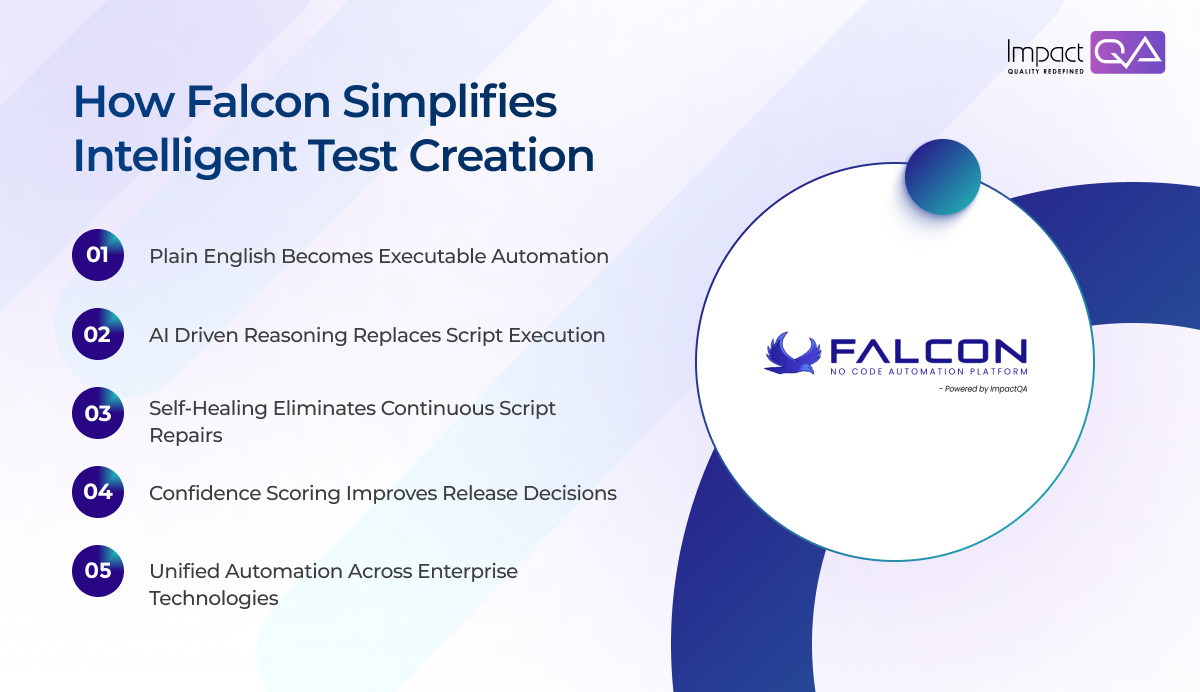
The following capabilities explain how Falcon transforms enterprise test creation.
Plain English Becomes Executable Automation
Users simply explain the business scenario exactly as they would describe it to another tester. Falcon interprets those instructions, identifies interface elements dynamically, and performs each activity independently. This makes the platform a practical no-code test automation platform for both technical and functional testing teams.
AI Driven Reasoning Replaces Script Execution
Instead of replaying recorded actions, Falcon evaluates every screen before selecting the next interaction. This intelligent decision making enables the platform to respond naturally to application changes while preserving the original business objective throughout execution.
Self-Healing Eliminates Continuous Script Repairs
Applications continuously receive interface updates that traditionally require manual automation revisions. Falcon automatically detects renamed elements, modified layouts, and navigation changes before adjusting execution intelligently. Consequently, teams spend considerably less time maintaining automation assets.
Confidence Scoring Improves Release Decisions
Automation should measure reliability rather than simply reporting pass or fail results. Falcon continuously evaluates execution consistency across repeated runs and assigns confidence scores that expose unstable scenarios before they influence production deployment decisions.
Unified Automation Across Enterprise Technologies
The Falcon no-code automation platform supports websites, Android applications, REST APIs, AI chatbots, Oracle Forms, and Mainframe environments through one consistent interface. Organizations therefore replace fragmented automation ecosystems with a centralized enterprise solution that simplifies governance and reporting.
Building Enterprise Automation That Scales with Business Growth
Creating automated tests is only the beginning of a successful QA strategy. As applications expand, automation must support additional business processes, larger regression suites, and multiple technology stacks without increasing maintenance effort. This is where Falcon distinguishes itself from conventional solutions. Beyond simplifying test creation, it enables organizations to scale automation through intelligent execution, cloud readiness, and seamless ecosystem integration. Moreover, its architecture allows QA teams to focus on validating business outcomes instead of maintaining automation frameworks.
The following capabilities demonstrate how Falcon supports enterprise scale automation.
One Platform Supports Multiple Testing Environments
Organizations rarely test only web applications. Mobile apps, APIs, AI chatbots, legacy systems, and enterprise platforms often coexist within the same ecosystem. Falcon brings all these environments together through a unified interface, allowing teams to standardize automation practices without investing in multiple testing products.
Cloud Native Execution Improves Test Scalability
As regression suites grow, execution speed becomes a business requirement. Falcon provisions cloud resources automatically and distributes workloads across multiple execution environments. Consequently, enterprises can execute hundreds of automated scenarios simultaneously without managing additional infrastructure or virtual machines.
Detailed Reporting Simplifies Failure Analysis
Automation reports should provide actionable insights rather than simple execution summaries. Falcon captures screenshots, execution logs, network activity, and feature level coverage during every run. This visibility helps QA engineers and developers investigate failures faster while reducing repetitive debugging effort.
Built In Integrations Fit Existing DevOps Pipelines
Automation delivers maximum value when integrated into continuous delivery workflows. Falcon connects seamlessly with Jenkins, GitHub Actions, Jira, BrowserStack, Slack, and other enterprise platforms. Consequently, organizations can modernize automation without replacing established development and release processes.
Enterprise Adoption Becomes Faster Across Teams
Because Falcon removes programming dependencies, automation becomes accessible to functional testers, business analysts, and product teams alongside automation engineers. This collaborative approach increases automation coverage while establishing consistent quality practices throughout software development projects.
Adopting Falcon Successfully Across Enterprise QA Teams
Implementing intelligent automation requires more than deploying a new platform. Organizations should establish structured adoption practices that align automation with business priorities, application complexity, and release objectives. Since Falcon replaces scripting with AI-driven execution, enterprises can modernize testing without disrupting existing engineering workflows. Additionally, following a phased implementation strategy allows teams to realize measurable improvements while building confidence in autonomous automation.
The following recommendations help organizations maximize value from their automation investment.
Begin With High Value Business Workflows
Critical customer journeys, payment processing, authentication, and core business transactions should be automated first. These workflows provide immediate business value while demonstrating how a codeless QA automation software reduces manual effort and improves regression consistency.
Expand Automation Across Multiple Applications
After validating initial success, organizations should extend automation to web platforms, mobile applications, APIs, and AI-driven interfaces. This phased expansion allows teams to standardize testing through a single scriptless automation testing framework rather than introducing separate tools for each technology.
Measure Automation Reliability Continuously
Execution volume alone does not indicate automation maturity. Teams should monitor confidence scores, execution consistency, and feature coverage to identify unstable scenarios before they affect release schedules. Falcon provides these insights automatically, supporting more informed quality decisions.
Integrate Automation into Continuous Delivery
Automation should execute automatically throughout development rather than only before production releases. Falcon’s integrations with enterprise CI/CD tools allow quality validation to become part of every build, reducing manual intervention while supporting faster software delivery.
Establish Long Term Automation Governance
Organizations evaluating a Falcon automation tool download should define automation standards, reporting practices, and ownership responsibilities from the beginning. A structured governance model ensures consistent adoption across projects while allowing the Falcon automation tool download to deliver sustainable value throughout the software lifecycle.
At ImpactQA, we empower QA teams with Falcon’s no-code automation, and end-to-end quality engineering.
Bottom Line
At ImpactQA, we help enterprises modernize their quality engineering strategy through intelligent automation that aligns with business objectives and long-term scalability. Whether you are evaluating a Falcon automation tool download for your first AI-driven initiative or planning a large-scale transformation with the Falcon no-code automation platform, we combine domain expertise with proven implementation practices to help organizations realize the full value of codeless QA automation software and a scriptless automation testing framework
Frequently Asked Questions (FAQs)
Share this post


Related Posts
Our Case Studies