Why Manual Testing Still Matters in an AI World & How to Modernize it

Quick Summary:
Manual testing is not fading. It is becoming more focused and insight-driven. While AI accelerates delivery, manual testing remains essential for validating user behavior, complex workflows, and unpredictable outcomes. This blog explains why a manual testing service still matters, the challenges it faces, and how organizations can modernize their manual software testing service using data-backed and hybrid testing strategies.
Table of Contents:
- Introduction
- Manual Testing Is Not Replaced, It Is Redefined
- The Challenge of Sustaining Manual Testing in Rapid Release Cycles
- Where Manual Testing Continues to Deliver Real Impact
- Moving from Execution Heavy to Intelligence Led Testing
- Modernizing Manual Testing with Data-Backed Strategies
- Conclusion
AI-driven automation has accelerated testing cycles, but it has not eliminated the need for human validation. According to MarketsandMarkets, the global test automation market is projected to grow from $28.1 billion in 2023 to over $55.2 billion by 2028, reflecting rapid adoption across industries. This growth signals a rising dependence on automation but also reinforces the need for complementary validation approaches to address gaps that automation alone cannot fully capture.
Despite this shift, most enterprises continue to rely on manual testing and automation testing together to achieve balanced quality outcomes. A structured manual testing service ensures that applications are validated beyond scripts, focusing on usability, workflow accuracy, and real-world behavior. A well-executed manual software testing service complements automation by identifying issues that require judgment, adaptability, and business context, making it indispensable in complex testing environments.
Combine data-driven insights with expert-led validation to improve quality and reduce risk.
Manual Testing Is Not Replaced, It Is Redefined
Automation has changed the way in which testers execute their work but has not diminished the necessity for assessing systems by human validators. Current organizations employ both manual testing and automated test solutions to develop a balanced approach that ensures both speed and depth.
Current manual QA testing does not only engage in executing previously defined scripts in an ongoing repetitive manner but rather focuses heavily on conducting intelligent assessments of where user behaviour, design logic, and system interaction require further analysis to beyond what automation can verify.
To remain effective, manual testing must move from a pure volume-based execution method to a value based validation method where the focus is placed on working through high-risk scenarios, newly created functionality, and highly complicated workflow processes rather than continually validating entire test suites that have no clear correlation with an end objective.
A streamlined manual testing service combines automation-related intelligence to help guide testers towards the areas that have the highest level of impact from a testing perspective. This ensures that testing initiatives are directly correlated to real system changes within an organization instead of relying exclusively upon static testing methodologies.
The Challenge of Sustaining Manual Testing in Rapid Release Cycles
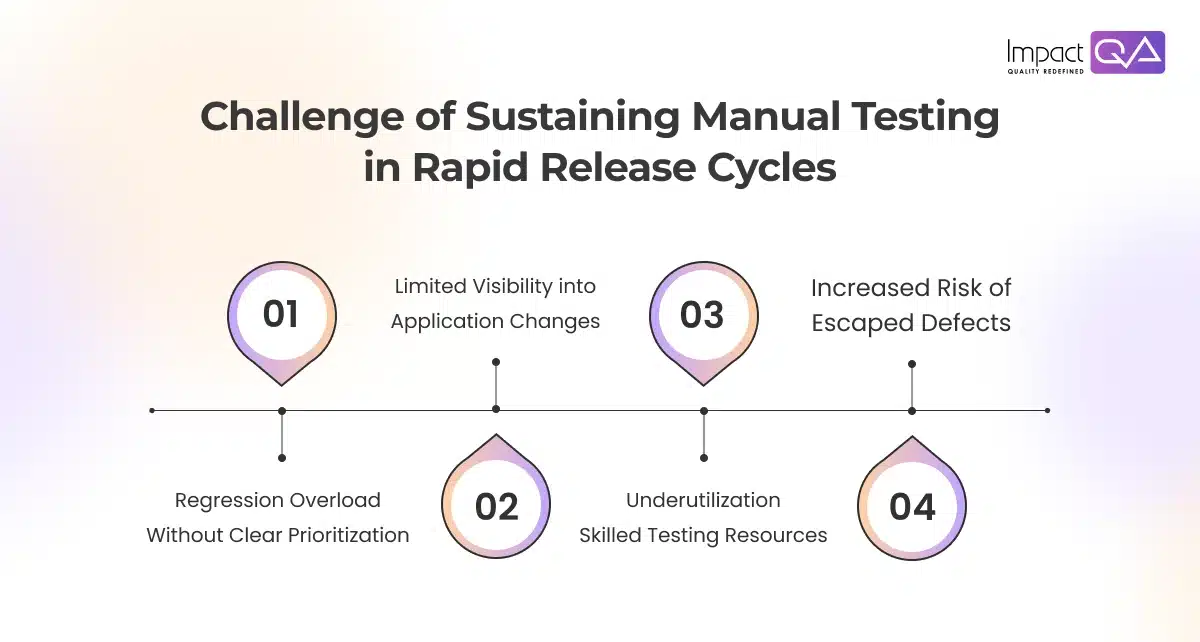
Frequent deployments and continuous updates create pressure on traditional manual software testing service models. Without structured prioritization, manual testing struggles to keep pace with development speed, leading to inefficiencies and increased risk exposure.
Regression Overload Without Clear Prioritization
Manual regression cycles often expand without direction, forcing teams to revalidate large test suites. This results in excessive effort on low-risk areas, while critical updates may not receive adequate testing attention during fast release cycles.
Limited Visibility into Application Changes
Testers frequently lack clarity on what has changed between builds. This creates uncertainty in test selection, leading to inconsistent coverage and inefficient execution across the manual testing service lifecycle.
Underutilization of Skilled Testing Resources
A manual testing service provider may allocate experienced testers to repetitive execution tasks. This reduces their ability to perform exploratory analysis and limits the overall value delivered by manual testing efforts.
Increased Risk of Escaped Defects
When testing is not aligned with code changes, validation gaps emerge. These gaps increase the likelihood of defects reaching production, highlighting the need for a more focused and insight-driven manual testing service approach.
Where Manual Testing Continues to Deliver Real Impact
Despite automation advancements, manual testing remains essential in areas requiring human judgment, interpretation, and adaptability. These capabilities ensure deeper validation across complex systems and user-driven scenarios.
Validation of Complex Business Workflows
A manual functional testing service ensures that workflows align with business rules and process logic. Testers validate end-to-end scenarios, identifying inconsistencies that require contextual understanding beyond predefined automated scripts.
User Experience and Usability Assessment
A manual QA testing service evaluates how users interact with applications in real conditions. It identifies usability issues, navigation challenges, and interface inconsistencies that directly impact user satisfaction and adoption.
Exploratory Testing for Unpredictable Behavior
Through exploratory testing services, testers investigate application behavior without predefined constraints. This approach helps uncover hidden defects and unexpected responses that structured automation scenarios may not be detected effectively.
Detailed API and Integration Validation
Manual API testing services allow testers to analyze responses in depth. They validate edge cases, data accuracy, and integration reliability to ensure that systems interact correctly under varying conditions.
Cross-Platform and Environment Consistency
Compatibility testing services ensure applications perform consistently across devices and platforms. Manual validation identifies environment-specific issues to ensure reliable performance in real-world usage scenarios.
Moving from Execution Heavy to Intelligence Led Testing
Manual testing must evolve from repetitive execution to intelligent validation. This shift enables teams to align testing efforts with development priorities while improving efficiency and overall quality outcomes.
Adoption of Risk-Based Testing Approaches
Modern manual testing focuses on identifying high-risk areas instead of executing full test suites. This approach ensures that critical functionalities receive greater attention, and improve defect detection, while reducing unnecessary effort.
Dynamic and Adaptive Test Design
A manual QA testing service continuously updates test scenarios based on application changes. This ensures that validation remains relevant, eliminating outdated test cases that no longer reflect current system behavior.
Alignment with Continuous Delivery Practices
Integrating manual testing and automation testing within development pipelines improves feedback cycles. This alignment ensures that testing is proactive, responsive, and closely connected to ongoing development activities.
Modernizing Manual Testing with Data-Backed Strategies
To stay relevant, manual testing needs to shift from broad, repetitive execution to a focused model driven by change intelligence, coverage visibility, and risk prioritization, ensuring validation efforts directly reflect system updates and business impact.
This transition is supported by specific strategies that bring precision and direction to manual testing efforts:
Implementation of Test Impact Analysis
Test impact analysis maps code changes to impacted functionalities and ensures that only relevant test cases are executed. This minimizes unnecessary effort and keeps the manual testing service aligned with actual system updates.
Use of Coverage Insights for Targeted Testing
A modern manual software testing service relies on visibility into test coverage. Teams can identify gaps and overlaps, ensuring that validation efforts are focused on areas that require attention rather than duplicating efforts.
Incremental and Continuous Regression Testing
Instead of executing regression testing in large cycles, teams adopt smaller and continuous validation approaches. This reduces workload, improves responsiveness, and aligns testing efforts with frequent development updates.
Combining Automation Insights with Manual Expertise
Automation identifies failures quickly, while manual testers analyze them in context. This collaboration improves root cause identification and ensures that testing outcomes are both accurate and meaningful.
Use data-driven validation to reduce effort and improve quality.
Conclusion
Manual testing continues to be a critical part of quality engineering, even as AI-driven automation advances. It provides contextual understanding, adaptability, and user-focused validation that automated tools cannot fully replicate. When aligned effectively, manual testing and automation testing create a balanced approach that improves both speed and accuracy.
ImpactQA delivers a comprehensive manual testing service designed for modern development environments. Our expertise in manual functional testing service execution, combined with structured and data-driven practices, ensures thorough validation across applications. As a trusted manual testing service provider, ImpactQA helps organizations implement the best manual testing service strategies and help organizations maintain strong quality standards.
Share this post


Related Posts
Our Case Studies