Quick Summary:
A trading platform upgrade must keep every position, valuation and invoice intact. CTRM software links those numbers, so one change can travel across the whole book. Automation runs five layers of checks: technical upgrade testing, trade lifecycle regression, before-and-after reconciliation, interface testing and performance rehearsal. Those reusable tests shorten every later upgrade and leave audit evidence behind.
Table of Contents:
- Introduction
- What Is CTRM Software?
- 5 Reasons Trading Platform Upgrades Need Automation
- How CTRM Test Automation Works in an Upgrade
- What Changes by Platform
- How to Choose the Best CTRM Testing Company
- Final Say
- FAQs
A trading platform upgrade comes with one essential requirement: the old and new versions must produce consistent results when tested with the same market data and trade inputs.
Every position, valuation and invoice has to survive the move to the new version.
The stakes are high in 2026.
Trafigura reported a net profit of $4.1 billion for the six months ended March 31, 2026, with oil and petroleum product volumes reaching 8.7 million barrels a day.
Glencore expects its 2026 marketing adjusted operating profit to exceed $5 billion.
Those books run on commodity trading software, and that software keeps changing.
CTRM test automation services protect the upgrade by replaying thousands of trades on the new version and comparing every result with the old one.
Here is what that software does, why upgrades are demanding and how automation keeps them on schedule.
What Is CTRM Software?
If you are asking what is CTRM software, the short answer is this: it is the system of record for a commodity trading business.
Commodity trading and risk management (CTRM) software records each deal, then follows it through to the final payment.
ETRM, or energy trading and risk management, is the energy-focused branch of the same family.
Most CTRM software solutions cover three areas of the business:
1. Front Office
Who uses it: Traders and originators
Traders capture deals here.
A deal holds the commodity, volume, price, delivery point and counterparty.
The system then updates the live position, which is the net amount the company has bought or sold.
2. Mid Office
Who uses it: Risk teams
Risk teams value the book here.
Mark-to-market (MTM) valuation prices open deals at today’s market rates, using forward curves, which are the market’s prices for future delivery dates.
Value at Risk (VaR) then estimates the likely loss over a set period at a chosen confidence level.
3. Back Office
Who uses it: Operations and finance
Scheduling arranges the physical movement of cargo, pipeline volumes or power.
Settlement then produces invoices and confirms payments, while accounting posts the results to the general ledger.
Major CTRM and ETRM platforms include ION’s Openlink Endur, RightAngle and Allegro, along with SAP Commodity Management (SAP CM).
5 Reasons Trading Platform Upgrades Need Automation
Each new version brings better functions, security and support.
It also touches a system where everything depends on everything else.
The list is in no particular order:
1. Every Number Feeds Another
Risk area: Calculation chains
Change one pricing rule, and the effect travels.
A pricing change can affect MTM valuation, profit and loss, position reporting and counterparty credit exposure.
A small rounding change can reach a regulator’s report.
A person can spot-check a few trades, while automation can compare every trade in the book.
2. Custom Code Sits on Top of the Product
Risk area: Customizations
Most trading firms extend their platform with custom reports, interfaces and scripts.
Endur, for example, supports custom scripting through JVS and OpenComponents.
The vendor tests its own product, while each customer’s additions stay the customer’s to verify.
3. Upgrades Keep Coming
Risk area: Testing cost
A 2017 Energy Risk survey cited consultants who estimated that large C/ETRM upgrades could cost $1 million to $2 million, with upgrades or new implementations occurring roughly every three years.
Those figures are dated, so treat them as a guide.
RightAngle upgrades can affect inventory, scheduling, accounting, reporting and risk workflows.
Manual regression must be rebuilt in people’s hours each time, while automated packs carry over to the next version.
4. Volatile Markets Shrink the Window
Risk area: Timing and load
Energy Risk’s 2026 software rankings drew 62=4 responses, and the commentary stressed that firms need to view positions and act quickly during the Middle East conflict.
Rising margin calls add pressure, since exchanges can demand more cash at short notice.
Hence, a long freeze on system changes is hard to justify, and a fast, repeatable test cycle becomes valuable.
5. Reporting Rules Keep Moving
Risk area: Compliance
The revised REMIT implementing and delegated regulations entered into force on 29 April 2026, with several new data-reporting requirements scheduled for phased application from October 2027.
US public companies subject to the Sarbanes-Oxley Act (SOX) must also maintain controls over financial reporting.
Upgrades can change the fields that feed those reports, so reporting belongs in every regression run.
How CTRM Test Automation Works in an Upgrade
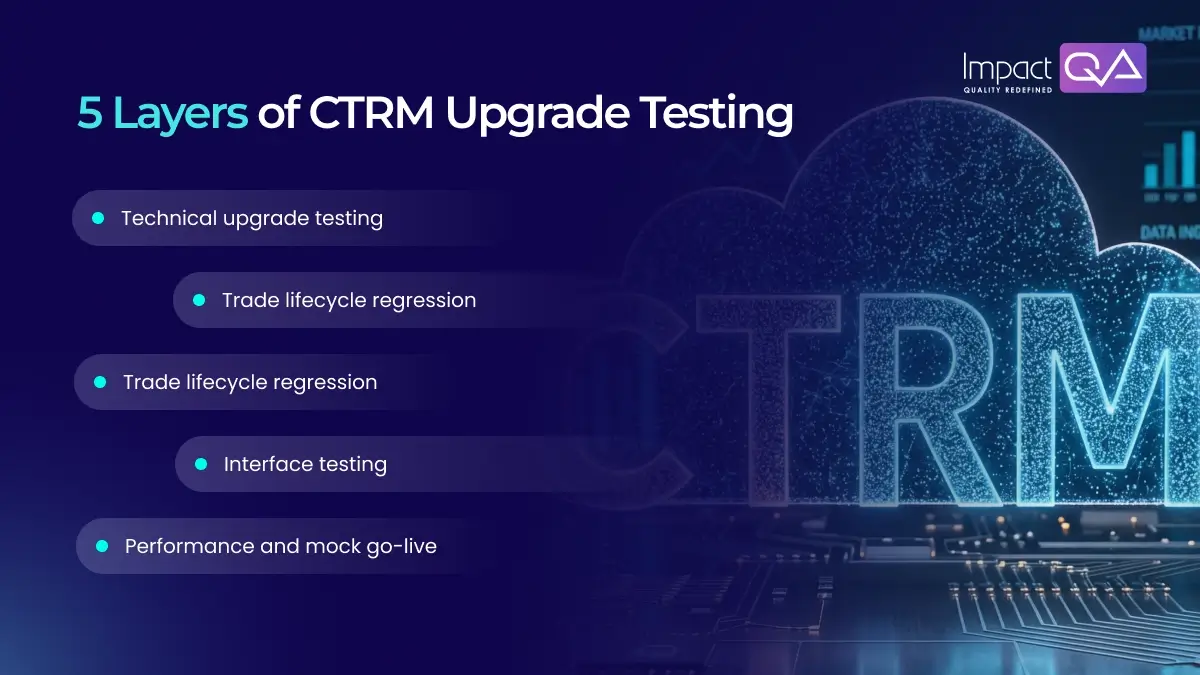
CTRM testing services build the safety net in five layers.
Each layer answers one question about the new version.
1. Technical Upgrade Testing
Question answered: Does the platform run?
Technical Upgrade Testing (TUT) confirms that the new version installs and starts cleanly.
It also checks database changes, custom code compilation, batch jobs and user access.
This is the first gate, and later layers depend on it.
2. Trade Lifecycle Regression
Question answered: Do business flows still work?
Automated scripts cover representative deal types and execute the applicable lifecycle steps, including confirmation, scheduling, invoicing and settlement.
These scripts are parameterized, which means one script reads many instruments and values from a data sheet.
So a single swap script can cover dozens of variations.
3. Before-and-After Reconciliation
Question answered: Do the numbers match?
This layer carries the most weight.
Load the same portfolio into both versions and run valuations using an identical market-data snapshot, valuation date, FX rates and reference data.
The automation compares MTM, positions, profit and loss, and VaR results against agreed tolerances for each measure.
Reconciliation Break = |New Value − Old Value| > Agreed Tolerance
For example, a configured tolerance of $1 would flag a $3 difference for review. Tolerances should reflect the currency, calculation and business risk of each measure. Analysts then decide whether the change is a defect or an intended vendor fix.
4. Interface Testing
Question answered: Does data still flow?
A CTRM platform depends on its neighbors.
Tests confirm that exchange prices reach the CTRM platform, trades flow into connected ERP systems and required data reaches downstream reporting systems.
They also validate retry rules, duplicate-message handling and alerts when an interface fails.
5. Performance and Mock Go-Live
Question answered: Will it hold under pressure?
End-of-day batch is the overnight run that values the book and produces reports.
Load and stress tests run the batch against expected and peak volumes, checking completion times, resource use and processing stability.
A mock go-live then rehearses the real cutover, timing each step of the move to production.
After launch, hypercare gives the business extra support during the first days on the new version.
AI now speeds up the first draft.
ImpactQA’s NeX-AI generates positive, negative, edge and integration cases from a prompt, and we report that it cuts test case writing effort by over 70%.
What Changes by Platform
The method stays steady, while the focus shifts with the product.
OpenLink Endur Solutions
Focus: Deal complexity and custom scripts
OpenLink Endur solutions serve gas, power, oil and financial trading, often with heavy customization.
Upgrade testing centers on deal booking, pricing, settlements and interfaces with risk engines and accounting.
RightAngle
Focus: Physical logistics
RightAngle CTRM software solutions serve crude, natural gas liquids and refined products.
Upgrade testing follows the physical chain across scheduling, ticketing, inventory, settlement and credit.
RightAngle testing solutions also add dependency checks for upstream and downstream systems.
Allegro and SAP CM
Focus: Native functions and ERP links
Allegro testing covers native functions and ETL jobs, which extract, transform and load data between systems, along with links to Intercontinental Exchange (ICE) and treasury platforms.
SAP CM testing follows commodity processes inside the wider SAP landscape, from migration planning through hypercare.
How to Choose the Best CTRM Testing Company
The best CTRM testing company will answer four questions clearly.
- Platform depth: Has the team tested your exact product and asset class?
- Independence: Does it test code written by others?
- Reusable assets: Will the scripts and data stay with you for the next upgrade?
- Evidence: Can it provide traceable test results, defect records and approval evidence for audit reviews?
Our 6-stage lifecycle guide on CTRM implementation and testing shows where these checks fit.
Final Say
From 2027, Glencore expects annual marketing adjusted operating profit of $2.8 billion to $4.2 billion under its revised guidance framework. For trading firms, that scale of activity makes reliable platform operations and controlled upgrades essential.
ImpactQA’s E/CTRM testing services cover Endur, RightAngle, Allegro and SAP CM, with upgrade testing, regression automation, mock go-live and hypercare. NeX-AI generates test cases and captures logs, screenshots and trace evidence to support audit reviews and internal controls.
The upgrade will arrive. Monday’s numbers will match.
Download the full case study and see how it works in action.
Frequently Asked Questions (FAQs)
Share this post


Related Posts
Our Case Studies