Quick Summary:
Complex trading workflows can now be tested with greater intelligence, speed, and precision. AI-powered CTRM testing helps organizations analyze dependencies, prioritize business-critical scenarios, validate calculations, automate regression, investigate failures, and assess performance across interconnected trading ecosystems. This article explores the strategies, challenges, use cases, lifecycle services, and best practices shaping CTRM quality engineering in 2026.
Table of Contents:
- Introduction
- Why CTRM Software Testing Needs a More Intelligent Quality Model
- AI-Powered Strategies for CTRM Quality and Performance
- Critical Testing Challenges Across CTRM Program
- From Consulting to Support: A Full Lifecycle CTRM Approach
- Where AI Can Deliver the Greatest Value in CTRM Testing
- Best Practices for AI-Powered CTRM Testing
- Final Say
A single change in a commodity contract can trigger a chain of recalculations across the trading lifecycle. In a modern commodity trading environment, these outcomes are interconnected rather than isolated testing events. This dependency makes CTRM software testing significantly more demanding than validating individual functions or executing a fixed regression suite.
The pressure is increasing as AI accelerates software development and expands the volume of system changes. Forrester’s 2025 Developer Survey found that 47% of respondents identified testing as an AI and generative AI use case within the software development lifecycle. For commodity trading platforms, the next step is to apply AI to dependency analysis, intelligent test selection, scenario generation, calculation validation, failure investigation, and performance analysis. In 2026, effective CTRM testing must determine not only whether a transaction works, but also how its downstream impact is validated across the complete trading ecosystem.
ImpactQA helps validate complex trading workflows with AI-driven quality engineering.
Why CTRM Software Testing Needs a More Intelligent Quality Model
The difficulty of testing a commodity trading platform lies in the relationships between business events. A trade can trigger pricing calculations, exposure updates, scheduling decisions, inventory movements, settlement entries, and financial postings. These processes may also depend on external market data, exchange rates, credit rules, and integration responses. As a result, a test that confirms successful trade capture may still miss a failure in a downstream process.
This makes conventional test execution insufficient for complex CTRM environments. The quality strategy must understand what changed, which business processes are connected to that change, and which failures could create the greatest operational or financial impact. AI can support this analysis by examining requirements, configuration data, application changes, test history, defects, logs, and business process relationships.
The objective is not to make testing fully autonomous without oversight. Instead, AI should reduce repetitive analysis and direct human expertise toward higher-risk decisions. This is particularly relevant for CTRM software companies managing multiple products, customer configurations, and integration models. A more intelligent testing model can help teams identify relevant scenarios faster while maintaining expert control over business-critical validation.
For organizations planning CTRM implementation and testing, this approach should begin during discovery and design. Testing teams can analyze process dependencies before configuration is complete. They can also identify data requirements, integration risks, performance thresholds, and critical business workflows before the first release reaches production.
AI-Powered Strategies for CTRM Quality and Performance
AI adds the greatest value when it is connected to the actual structure of the trading system. Generic test generation may create large volumes of scenarios, but domain-aware analysis can identify which scenarios matter most.
1. AI-Based Dependency Mapping
AI can analyze requirements, configuration changes, interfaces, workflows, and historical defects to map relationships across the trade lifecycle. A change in pricing logic can therefore trigger a review of valuation, exposure, settlement, and reporting scenarios.
2. Intelligent Test Scenario Generation
Generative AI can create scenarios from business requirements, process documents, configuration rules, and existing test assets. Teams can generate positive, negative, boundary, exception, and integration cases while domain experts review the resulting business logic.
3. Risk-Based Regression Selection
Rather than executing every regression test after every change, AI can assess code modifications, configuration updates, historical failures, and process dependencies. It can then prioritize test scenarios associated with the greatest business and technical risk.
4. AI-Assisted Test Data Creation
Complex trading workflows require realistic combinations of commodities, contracts, prices, volumes, currencies, counterparties, and market conditions. AI can help create controlled synthetic data that reflects these combinations without exposing sensitive production information.
5. Intelligent Failure Analysis
AI can correlate failed tests with application logs, database events, integration messages, infrastructure metrics, and previous defects. This can help distinguish a genuine functional defect from a data issue, timing problem, environment failure, or recurring automation error.
6. Continuous Performance Analysis
Performance testing should not be limited to scheduled load tests. AI can analyze response time trends, transaction volumes, resource utilization, and workload behaviour to identify gradual degradation before it becomes a major operational issue.
Critical Testing Challenges Across CTRM Program
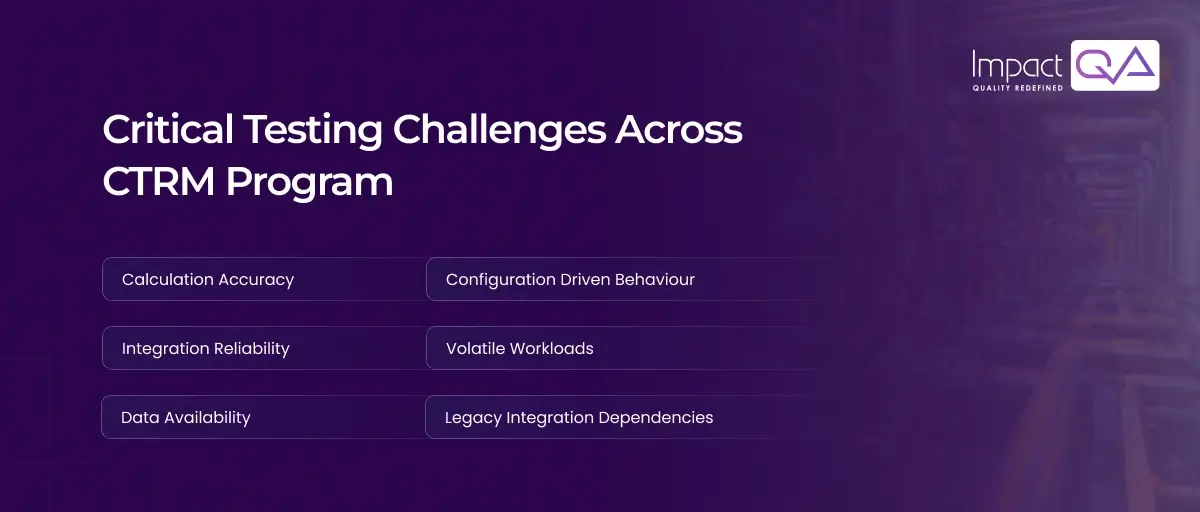
AI can improve testing efficiency, but it does not remove the underlying complexity of commodity trading systems. Quality teams must still address business rules, data accuracy, integrations, performance, security, and operational continuity.
1. Calculation Accuracy
Pricing, valuation, exposure, settlement, fees, taxes, and currency conversions often depend on multiple variables. Testing must validate expected results across changing market conditions and confirm that small configuration changes do not create financial discrepancies.
2. Configuration Driven Behaviour
CTRM platforms are heavily configured for different commodities, contracts, entities, markets, and operating models. A minor configuration change can alter several workflows. Testing therefore requires impact analysis instead of isolated feature validation.
3. Integration Reliability
Trading platforms commonly exchange information with ERP systems, market data providers, banks, logistics applications, and reporting platforms. Testing must validate data mapping, message timing, duplicate handling, error recovery, and downstream consistency.
4. Volatile Workloads
A platform may experience sharp changes in transaction volume during market events, trading peaks, batch processing, or settlement periods. Performance testing must therefore evaluate realistic workload patterns rather than relying only on average daily traffic.
5. Data Availability
Real production data may contain sensitive commercial and financial information. Yet simplistic test data cannot reproduce the complexity of actual trading operations. Synthetic data must represent realistic relationships between trades, contracts, positions, prices, and settlements.
6. Legacy Integration Dependencies
Many organizations operate modern CTRM platforms alongside older enterprise applications. These connections can create hidden dependencies, inconsistent data formats, and delayed responses. Testing must account for the behaviour of the complete ecosystem.
From Consulting to Support: A Full Lifecycle CTRM Approach
Successful CTRM programs require more than implementation followed by a final testing phase. Quality decisions made during consulting and design can directly influence implementation effort, testing complexity, operational stability, and long-term support requirements.
1. Consulting Before Implementation
Consulting teams can assess business processes, platform suitability, integration requirements, data flows, testing risks, and performance expectations before implementation begins. This helps the organization identify gaps before they become expensive configuration or migration issues.
2. Implementation With Quality Built-In
During implementation, testing should run alongside configuration, integration, data migration, and workflow development. Early validation can identify incorrect business rules and integration assumptions before they spread across the program.
3. Testing Across the Complete Lifecycle
Functional, integration, regression, performance, security, data migration, and user acceptance testing should reflect the complete trading lifecycle. AI can assist with prioritization, scenario creation, execution analysis, and defect investigation.
4. Support After Go-Live
Production support should extend beyond incident resolution. Teams can analyze recurring failures, performance trends, transaction issues, and change patterns to identify areas requiring corrective action or additional testing.
5. Continuous Optimization
As business processes and market requirements change, CTRM environments require ongoing refinement. Continuous testing, performance monitoring, regression updates, and configuration reviews help maintain system reliability after the initial implementation.
Where AI Can Deliver the Greatest Value in CTRM Testing
AI is most useful when testing involves large volumes of data, complex dependencies, or repeated analysis. The following use cases demonstrate where intelligent quality engineering can provide practical value.
- Trade Capture and Contract Validation
AI can generate combinations involving commodity types, counterparties, contract terms, pricing conditions, quantities, currencies, and transaction dates. It can also identify missing combinations within existing test coverage.
- Pricing and Valuation
Testing teams can compare system calculations against expected outcomes across changing prices, currencies, fees, and contract conditions. AI can identify unusual calculation patterns that require expert review.
- Risk and Exposure
AI can generate scenarios involving changing positions, price movements, credit limits, and portfolio conditions. These scenarios can test whether exposure calculations remain consistent as transaction data changes.
- Scheduling and Logistics
Scheduling may depend on inventory, transportation capacity, delivery windows, and contractual obligations. AI can create combinations that expose conflicts between operational constraints and trading commitments.
- Settlement and Financial Reporting
AI can compare data across trade capture, settlement, accounting, and reporting systems. This helps identify mismatches that may remain invisible when each application is tested separately.
- Performance and Capacity
AI can analyze workload patterns and historical performance data to create realistic test scenarios. It can also identify the transaction types and system layers associated with response time degradation.
ImpactQA delivers consulting, testing, automation, and post implementation support.
Best Practices for AI-Powered CTRM Testing
AI adoption should be controlled by clear quality objectives. Without defined measures, organizations may produce more test cases without improving actual coverage or defect detection.
- Establish a Knowledge Base
AI requires accurate context. Teams should maintain structured information about business processes, configurations, integrations, requirements, defects, and test assets to improve the relevance of generated scenarios.
- Prioritize Business Risk
Testing should reflect the consequences of failure. High-value transactions, financial calculations, risk exposure, settlement, and regulatory reporting require deeper validation than low-impact administrative functions.
- Keep Experts in the Loop
AI-generated scenarios and analyses should undergo human review. Domain experts remain essential for validating business logic, interpreting unusual results, and determining whether a technical failure represents a material operational risk.
- Measure Quality Outcomes
Useful metrics include defect leakage, risk coverage, test maintenance effort, execution efficiency, performance thresholds, and failure analysis time. The number of automated tests alone does not demonstrate testing effectiveness.
- Protect Sensitive Information
AI tools must operate within appropriate data governance controls. Trading information, pricing data, financial records, and customer information should be protected through suitable access, masking, and deployment policies.
- Review AI Output Regularly
AI models can produce incorrect assumptions, duplicate scenarios, or incomplete coverage. Regular sampling and expert review are necessary to confirm that generated tests remain relevant as the platform changes.
Final Say
At ImpactQA, we support the complete CTRM lifecycle through consulting, implementation, testing, and post-implementation support. Our CTRM testing services address functional accuracy, integrations, regression, performance, and complex trading workflows. With expertise across leading CTRM software solutions, we help organizations build, validate, and continuously optimize reliable commodity trading platforms.
Share this post


Related Posts
Our Case Studies