Quick Summary:
E/CTRM software supports high-stakes trading, risk, scheduling, settlement, and financial decisions. That makes quality more than a final testing activity. It must be considered throughout implementation, from requirements and data migration through integrations, calculations, go-live, upgrades, and ongoing change.
This guide explains the 6-stage E/CTRM implementation and testing lifecycle, the difference between CTRM and ETRM, where Quality Engineering fits across the lifecycle, how AI can accelerate test design, and what organizations should look for in an E/CTRM implementation and testing partner.
Table of Contents:
- Introduction
- What Is E/CTRM Software? CTRM vs. ETRM
- The E/CTRM Lifecycle: 6 Stages of Implementation and Testing
- Where Quality Engineering and AI Fit Into the E/CTRM Lifecycle
- What to Look for in an E/CTRM Implementation and Testing Partner
- Final Say
- Frequently Asked Questions
An E/CTRM platform supports decisions and processes across the trading lifecycle: transaction capture, contract management, pricing, valuation, risk, scheduling, logistics, settlement, accounting, and reporting. Reliable quality engineering helps ensure these processes work correctly as the platform is implemented and continues to evolve.
E/CTRM implementation and testing spans business requirements, configurations, data, integrations, calculations, workflows, performance, security, and go-live readiness. Testing then continues through meaningful platform changes, including patches, upgrades, integrations, configuration updates, regulatory changes, and new business requirements.
In this article, E/CTRM refers collectively to Energy Trading and Risk Management and Commodity Trading and Risk Management platforms. The focus is not simply on testing the application, but on validating the business scenarios and interconnected workflows implemented within it.
ImpactQA supports E/CTRM implementation and testing across the lifecycle, from requirements and migration through go-live and post-production validation.
What Is E/CTRM Software? CTRM vs. ETRM
Commodity Trading and Risk Management (CTRM) software manages the full trade lifecycle, trade capture, pricing, market and credit risk, scheduling, settlement, and regulatory reporting, across any commodity type a business trade.
ETRM, Energy Trading and Risk Management software, covers the same ground scoped specifically to energy, crude oil, natural gas, power, and refined products, with pricing models and compliance tools built for that market alone.
Technically, ETRM sits as a specialized subset of CTRM. Here’s how the two compare:
Dimension |
CTRM Software |
ETRM Software |
| Commodity scope | Any commodity type traded by a business | Energy commodities specifically |
| Best fit for | Firms trading across multiple commodity categories | Firms focused on a single energy vertical |
| Pricing models | Broad, adaptable frameworks | Deep, energy-specific pricing logic |
| Regulatory tools | General compliance coverage | Energy-market-specific compliance |
| Relationships | The broader category | A specialized subset of CTRM |
Both types of platforms connect functions across the front, middle, and back office. The choice between CTRM software solutions and ETRM solutions depends on the commodities, workflows, operating model, and regulatory environment of the organization. Our article on CTRM vs. ETRM comparison covers the distinction in detail.
The E/CTRM Lifecycle: 6 Stages of Implementation and Testing
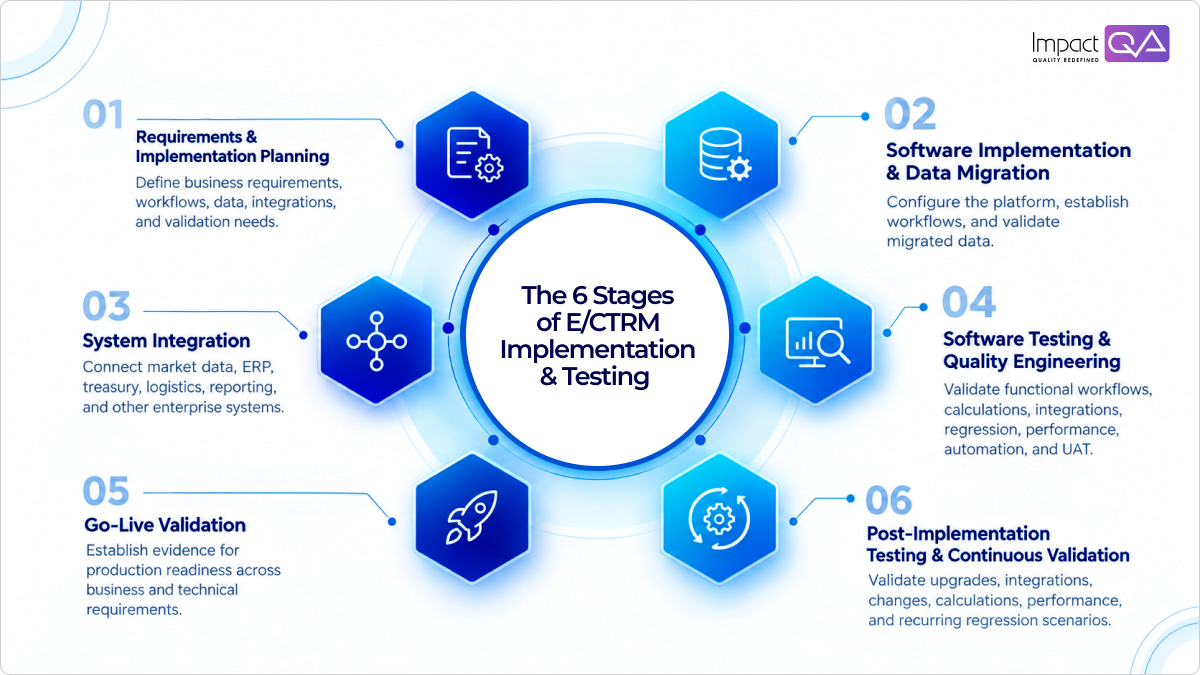
An E/CTRM platform evolves through several connected stages. Decisions made during requirements and implementation influence data quality, integration behavior, calculation accuracy, go-live readiness, and long-term operational stability.
Quality Engineering should therefore not be treated as a single activity that starts after implementation. It should operate as a continuous layer across the lifecycle, with the type of validation changing as the platform moves from planning to production and ongoing change.
Here’s the full arc, in the order a trading organization moves through from implementation to testing:
1. Requirements & Implementation Planning
Every E/CTRM implementation begins with understanding how the organization trades and operates.
Planning typically covers:
- Commodity and asset classes
- Physical and financial trading workflows
- Trade capture and contract management
- Pricing and valuation requirements
- Market-data dependencies
- Position and exposure management
- Risk and credit processes
- Scheduling and logistics
- Inventory and movement workflows
- Settlement and accounting
- Regulatory obligations
- Enterprise-system integrations
- Reporting requirements
- Data migration requirements
These considerations provide the foundation for configuration and implementation decisions.
Quality Engineering should be introduced at this stage rather than waiting for the first executable build. ETRM testing consultants and C/ETRM QA experts can review requirements and business scenarios to identify ambiguity, missing validation rules, integration dependencies, calculation risks, and test-data requirements while changes are still relatively inexpensive to make.
The objective is simple: define not only what the platform should do, but also how the organization will prove that it works correctly.
2. Software Implementation and Data Migration
E/CTRM implementation introduces configurations, workflows, business rules, interfaces, calculations, and data into the target environment.
Data migration can include:
- Historical trades
- Counterparty information
- Pricing information
- Reference and master data
- Contracts
- Positions
- Settlement information
- Market data
- Curves and related pricing inputs
- Inventory or logistics information
Testing during this stage should go beyond confirming that data has been loaded successfully.
The key question is whether the migrated data retains its business meaning.
Validation can include:
- Source-to-target record reconciliation
- Trade-count reconciliation
- Position reconciliation
- Contract and counterparty validation
- Reference-data validation
- Pricing-data validation
- Historical trade validation
- Settlement-data validation
- Opening balance and position checks
- Downstream data validation
A technically successful migration can still produce business problems if trades, positions, valuations, or settlement information do not reconcile with the source environment.
For that reason, data quality and reconciliation should be treated as core components of E/CTRM implementation testing.
3. System Integration
E/CTRM platforms rarely operate in isolation.
The surrounding technology ecosystem can include market-data providers, ERP platforms, treasury applications, logistics systems, exchanges, reporting platforms, regulatory systems, data warehouses, and internal applications.
A typical business flow may look like:
Market data → E/CTRM → pricing and valuation → risk → scheduling → ERP/settlement → reporting
A defect anywhere in that chain can affect downstream business processes even when the E/CTRM application itself appears to be functioning correctly.
C/ETRM integration testing services validate the movement, transformation, processing, and reconciliation of information across these connected systems.
Testing scenarios can cover:
- APIs
- Batch interfaces
- Real-time feeds
- Market-data feeds
- Data transformation
- Message processing
- Error handling
- Recovery workflows
- Interface failures
- Downstream reporting
- ERP integration
- Treasury integration
- Scheduling and logistics interfaces
- Market-data synchronization
Integration testing should be driven by representative business scenarios rather than isolated interface checks wherever possible.
For example, validating that a trade reaches another system is only one part of the test. Teams also need to confirm that the receiving system interprets the trade correctly and that the resulting position, valuation, settlement, or accounting outcome remains accurate.
4. Software Testing and Quality Engineering
Quality Engineering cuts across the entire E/CTRM lifecycle, but this stage represents the point where the broader validation strategy is executed most extensively.
The focus is not simply whether individual screens or functions work. It is whether the business scenarios implemented in the platform produce the expected outcomes across the trading lifecycle.
Functional Testing
Functional testing validates core workflows such as:
- Trade entry
- Contract creation
- Amendments
- Cancellations
- Trade lifecycle events
- Position management
- Scheduling
- Settlement
- Reporting
- User and role-based workflows
Calculation Testing
Calculation validation is particularly important in E/CTRM environments.
Testing can cover:
- Pricing
- Valuation
- Mark-to-market
- P&L
- Exposure
- Risk calculations
- Fees
- Taxes
- Accruals
- Currency conversions
- Settlement calculations
- Curve and market-data dependencies
Calculation testing should validate both the calculation itself and the business inputs that drive the result.
A small error in a pricing input, business rule, configuration, or calculation engine can propagate into valuation, risk, P&L, settlement, and financial reporting.
Integration Testing
Integration testing verifies data exchange with connected systems and confirms that failures, retries, exceptions, and recovery processes behave as expected.
Regression Testing
Regression testing ensures that patches, configuration changes, upgrades, new integrations, and business-rule changes do not disrupt existing workflows.
Because E/CTRM platforms contain highly interconnected processes, regression testing should focus on business impact rather than simply rerunning a static collection of scripts.
Performance Testing
Performance testing evaluates how the platform responds under realistic transaction volumes, concurrent users, market-data loads, batch processing, and other production-like workloads.
The objective is to identify performance constraints before they affect trading and operational processes.
Business Scenario Testing
Across all these testing types, business scenario testing provides the connecting layer.
Examples may include:
Physical trade → pricing → scheduling → inventory → movement → settlement
or:
Financial trade → valuation → exposure → P&L → settlement → accounting
Testing these end-to-end scenarios provides stronger evidence that the E/CTRM ecosystem works as an integrated business process rather than merely confirming that individual functions work independently.
5. Go-Live
Go-live testing focuses on the evidence required for a controlled transition into production.
Validation can cover:
- Trade capture
- Contract workflows
- Pricing
- Valuation
- Risk calculations
- Position management
- Scheduling
- Settlement
- Regulatory reporting
- Market data
- Integrations
- Performance
- Data migration
- Reconciliation
- UAT scenarios
- Critical business scenarios
Production-like test scenarios and mock cutovers help teams validate critical workflows before launch.
A mock cutover can provide an opportunity to validate:
- Migration timelines
- Data completeness
- Opening positions
- Opening balances
- Trade reconciliation
- Interface readiness
- Business-critical workflows
- User readiness
- Regression results
- Outstanding defects
- Rollback considerations
Go-live validation therefore becomes more than a final testing checkpoint. It provides structured evidence that the technology, data, integrations, and business processes are ready for production.
6. Post-Implementation Testing & Continuous Validation
Testing does not end when an E/CTRM platform goes live.
Trading volumes change. Regulations evolve. Market-data sources change. Integrations are updated. Business processes are modified. New commodities and products are introduced. Platforms receive patches and upgrades.
Each change can introduce new dependencies or affect existing calculations and workflows.
Post-implementation testing can include:
- Patch validation
- Upgrade testing
- Regression testing
- Integration re-validation
- Calculation testing
- Data validation
- Performance validation
- New functionality testing
- Configuration validation
- Production-support testing
- Targeted business-scenario testing
Maintaining a risk-based regression suite and continuously validating critical workflows helps organizations identify quality issues before changes affect business operations.
This is particularly important for E/CTRM environments where an apparently unrelated change can affect a shared calculation engine, market-data dependency, interface, or downstream workflow.
Is Your E/CTRM Platform Ready for Go-Live? A successful implementation needs more than configuration. ImpactQA supports E/CTRM implementation and testing across the lifecycle, from requirements and migration through go-live and post-production validation. Talk to our experts.
Where Quality Engineering and AI Fits Into the E/CTRM Lifecycle
Quality Engineering should operate across the E/CTRM lifecycle rather than being limited to a final testing phase.
The approach can evolve from early requirements validation to data reconciliation, integration testing, calculation validation, regression automation, go-live readiness, and continuous production validation.
AI can further accelerate some of the most time-consuming activities within this process. One such area is test scenario design.
ImpactQA’s Nex AI helps generate E/CTRM test scenarios from natural-language prompts and business requirements. This can reduce manual test-design effort and help teams build broader test coverage more efficiently.
AI-assisted testing can support activities such as:
- Translating requirements into test scenarios
- Expanding scenario coverage
- Identifying variations and edge cases
- Supporting test-data preparation
- Accelerating regression-test design
- Identifying scenarios affected by changes
- Supporting automation workflows
- Analyzing test results
The objective is not to replace E/CTRM domain expertise. Instead, AI can help domain experts and QA teams move faster from business requirements to executable validation while retaining human review and business judgment.
This makes AI a capability within the Quality Engineering lifecycle rather than a replacement for the lifecycle itself. ImpactQA’s broader perspective on AI-driven E/CTRM testing is covered in the article on the future of CTRM testing.
What to Look for in an E/CTRM Implementation and Testing Partner
Organizations evaluating an E/CTRM implementation and testing partner should assess both platform implementation experience and depth of software testing capability.
S. No. |
Area to Evaluate |
What to Look For |
| 1. | Platform expertise | Endur, RightAngle, Allegro, SAP CM, or the target platform |
| 2. | Implementation capability | Requirements, configuration, workflows, data migration and implementation support |
| 3. | Commodity domain knowledge | Commodity trading processes, physical and financial workflows, and business requirements |
| 4. | Business scenario expertise | Ability to model and validate end-to-end trading scenarios rather than isolated application functions |
| 5. | Functional testing | Trade, contract, pricing, valuation, scheduling, risk, settlement, and reporting validation |
| 6. | Integration testing | Market data, ERP, treasury, logistics, reporting, regulatory, and enterprise-system interfaces |
| 7. | Data validation | Migration accuracy, reconciliation, positions, trades, contracts, reference data, and downstream consistency |
| 8. | Regression | Repeatable risk-based validation after patches, configuration changes, upgrades, and integrations |
| 9. | Automation | Automated execution for high-value and repeatable scenarios, particularly regression workflows |
| 10. | Performance | Realistic workloads, transaction volumes, concurrent usage, and scalability validation |
| 11. | Go-live readiness | Mock cutover, production-like scenarios, reconciliation, UAT support, and production-readiness validation |
| 12. | AI-assisted testing | Practical capabilities for test-scenario generation, coverage expansion, and intelligent automation |
| 13. | Post-implementation testing | Recurring validation across platform changes, upgrades, integrations, and new business requirements |
The same principle applies when evaluating OpenLink Endur solutions, Allegro, or SAP CM environments. The strongest fit comes from a partner whose implementation support and testing capabilities connect requirements with measurable validation outcomes.
E/CTRM expertise, implementation support, comprehensive testing, AI-powered test generation, and automation across major C/ETRM platforms.
Final Say
An E/CTRM platform is a long-term technology investment. Its quality depends on how effectively business requirements are translated into implementation decisions and how thoroughly the platform is validated before and after go-live.
ImpactQA supports organizations with E/CTRM implementation and comprehensive software testing, covering functional workflows, integrations, calculations, regression, performance, and test automation.
Its Nex AI solution further helps accelerate test scenario generation from natural-language prompts and business requirements, reducing manual test-design effort and supporting broader coverage.
For organizations implementing an E/CTRM platform or validating an existing environment, the objective remains straightforward: implement accurately, validate thoroughly, and maintain quality as the platform changes.
Download the full case study and see how it works in action.
Frequently Asked Questions (FAQs)
Share this post


Related Posts
Our Case Studies