Can RightAngle Testing Solutions Improve CTRM System Reliability and Operational Performance?

Quick Summary:
This blog explores how RightAngle Testing Solutions helps energy trading firms simplify operations, improve accuracy, and gain better control over critical business processes. It breaks down RightAngle’s capabilities and examines how tailored testing strategies from firms like ImpactQA ensure stable performance, smarter workflows, and reduced operational risk across CTRM solutions.
Table of Contents:
- Introduction
- Understanding RightAngle’s Role in Hydrocarbon Trading
- Why Testing is Integral to RightAngle Implementation
- Key Benefits of RightAngle Testing Solutions
- Streamlined Testing for Crude, NGLs, and Refined Products
- Common Challenges Solved by RightAngle Testing
- How ImpactQA Adds Value Through RightAngle QA Services
- Final Thoughts
Managing commodity and energy trading is a complicated, high-stakes task. With price fluctuations, logistics coordination, compliance updates, and risk exposure all moving in real-time, companies need platforms that do more than just process transactions. They need systems that support end-to-end visibility and fast decision-making. This is where solutions like RightAngle deliver measurable value by aligning real-time trading data with operational control and risk transparency.
Built for companies handling liquid hydrocarbons, RightAngle helps coordinate scheduling, ticketing, inventory management, and settlement across various departments. However, as with any enterprise platform, performance and reliability are only as strong as the testing behind the implementation. A system may be configured with best practices, but if its workflows are not rigorously validated, small issues can snowball into large-scale inefficiencies.
RightAngle Testing Solutions are specifically engineered to resolve this issue. By simulating business-critical scenarios and uncovering edge cases early, structured testing ensures system resilience and transactional accuracy. Through this blog, we uncover how targeted QA methods can make a meaningful impact across your RightAngle ecosystem and how CTRM solutions from ImpactQA help streamline the full lifecycle.
ImpactQA ensures your platform can handle upgrades, new integrations, and business growth without disruption.
Understanding RightAngle’s Role in Hydrocarbon Trading
RightAngle is designed to streamline the commercial operations of crude, refined products, and NGL businesses. It supports every touchpoint, from deal capture to financial reporting. Its true value lies in centralizing fragmented processes across multiple stakeholders such as traders, schedulers, terminal operators, risk managers, and accountants.
Key functional areas covered by RightAngle include:
- Deal capture and validation
- Scheduling and movement of product
- Inventory management
- Ticketing and BOLs
- AP matching and settlement
- Credit risk monitoring
- Financial and regulatory reporting
When configured correctly, RightAngle provides real-time visibility and automation for operational workflows. But without precise validation, the complexities of customizations and third-party integrations can introduce risks. ImpactQA’s CTRM solutions are designed to address these validation challenges early, ensuring workflows are both reliable and scalable.
Why Testing is Integral to RightAngle Implementation
RightAngle implementations often involve multi-layered business logic. Testing is a critical function at every milestone, whether it’s an initial rollout, module expansion, or system upgrade, testing helps validate:
- Functional accuracy of trade-to-settlement processes
- Integration with third-party systems (ERP, terminal systems, pricing engines)
- Calculation logic for risk, pricing, and financial KPIs
- Regulatory compliance and data governance
- Business continuity across process exceptions and negative scenarios
Without robust testing protocols, businesses may face revenue leakage, duplicate data, compliance issues, or inaccurate reporting. That’s why structured testing is central to any RightAngle deployment.
Key Benefits of RightAngle Testing Solutions
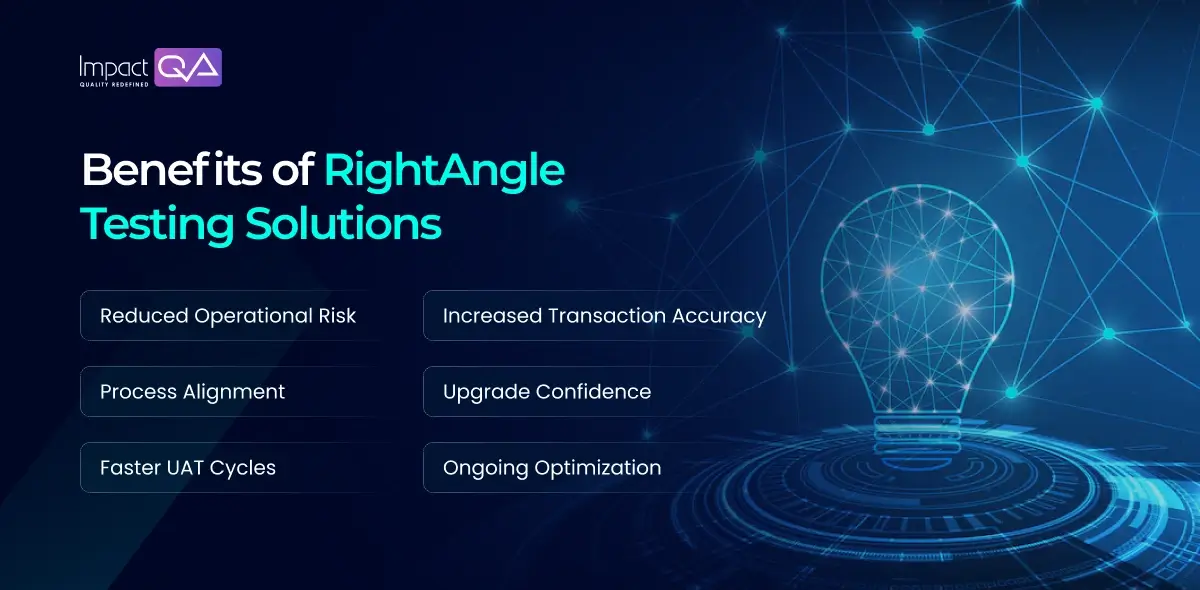
Rigorous testing for RightAngle plays a critical role in minimizing disruptions, maintaining transaction integrity, and supporting business continuity. QA efforts across functional, integration, performance, and automation layers contribute to a dependable CTRM environment.
Here are the six key benefits of deploying structured RightAngle testing strategies:
1. Reduced Operational Risk
RightAngle systems are often customized to support specific commodity flows, logistics, and settlements. Testing helps identify configuration issues, integration breaks, and access problems before they affect live operations. This reduces the chance of trade errors, financial inconsistencies, and compliance gaps.
2. Increased Transaction Accuracy
Testing routines validate key processes such as trade capture, ticket matching, inventory movements, and financial settlement. Accurate execution across these areas prevents data mismatches, eliminates the need for rework, and strengthens audit readiness.
3. Process Alignment
Business workflows rarely follow a one-size-fits-all template. Customized QA ensures that RightAngle reflects the actual operating procedures of an organization. This includes testing for pipeline scheduling, volumetric allocations, tax rules, and exception handling to ensure operational alignment.
4. Upgrade Confidence
When new patches or features are introduced, structured regression testing enables teams to validate stability across modules. This builds confidence to implement vendor updates while keeping critical processes unaffected.
5. Faster UAT Cycles
Automated scripts support quicker and more reliable user acceptance testing. Core workflows are covered efficiently, allowing business users to focus on edge cases and exceptions. This reduces testing effort and improves rollout timelines.
6. Ongoing Optimization
Repeatable regression testing frameworks allow organizations to continuously refine system behavior. With each update or enhancement, QA teams can track the impact on performance, functionality, and compliance. This drives long-term system reliability and supports future scalability.
With CTRM solutions from ImpactQA, these benefits are further magnified through purpose-built accelerators, business-aligned test design, and performance benchmarking to ensure your RightAngle environment delivers measurable value.
Streamlined Testing for Crude, NGLs, and Refined Products
Energy firms dealing with multiple product lines require testing strategies that are flexible yet precise. RightAngle Testing Solutions include:
- Automated validation for movement scheduling across pipelines, trucks, and barges
- Testing ticket creation, settlement, and reconciliation workflows
- Verification of inventory levels and reconciliation reports across multiple locations
- Testing AP matching logic across vendors and invoices
- Scenario-based validations for credit limit breaches, compliance rules, and price fluctuations
Testing is conducted not only for standard workflows but also for edge cases like:
- Mismatched BOLs
- Incomplete ticket entries
- Currency discrepancies
- Product swaps and re-grades
ImpactQA’s domain-aligned CTRM testing services are tailored to cover these nuances. We build reusable testing libraries that capture the complexity of your operations and evolve with your business.
Common Challenges Solved by RightAngle Testing
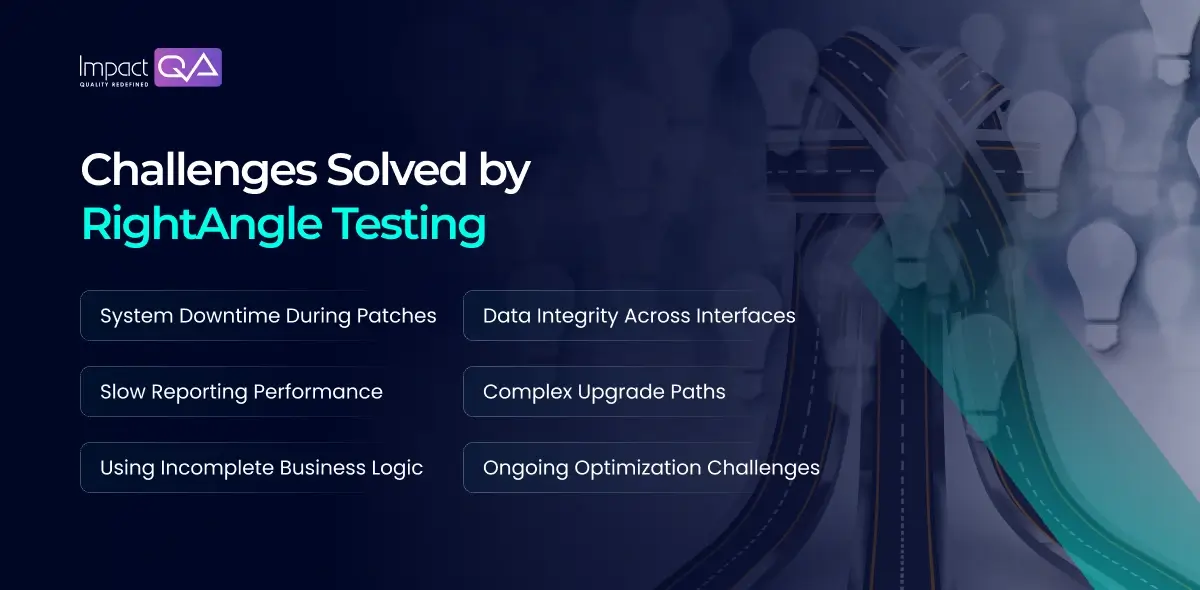
RightAngle is integral to commodity and energy trading operations, but recurring technical challenges can interrupt workflows and impact business continuity. Rigorous QA plays a critical role in detecting and mitigating system-level issues before they disrupt trading, reporting, or compliance. Below are key challenges addressed through structured RightAngle testing:
System Downtime During Patches
Applying vendor patches or minor configuration changes without a QA buffer can cause unintended disruptions across ticketing, scheduling, or invoicing. Comprehensive pre- and post-patch validation helps ensure all business-critical modules operate correctly. This allows smooth transitions into production environments with minimal business impact or rollback scenarios.
Data Integrity Across Interfaces
RightAngle interacts with external systems like ERP, market data feeds, and settlement platforms. Each integration point must preserve data accuracy, especially for contracts, trades, and position updates. Interface testing confirms that fields like timestamps, quantities, and pricing remain consistent across platforms, helping eliminate reconciliation errors downstream.
Slow Reporting Performance
Daily P&L, credit exposure, and logistics reports depend on efficient data extraction from multiple modules. Performance testing identifies slow-running queries, inefficient joins, or overloaded datasets. These insights help fine-tune the reporting layer to deliver timely, reliable outputs aligned with trading cycles and audit requirements.
Complex Upgrade Paths
RightAngle upgrades often involve schema changes, new features, and modified system behavior. Without targeted regression testing, legacy processes or custom reports may break. Structured QA helps validate pricing engines, configuration rules, and workflows to maintain business continuity and avoid unexpected downtime during production rollouts.
Using Incomplete Business Logic
RightAngle templates do not always match an organization’s unique workflows for contract management, transport, or risk. Functional testing is customized to reflect real-world processes to ensure ticket lifecycle logic, pricing rules, and invoicing steps align with business practices rather than default system behavior.
Ongoing Optimization Challenges
As trading models evolve, RightAngle configurations must also be updated. Without a repeatable testing strategy, these iterations risk introducing regression errors. Continuous testing frameworks make it easier to validate enhancements and new configurations regularly. This supports long-term system stability and stakeholder confidence across operations and IT.
How ImpactQA Adds Value Through RightAngle QA Services
ImpactQA specializes in delivering RightAngle-focused CTRM solutions built to address operational complexity, system variability, and dynamic business requirements.
We provide:
- End-to-end QA coverage tailored to RightAngle’s crude, NGL, and refined product workflows
- Pre-built accelerators for deal capture, AP matching, ticketing, and credit risk scenarios
- Regression packs aligned with patching and upgrade schedules
- Interface testing for real-time data validation across downstream systems
- Automated business rule testing and exception case simulation
- 24×7 support models to ensure continuous operational confidence
Our CTRM QA experts have deep hands-on experience in RightAngle implementations, integrations, and support. We ensure testing isn’t a bottleneck but a business driver. From validating financial calculations to verifying custom BI reports, every scenario is grounded in domain relevance and performance benchmarks.
Our experts validate every layer, from workflows to data mappings, to secure seamless transitions with zero business disruption.
Final Thoughts
Testing RightAngle is not a post-deployment formality, it is a business imperative that shapes how reliably your CTRM platform performs under real-world pressure. Every validated workflow, reconciled transaction, and simulated exception adds clarity to trade operations and strengthens regulatory alignment. This is where technology meets accountability.
Structured testing reveals hidden inefficiencies, allowing faster resolutions before they disrupt operations. It lays the foundation for confident decisions, driven by clean data, consistent logic, and traceable execution. As energy trading becomes more data-intensive and compliance-driven, testing stands as the gatekeeper of system stability. It ensures your RightAngle platform runs with purpose, precision, and resilience.
Share this post


Related Posts
Our Case Studies