Quick Summary:
NeX-AI is ImpactQA’s AI-driven testing platform for enterprise applications, including SAP Commodity Management (SAP CM), Openlink Endur, Allegro, and RightAngle. It uses natural-language prompts to generate structured test cases with steps and expected results across positive, negative, edge-case, and integration scenarios. ImpactQA combines AI-assisted test generation with domain-led QA to help trading organizations prepare test scenarios, review coverage gaps, and maintain traceability across complex CTRM workflows.
Table of Contents:
- Introduction
- Why CTRM systems need specialized AI testing
- How NeX-AI generates test cases
- Applying NeX-AI to Endur and RightAngle
- Six ways NeX-AI supports CTRM quality engineering
- How NeX-AI fits into regression automation
- How ImpactQA supports enterprise CTRM testing
- Final Say
- Frequently Asked Questions (FAQs)
Before a commodity trade is fully on the books, it has been through deal capture, pricing and risk assessment, then scheduling, invoicing and settlement. A defect at any one of those stops can skew the calculations after it, and suddenly trading and finance are reconciling two different sets of numbers. That’s why testing here takes real knowledge of the application, how it’s configured and which business rules govern each transaction.
Openlink Endur and RightAngle both run complex commodity trading operations, but you’d test them quite differently. Endur work leans toward trade lifecycle processing, valuation, risk and settlement. RightAngle sits closer to the physical barrel: movements, scheduling, ticket matching, inventory and financial reconciliation.
At ImpactQA, we built NeX-AI so QA teams could spend less time writing test cases by hand. As an AI testing platform for CTRM, it handles context-aware test generation for Endur, RightAngle, Allegro and SAP CM. Our teams check those cases against business requirements before they go into functional, integration and regression testing.
What does NeX-AI do? It turns natural-language testing requirements into structured test cases for supported enterprise and commodity trading platforms. QA teams review the steps and expected results, then use what they approve in functional, integration or regression testing.
See how NeX-AI's AI-powered test generation can help QA teams prepare structured scenarios from natural-language requirements.
Why Do CTRM Systems Need Specialized AI Testing?
CTRM testing is about business rules and transaction outcomes across the whole trade lifecycle. A screen accepting input only tells you the screen works. You still need to know the pricing formula is right, the inventory updated and the settlement calculated correctly, and that takes scenarios built around the configured platform and whatever sits downstream of it.
Take an Endur deal amendment. Change one pricing input and valuation may shift, along with any reporting that follows. The QA team has to verify the recalculation, make sure the amended deal kept its correct attributes, and see whether connected systems picked up the new information.
RightAngle has its own chain of dependencies. A scheduled movement may generate tickets that feed inventory and invoicing, so one wrong quantity or reference on a ticket can surface much later, during reconciliation and settlement.
Keeping manual test design current gets harder every time a portfolio, configuration or interface changes. AI-powered test case generation lets teams prepare more scenarios from defined requirements, while domain experts still sign off the expected results and business-specific rules.
How Does NeX-AI Generate Test Cases for Endur and RightAngle?
NeX-AI uses generative AI to convert natural-language prompts into structured test cases with steps and expected results. On supported commodity trading platforms, you get positive, negative, edge-case and integration scenarios.
A tester describes the workflow, the conditions and the outcome they expect. NeX-AI generates test cases from that, and the QA team reviews and refines them. Within NeX-AI, AI testing platform features such as test scoring help teams assess the output, while reusable data tagging keeps related test information organized.
For Endur, a prompt might describe a deal amendment that changes a configured pricing input after booking. The cases that come back may cover the valuation change, invalid inputs and the effect on related records. The tester then checks each one against the implementation’s pricing logic and data requirements.
For RightAngle, try a physical movement with a missing ticket reference. The QA team then looks at how the generated scenarios treat exception handling, inventory updates and downstream invoicing.
There’s also a feedback loop designed to help the platform adapt to the product environment, though QA teams should validate how that applies to their own configuration and process.
At ImpactQA, we treat AI-generated cases as structured test assets that still need technical review. The expected result has to match the real requirement, configuration and interface contract. That review is what keeps the test library useful as the application changes.
Six Ways NeX-AI Supports CTRM Quality Engineering
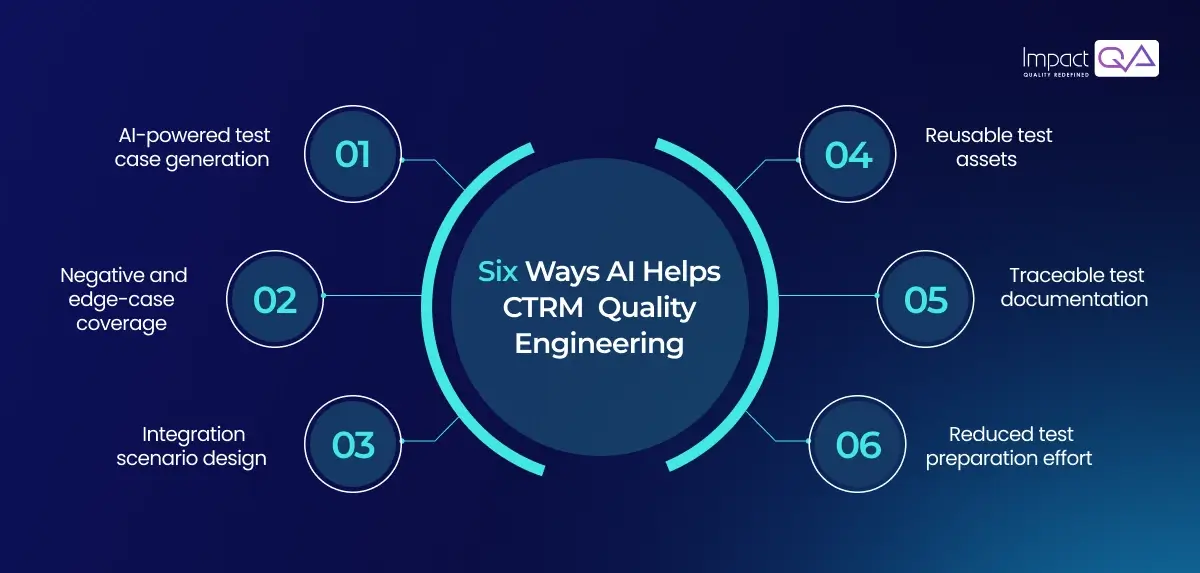
1. Generate Test Cases From Plain-Language Requirements
Starting every case from a blank document is slow. With NeX-AI, testers give a clear prompt and review what it generates, which takes much of the manual work out of turning business requirements into structured scenarios.
You’ll feel the difference when a new deal type brings several variations in pricing, contract attributes or transaction status. Teams can get a first set of cases ready, then refine it with trading, operations and finance.
2. Expand Negative and Edge-Case Coverage
Routine transactions rarely expose every failure condition. Testing also has to cover missing reference data, invalid values, boundary quantities, unavailable pricing inputs and transactions outside configured tolerances.
NeX-AI’s negative and edge-case test generation lets QA teams work through these systematically. Say a RightAngle ticket’s quantity differs from the scheduled movement. Depending on the configured business rules, the right response could be rejecting the input, raising an exception or applying an approved tolerance.
3. Prepare Integration Test Scenarios
CTRM platforms talk to market data providers, risk engines, ERP applications, scheduling systems and reporting tools. Integration testing confirms that values, identifiers, timestamps and transaction statuses stay consistent along the way.
NeX-AI can help prepare test cases around these dependencies. A tester might set up a scenario where an amended trade should update a downstream record, then compare the generated steps with the interface specification.
You’ll still configure the execution environment and interface access separately, because only a real run proves an integration works.
4. Support Reusable Test Assets
A good test library outlasts a single release. NeX-AI’s structured test cases can be reviewed and organized into reusable assets that fit your internal standards and toolchain, with reusable data tagging keeping related test information in order.
On Endur, that could be a case validating a pricing rule across approved combinations of instruments and market inputs. On RightAngle, it could be movement-to-ticket matching under different quantity conditions.
Parameterization, test-data management and automation scripting then carry approved scenarios across environments and releases. The feedback loop may also help the platform adapt to the product environment, depending on how it’s configured and used.
5. Improve Test Traceability
Enterprise QA teams need to show what was tested, what result was expected and what actually happened. NeX-AI supports access controls and spreadsheet exports, and it captures logs, screenshots and trace evidence automatically.
Listed integrations include Jira, TestRail, Git, Jenkins and SAP Solution Manager, so test preparation can slot into existing delivery and defect-management workflows.
Audit readiness still comes down to your own control design, evidence-retention policies, permissions and approval procedures, so confirm those before generated evidence goes into a formal audit.
6. Reduce Test Preparation Effort
NeX-AI reduces test case writing effort by over 70% and improves test coverage by over 45%. Your own numbers will depend on requirement quality, configuration complexity, how many scenarios get reviewed and how your team tests. We’d suggest setting a baseline for test-design effort and coverage first, then measuring over comparable releases.
Applying NeX-AI to Endur and RightAngle: Six Practical Test Examples
Here’s how teams can use AI-generated test cases as a starting point for platform-specific validation.
Platform |
Test Focus |
Example Validation |
| Endur | Deal amendments | Confirm that a change to an approved pricing input produces the expected valuation |
| Endur | Risk and reporting | Check that updated trade attributes reach the relevant downstream records |
| Endur | Settlement | Verify settlement calculations against approved deal terms and reference data |
| RightAngle | Scheduling | Validate movement quantities against configured contract rules |
| RightAngle | Ticket matching | Check how missing or mismatched ticket references are handled |
| RightAngle | Inventory and invoicing | Reconcile movement records with inventory updates and invoice calculations |
Adapt these to the client’s configuration, interfaces, data model and acceptance criteria. They’re examples of test design, and they don’t claim that NeX-AI generates or executes every scenario automatically.
How Does NeX-AI Fit Into CTRM Regression Automation?
Test generation and regression execution are two different jobs. NeX-AI helps prepare test cases, and an execution framework runs the approved ones repeatedly, comparing actual results with expected outcomes.
At ImpactQA, we pair AI-assisted test preparation with platform-specific testing and automation services. On Endur, that can include functional validation, technical upgrade testing, performance testing and regression coverage for trade, risk and settlement workflows. On RightAngle, we cover pricing logic, scheduling, ticketing, financial integrations and regression after patches or configuration changes.
A practical regression workflow looks like this:
- Prioritize critical transactions: Rank scenarios by business impact, transaction volume and failure risk.
- Review generated cases: Check preconditions, data, steps and expected results against approved requirements.
- Prepare test data: Set up representative instruments, contracts, market inputs and exception conditions.
- Automate suitable cases: Script the stable, repeatable scenarios in your chosen automation framework.
- Run and investigate: Execute the suite after changes, record failures and trace each defect to its workflow.
- Maintain coverage: Update test assets when requirements, interfaces or platform configurations change.
That way, test generation and test execution stay clearly separate. NeX-AI supports the first part, and your wider automation environment and QA process decide how approved cases are run and maintained.
How ImpactQA Helps Enterprises Apply NeX-AI
At ImpactQA, we pair NeX-AI with our experience in enterprise software testing and commodity trading platforms. We look at the business process and its technical dependencies first, then work out where AI-assisted test generation can cut manual preparation and improve scenario coverage.
For Endur, our Openlink Endur testing and automation services cover functional workflows, integrations, performance, regression and upgrade readiness.
For RightAngle, our RightAngle testing services address trade workflows, pricing, market data feeds, ticketing, financial interfaces and regression validation.
NeX-AI supports SAP Commodity Management too, so organizations evaluating an AI-powered SAP testing platform can prepare structured test cases for relevant SAP CM workflows alongside their CTRM testing.
A good way to begin NeX-AI software testing is with one high-value workflow, such as an Endur pricing amendment or a RightAngle movement-to-invoice process. Our QA specialists can review the requirements, assess the generated cases, find the gaps and decide which scenarios suit manual validation or automated regression.
Explore the NeX-AI testing platform to see how AI-driven test generation can fit into your enterprise QA process.
ImpactQA provides platform-specific testing across commodity trading systems.
Final Say
CTRM testing comes down to accurate business rules, reliable integrations and repeatable validation across the trade lifecycle. NeX-AI gives ImpactQA teams and enterprise QA organizations a practical starting point, with structured test cases for Endur, RightAngle, Allegro and SAP CM.
If you are planning an Endur or RightAngle upgrade, contact ImpactQA to discuss your testing requirements and see where NeX-AI can support your QA workflow.
Frequently Asked Questions (FAQs)
Share this post


Related Posts
Our Case Studies