What Are the Key Challenges in Blockchain Application Testing QA Teams Must Address?

Quick Summary:
Blockchain technology is gaining traction across industries, yet its complexity creates serious obstacles for QA teams. From validating decentralized transactions to testing performance under extreme workloads, Blockchain application testing demands a unique approach. This article explores the key challenges in blockchain application testing, explains how it differs from traditional testing, and outlines ways to overcome these issues. It also emphasizes why expert QA support is crucial for organizations adopting blockchain solutions.
Table of Contents:
- Introduction
- How Blockchain Application Testing Differs from Traditional Testing
- Key Challenges in Blockchain Application Testing
- Key Security Priorities in Blockchain Testing
- Managing Scalability and Performance Bottlenecks
- Smart Contract Testing Challenges and Effective QA Measures
- Compliance and Regulatory Testing in Blockchain Applications
- Closing Insights
Blockchain has grown from powering cryptocurrencies to fueling applications in banking, healthcare, supply chain, and government services. As organizations invest in distributed ledger systems, the demand for reliable and secure solutions intensifies. However, testing these applications is far from simple. Traditional QA models fall short when applied to decentralized systems that rely on consensus, immutability, and smart contracts.
QA teams working on blockchain projects encounter multi-layered difficulties, ranging from unpredictable network conditions to validation of cryptographic protocols. Security is non-negotiable, while scalability remains a constant concern. Blockchain application testing is not merely about functional correctness but about validating trust, transparency, and resilience. The following sections unpack the major challenges in blockchain application testing and provide deeper insights into how teams can approach them systematically.
ImpactQA provides end-to-end Blockchain application testing strategies to secure your digital ecosystem.
How Blockchain Application Testing Differs from Traditional Testing
Unlike conventional client-server applications, blockchain works on a distributed and consensus-driven model. Testing requires a different mindset because the rules of data handling, validation, and execution are fundamentally different. Some notable distinctions include:
- Immutable data: Once written, data cannot be changed, making error detection and rollback difficult.
- Consensus-driven validation: Transactions are validated by multiple nodes, which introduces latency and complexity in simulation.
- Complex environment setup: Replicating a live blockchain network in test environments is far more demanding than standard staging setups.
- Smart contract testing: Unlike APIs or backend logic, smart contracts execute automatically, and errors can lead to financial or reputational losses.
These differences amplify the blockchain challenges and applications that QA teams must address. Unlike traditional systems, validation cannot rely on centralized checkpoints, making test coverage across distributed nodes essential. In this context, Blockchain application testing demands not only advanced technical expertise but also a structured approach to verifying security, reliability, and compliance within decentralized ecosystems.
Key Challenges in Blockchain Application Testing
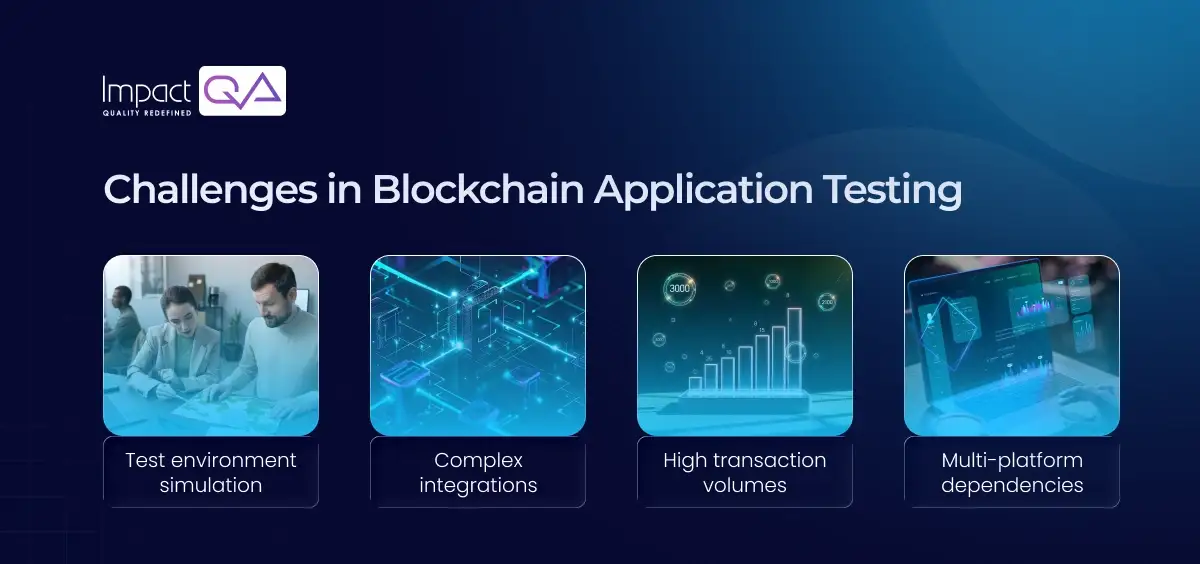
QA teams face a mix of technical, architectural, and environmental hurdles. The challenges in blockchain application testing demand specialized skill sets and advanced automation tools to avoid critical failures in production. Some of the most pressing challenges are:
- Test environment simulation: Recreating a decentralized peer-to-peer network is resource-heavy and time-consuming.
- Complex integrations: Blockchain applications often interact with payment systems, IoT devices, or existing enterprise software. Testing these integrations requires deeper coverage.
- High transaction volumes: Validating system stability under heavy loads is essential but challenging due to unpredictable transaction peaks.
- Multi-platform dependencies: Blockchain applications are not limited to one platform. They run across mobile, web, and enterprise systems, adding layers of compatibility testing.
Key Security Priorities in Blockchain Testing
In Blockchain application testing, security validation is one of the most complex responsibilities for QA teams. Since blockchain transactions are immutable and permanently recorded, even the smallest vulnerability can lead to irreversible consequences. Unlike traditional applications, where breaches can be patched or data restored, blockchain systems are far less forgiving. This makes proactive and multi-layered security testing indispensable.
For effective testing, QA teams must establish rigorous checks across critical security dimensions, including:
- Cryptographic algorithms: Ensuring that hashing and encryption mechanisms remain tamper-proof against attacks.
- Permissioned access: Verifying role-based access controls and safeguarding restricted data across distributed nodes.
- Data validation: Confirming that transaction data cannot be manipulated, lost, or altered during transmission.
- Attack simulations: Conducting penetration tests to measure resilience against DDoS, Sybil, and other network-based exploits.
Managing Scalability and Performance Bottlenecks
One of the biggest blockchain challenges and applications in QA relates to scalability. A blockchain system must process thousands of transactions per second without delay or failure. Performance testing, therefore, focuses on:
- Transaction throughput: Measuring how the system handles simultaneous requests.
- Latency issues: Identifying bottlenecks in block validation and propagation.
- Resource utilization: Tracking CPU and memory usage across distributed nodes.
- Network load testing: Validating performance under conditions of fluctuating bandwidth.
Sr. No. |
Scalability Concern |
Impact on QA Testing |
| 1. | Transaction spikes | Requires stress testing with simulated load patterns |
| 2. | Node synchronization delays | Demands cross-node consistency validation |
| 3. | Storage growth | Long-term performance degradation must be assessed |
| 4. | Multi-chain interactions | Complexity in cross-blockchain validations increases risks |
Smart Contract Testing Challenges and Effective QA Measures
Smart contracts are the backbone of decentralized applications, automating agreements without intermediaries. Their reliability directly impacts financial security and business operations. Even a single overlooked error in coding can trigger major exploits or lead to costly disputes. This makes their testing process highly complex, requiring advanced approaches tailored to the nature of blockchain execution.
- Static analysis: Reviewing source code to detect logical and security flaws. Helps identify vulnerabilities early in the development cycle.
- Gas usage validation: Ensuring that contract execution remains cost-efficient. Prevents unnecessary costs during frequent or large-scale transactions.
- Boundary condition checks: Testing how contracts behave under extreme input scenarios. Verifies system resilience against abnormal or unexpected values.
- Upgrade testing: Validating seamless updates when contracts are patched or replaced. Confirms continuity without disrupting user or business workflows.
Compliance and Regulatory Testing in Blockchain Applications
As blockchain integrates into finance, healthcare, and government systems, compliance becomes a critical dimension of QA. Unlike traditional apps, the immutable nature of blockchain records can conflict with regulatory requirements such as data privacy and right-to-erasure. QA teams must therefore embed compliance validation into blockchain application testing.
Key focus areas include:
- Data privacy obligations: Verifying compliance with regulations like GDPR, HIPAA, and CCPA where personal information is involved.
- Identity management checks: Testing KYC/AML modules to ensure accurate identity verification.
- Auditability: Ensuring systems maintain transparent and compliant audit trails.
- Regional standards: Adapting testing frameworks to local regulatory frameworks across jurisdictions.
- Integration with legal frameworks: Validating how smart contracts comply with contractual and regulatory obligations.
These compliance checks address some of the toughest challenges in blockchain application testing by aligning technology with the legal frameworks that govern its use. For QA teams, this means creating a balance between immutability, transparency, and regulatory obligations.
ImpactQA enables high-performance, secure, and regulatory-ready blockchain solutions.
Closing Insights
Blockchain application testing is complex because it demands much more than validating user journeys or backend logic. It requires testing decentralized consensus models, immutable ledgers, autonomous contracts, and regulatory compliance while ensuring high security and scalability. So, it’s important that QA teams evolve beyond traditional methods to address these multifaceted issues effectively.
Organizations adopting blockchain cannot afford testing failures, as errors can compromise transparency, security, and compliance. This is why expert partners become indispensable. A specialized provider like ImpactQA brings advanced frameworks, domain knowledge, and global expertise that make blockchain application testing reliable and future-ready. Working with such experts helps businesses confidently deploy decentralized solutions at scale.
Share this post


Related Posts
Our Case Studies