Quick Summary:
The transition from isolated simulation to continuous, production-integrated telemetry marks a fundamental shift in software quality engineering. Traditional testing models that evaluate applications in static environments fail to catch the transient bottlenecks of highly distributed, cloud-native microservices. Modern performance engineering addresses this by merging historical load profiling with real-time operational telemetry, allowing enterprises to proactively mitigate architectural risks.
Table of Contents:
- Introduction
- Building Scalable Architectures Through Deep System Telemetry
- Core Challenges Enterprises Face During Performance Engineering
- Driving Strategic Business Value from Reliability Frameworks
- Systemic Methodologies for Modern Infrastructure Validation
- Dynamic Execution Strategies Across Contemporary Deployment Pipelines
- Conclusion
High-concurrency software delivery requires a validation strategy that predicts exactly how distributed cloud networks behave under heavy transactional stress. Traditional verification routines rely on artificial staging environments that isolate software layers from actual user behavior, which ultimately hides structural flaws from engineering teams. This structural disconnect makes it difficult to track erratic data patterns or pinpoint exactly where a database might lock up during sudden traffic surges.
Moving beyond isolated script simulation requires an integrated framework that combines simulated traffic stress with live, operational system tracking. This practical combination simultaneously monitors deep-tier thread behavior, resource constraints, and database connection pooling while synthetic load runs against the infrastructure. Establishing this clear, multi-layered visibility early in development allows engineers to catch transient memory leaks and database failures before they compromise the live production system.
ImpactQA applies intelligent performance testing services to reduce operational risk and accelerate software releases.
Building Scalable Architectures Through Deep System Telemetry
The contemporary application delivery pipeline demands a transition from superficial script execution to deep system telemetry across all layers. Utilizing advanced performance testing services allows organizations to look beyond basic request-response metrics and focus directly on complex runtime behavior.
Distributed Tracing
Engineers embed unique telemetry headers across microservices to monitor cross-application dependency behaviors. This approach exposes exact database query durations and microservice network latency during high-volume performance testing tools evaluations.
Kernel Telemetry
Deploying light data collectors within cloud nodes allows teams to capture system-level logs without modifying source code. This monitoring happens organically during standard load testing service routines to track CPU allocation.
Metric Correlation
Modern diagnostic systems map runtime resource spikes directly to corresponding synthetic traffic events. This automated linking isolates performance degradations down to specific code adjustments executed during active simulation cycles.
Pipeline Telemetry
Continuous tracking systems feed direct performance indicators into shared engineering dashboards during development. This ensures that infrastructure scaling metrics remain transparent across engineering teams throughout early software delivery cycles.
Cloud Monitoring
Distributed architectures require deep visibility into third-party managed systems and multi-cloud databases. Evaluating these infrastructure layers under peak strain reveals hidden resource exhaustion patterns before code gets pushed to production environments.
Core Challenges Enterprises Face During Performance Engineering
Validating modern, distributed software platforms introduces severe operational complexities that old approaches cannot handle. A specialized performance testing company helps mitigate these operational risks by utilizing service virtualization and data engineering to mimic true complexity.
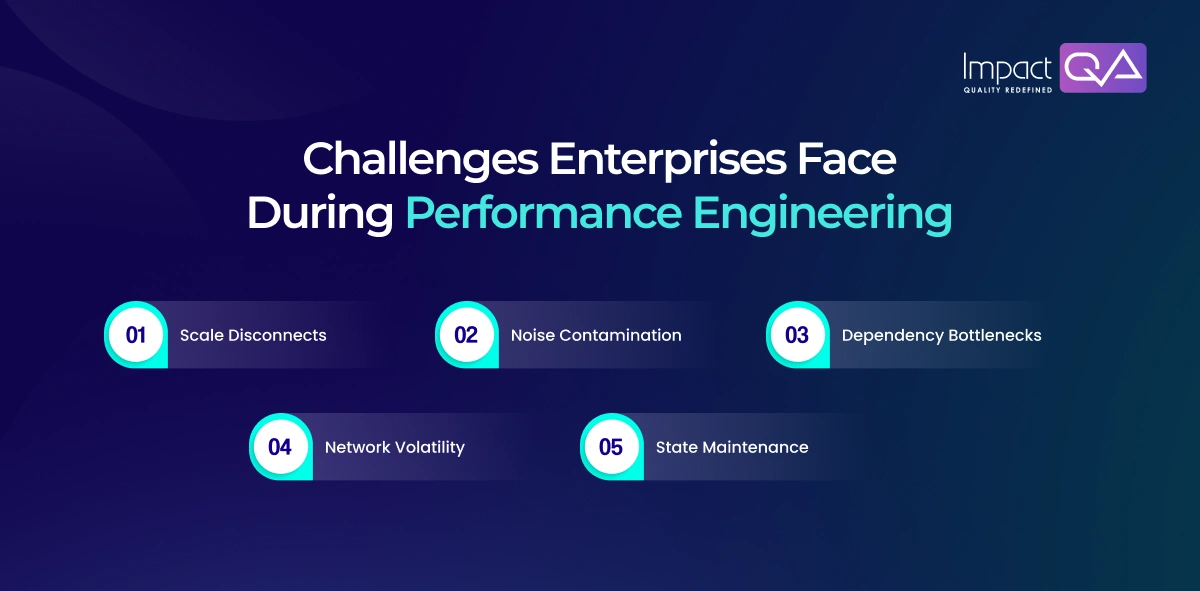
Scale Disconnects
Staging infrastructure is often a fraction of actual production sizing, creating massive analytical blind spots. This structural difference causes hidden database lockups to slip past standard validation checks undetected.
Noise Contamination
Flaky test scripts and unstable environment configurations generate false alerts that mask genuine architectural problems. Cleaning up this analytical static requires rigorous data engineering to ensure reliable system validation results.
Dependency Bottlenecks
Modern applications depend on numerous third-party payment gateways and external messaging services that resist basic simulation. Virtualizing these external components is necessary to isolate internal application performance from external network constraints.
Network Volatility
Varying data speeds, localized latency, and packet loss create highly unpredictable user experiences across global regions. Replicating these real-world variations requires specialized mobile performance testing services to measure genuine end-user interface responsiveness.
State Maintenance
Managing large, realistic test data sets across rapid deployment cycles remains exceptionally tedious. Automated data generation pipelines must continuously refresh database states to prevent cached data from distorting accuracy.
Driving Strategic Business Value From Reliability Frameworks
Investing in a modern validation framework allows enterprises to transform quality assurance into a proactive mechanism for operational efficiency. Utilizing dedicated scalability testing services provides definitive data on exactly where an application’s infrastructure breaks under heavy load.
Cost Reductions
Identifying structural deficiencies early in development cycles dramatically decreases the time spent on post-release remediation. This defensive shift reduces total engineering hours spent resolving operational emergencies during business hours.
Expense Control
Detailed scalability profiles give infrastructure teams precise insight into automated scaling limits. This clear visibility prevents the over-provisioning of cloud instances, lowering monthly cloud operational expenditures significantly.
Outage Prevention
Proactive system validation ensures that high-volume digital platforms remain operational during unpredictable consumer traffic events. This continuous protection limits sudden revenue losses caused by unexpected web server crashes.
Root-Cause Acceleration
Coupling active system stress with deep transactional visibility shortens diagnostic timelines from days to minutes. This speed allows developers to isolate specific broken code statements immediately upon test failure.
Confidence Verification
Continuous quality verification gives leadership teams objective, data-driven green lights for rapid production updates. This automated assurance eliminates subjective guesswork surrounding application stability prior to major software updates.
Systemic Methodologies for Modern Infrastructure Validation
Transitioning to an observability-driven strategy requires careful coordination across application architectures, infrastructure, and delivery pipelines. Advanced performance engineering solutions must be woven directly into the software development lifecycle, rather than treated as an afterthought or a final checklist item.
Pattern Replicas
Engineers analyze active production logs to map authentic consumer journeys and realistic data distributions. These real-world patterns are converted directly into automated test scripts to ensure realistic testing simulations.
Regression Checks
Performance verification assertions run automatically alongside functional tests within continuous delivery pipelines. This process relies on performance test automation to block builds that introduce severe latency regressions.
Dependency Mapping
Testing teams utilize application performance testing services to track how interdependent microservices communicate under heavy strain. This tracing highlights hidden cascading delays where one slow microservice chokes several downstream applications.
Condition Probing
Validation routines intentionally push software systems beyond theoretical operating limits to observe failure states. This strict testing process verifies that automated recovery mechanisms activate correctly without losing user sessions.
Profiling Execution
Low-impact profiling agents analyze memory allocation and thread performance directly within automated testing branches. This continuous diagnostic check captures transient memory leaks that only appear during prolonged execution windows.
Dynamic Execution Strategies Across Contemporary Deployment Pipelines
To keep pace with accelerated deployment schedules, modern enterprises must move away from manual execution and adopt automated, continuous validation models. Building an enterprise performance testing strategy requires a combination of automated execution tools and real-time observability dashboards.
Machine Learning
Advanced testing engines apply analytical algorithms to isolate minor speed deviations from background environment fluctuations. This intelligent filtering prevents engineering teams from wasting time chasing down false environmental alerts.
Build Thresholds
Delivery pipelines use strict, programmatic latency benchmarks to evaluate every single incoming code modification. If a commit drops application speeds below acceptable limits, the build gets rejected automatically.
Global Concurrency
Modern frameworks launch synchronized traffic loads from multiple global cloud zones simultaneously. This comprehensive setup tests geographic distribution networks, load balancers, and regional database synchronization speeds under peak load.
Progressive Routing
Engineering groups run low-volume automated load scripts against canary deployments inside production environments. This strategy validates live application performance safely before routing the entire consumer base to new software versions.
Feedback Loops
Telemetry insights gathered from live production workloads feed directly back into early developmental testing scripts. This continuous cyclical loop updates testing parameters to match changing user habits and system growth.
ImpactQA delivers continuous performance testing to isolate bottlenecks and stabilize global enterprise applications.
Conclusion
Transitioning to a unified validation strategy ensures that enterprise applications maintain stability under heavy transactional stress. By pairing simulated traffic patterns with active system tracking, software teams can systematically reveal thread behavior limitations, database constraints, and hidden memory leaks early in development.
As one of the best test automation services providers in the US, ImpactQA delivers tailored expertise to help organizations transform their quality assurance workflows. Our extensive performance testing services combine specialized consulting with production-level tracking to keep multi-cloud platforms highly resilient. Partnering with a dedicated performance testing company allows engineering groups to integrate automated checks smoothly into delivery pipelines, control cloud infrastructure expenditures, and deploy complex software with total confidence.
Explore how strategic performance testing improved reliability and scalability in our latest case study.
Share this post


Related Posts
Our Case Studies