Quick Summary:
Performance testing is becoming more intelligent as AI and Generative AI bring deeper analysis, smarter workload modeling, synthetic test-data generation, automated test creation, anomaly detection, and predictive insights into the testing lifecycle. The shift is particularly significant for cloud-native, distributed, and AI-powered applications, where performance depends on multiple interconnected components rather than a single application layer. This blog explores how AI is reshaping modern performance testing strategies and what enterprises should consider when adopting AI-enabled performance engineering.
Table of Contents:
- Introduction
- About AI and Gen AI in Performance Testing
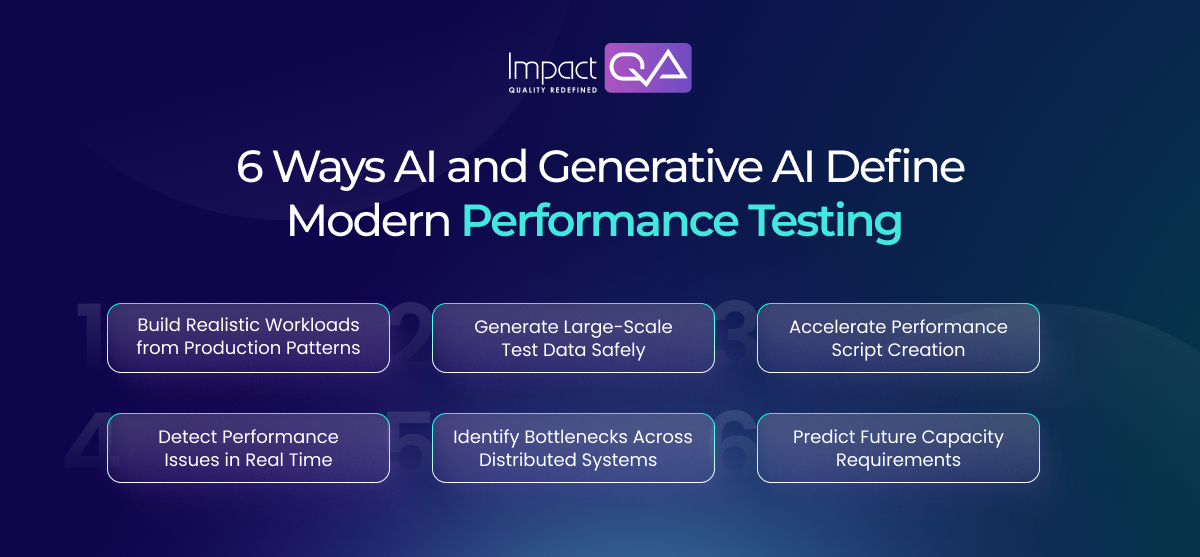
- 6 Ways AI and Generative AI Define the Role of Modern Performance Testing
- What Should Enterprises Look for in AI-Powered Performance Testing Tools?
- Why Human Performance Engineering Expertise Still Matters?
- Final Say
- Frequently Asked Questions
Performance testing has always been an exercise in reproducing real-world pressure inside a controlled environment. The challenge has become more interesting as modern applications have grown more dynamic.
A customer transaction today can span APIs, microservices, databases, cloud services, and AI components, creating complex workloads. That complexity has real financial stakes because industry downtime can cost businesses hundreds of thousands to millions per hour. It’s this kind of pressure that creates valuable opportunities for AI in performance testing.
They can help teams understand changing workloads, create richer test scenarios, uncover performance issues faster, and make better capacity decisions. The result is a more connected approach to software performance testing, where real-world data can influence how tests are designed, executed, and analyzed.
This article examines how AI, especially Gen AI, are changing performance testing.
ImpactQA's combines AI-powered testing with expert insights to deliver performance results that reflect real-world conditions.
About AI and Gen AI in Performance Testing
Performance testing evaluates how an application performs under expected and unexpected levels of user traffic. It measures important factors such as response time, throughput, scalability, stability, resource utilization, and error rates. The goal is to identify bottlenecks and confirm that the application can deliver a reliable user experience under realistic conditions.
Artificial Intelligence (AI) is the broader umbrella that enables systems to analyze data, recognize patterns, make predictions, and support decisions. In performance testing, AI can analyze test results and system data to identify anomalies, spot trends, find bottlenecks, and support capacity planning.
Generative AI (Gen AI) is a specialized branch of AI that creates new content based on learned patterns. Generative AI in performance testing can generate test scenarios, performance scripts, synthetic test data, workload variations, test documentation, and summaries of test results. It can also help update scripts when APIs or application workflows change.
AI and Gen AI are closely linked with performance testing but serve different purposes. AI primarily analyzes, predicts, and recommends, while Gen AI primarily creates and accelerates testing assets.
This combination makes performance testing in software more tuned in with real-world application behavior. It also explains the pace of enterprise adoption, with close to 80% of enterprises expected to be using AI-powered testing tools by 2027, up from roughly 15% in 2023.
6 Ways AI and Generative AI Define the Role of Modern Performance Testing
AI is influencing performance engineering across the lifecycle. The change becomes clearer through six practical applications.
1. It creates more realistic workload models
Many performance environments struggle more with unrealistic workloads than insufficient tooling. Cause production traffic rarely behaves like a perfectly balanced script. Users browse, search, abandon carts, retry transactions, generate reports, refresh pages, and arrive in unpredictable bursts.
AI can study workload patterns to build more representative models. That gives engineers a stronger basis for testing how an application may behave under real demand.
2. It accelerates synthetic test-data generation
Large-scale performance tests often need millions of records with realistic relationships, data volumes, and distribution patterns.
Generative AI can help create synthetic datasets that reproduce important characteristics of production data while reducing direct dependence on sensitive records.
This becomes particularly useful for database-heavy applications, where data volume and distribution can influence indexing, joins, caching, query performance, and storage behavior.
3. It speeds up test-script creation and maintenance
Performance scripts involve considerable engineering work: parameterization, correlation, authentication, dynamic values, request sequencing, and maintenance after application changes.
Generative AI can produce starter scripts from API specifications or business workflows and suggest updates when interfaces change.
The engineer still defines the correct workload and validates the generated logic. The productivity gain comes from reducing repetitive construction work while preserving engineering control over the final test.
4. It turns performance data into meaningful signals
Given that enterprises collect enormous amounts of performance data across test runs, AI can analyze it to detect anomalies, uncover trends, and surface performance risks. That moves analysis beyond static threshold checking.
A small latency change becomes considerably more interesting when it appears alongside rising database wait time, connection-pool pressure, or a recent deployment.
5. It helps trace bottlenecks across distributed systems
Consider a checkout request that suddenly takes twice as long. The application server may look healthy while the real constraint sits further down the transaction path.
Checkout latency → Payment service → Database query → Connection-pool saturation
In a distributed architecture, tracing that chain can involve application logs, infrastructure metrics, service telemetry, and dependency behaviour. AI-assisted analysis can correlate these signals and help narrow the search for the underlying bottleneck.
That gives engineers a broader view of performance across the transaction rather than isolating the investigation to a single component.
6. It brings predictive analysis into capacity planning
Capacity planning has traditionally relied on observed behaviour under defined workloads. AI extends that analysis by examining historical patterns and modelling how performance may change as traffic or data volumes grow.
An engineering team can use those insights to estimate where resource consumption may become critical and investigate likely saturation points before demand reaches them.
For growing platforms, this creates a useful bridge between performance testing and infrastructure planning. Test results become a source of evidence for future capacity decisions rather than a record of what happened in a single test run.
What Should Enterprises Look for in AI-Powered Performance Testing Tools?
AI capability alone should never be the deciding factor when evaluating performance testing tools. The stronger question is how deeply intelligence is integrated into the testing workflow. Here is what the enterprises should keep in mind:
Production-informed workload modeling
A tool that just generates higher request volumes is just brute-forcing modeling reality. What matters is whether the platform draws on production observability data (the way Dynatrace, Datadog, and New Relic do) to understand actual traffic behavior and service dependencies, then feeds that into a load-testing engine like LoadRunner, JMeter, or Gatling. That pairing is what turns a workload model from a guess into a reflection of real usage.
Data depth behind the AI
Not all “AI-powered” claims are equal. The useful ones work across historical test results and application, infrastructure, database, and observability data, which is exactly what lets Datadog Watchdog or New Relic Applied Intelligence catch abnormal behavior a threshold alert would miss entirely.
Explainability
If a tool flags a bottleneck or a capacity risk, it should be able to show its work — the telemetry, traces, and dependency chain behind the call, not just the conclusion. Without that trail, engineers have no way to confirm whether the issue is actually a database problem, a service problem, or a configuration one, and no way to trust the recommendation enough to act on it.
Cloud-native readiness
Microservices, Kubernetes, serverless functions, and asynchronous workflows don’t behave like a monolith under load, so the testing approach can’t either. This is where the same load-generation and observability tools already mentioned need to talk to each other.
Support for AI-application testing
Enterprises building GenAI features need a different lens entirely: inference latency, token behavior, concurrency, retrieval performance. Tools like LangSmith, TruLens, and Arize Phoenix fill that gap specifically, and it’s worth confirming upfront whether a platform actually measures time to first token, tokens per second, and retrieval latency or just claims “AI support” without any of the metrics that matter for it.
These distinctions are also what separate performance testing companies that simply execute tests from providers with real performance-engineering depth. A credible partner should be able to name which tools they use, explain how the AI in them works, and show how a human engineer validates what it finds.
Why Human Performance Engineering Expertise Still Matters?
AI is highly effective at processing patterns. Performance engineering requires interpreting why those patterns matter.
An experienced engineer knows to question a surprising result.
- Did the workload change?
- Did the environment change?
- Did caching behave differently?
- Did a dependency slow down?
- Did autoscaling react late?
- Did the dataset change?
For enterprises evaluating software performance testing companies, technical judgment should therefore sit alongside AI capability, tooling depth, observability expertise, and testing methodology.
The strongest model combines intelligent automation with experienced engineering decisions, which is the model ImpactQA applies across its performance testing engagements: AI-assisted analysis and test generation, validated and interpreted by engineers who understand the architecture behind the numbers.
ImpactQA helps enterprises identify bottlenecks before customers do.
Final Say
With AI and Gen AI, performance testing is heading toward continuous, always-on validation baked into CI/CD pipelines. Enterprises are increasingly investing in observability-driven platforms that connect production signals directly to test design, and agentic AI is starting to take on more of the diagnostic work.
The next frontier is AI-native applications themselves, where token speed and inference cost become as critical as response time. But the direction is clear: automation will keep accelerating the work, while engineering judgment stays the deciding factor.
How did they cut costs by 30%? The answer's inside.
Frequently Asked Questions (FAQs)
Share this post


Related Posts
Our Case Studies