Quick Summary:
Codeless tools are ready for selected enterprise workloads: stable regression, acceptance tests, packaged applications and visual checks. They reduce scripting but do not remove engineering needs. Complex integrations, database validation, legacy interfaces and governance still require technical depth. A pilot measuring feasibility, maintenance and defect detection helps determine fit. Most enterprises need a blend of manual, codeless and coded testing.
Table of Contents:
- Introduction
- 3 Generations of Codeless Functional Testing Tools
- 5 Areas Where Codeless Tools Are Enterprise-Ready
- 4 Areas Where Enterprises Still Need Engineering Depth
- How to Judge Enterprise Readiness in 3 Metrics
- Final Say
- FAQs
Functional testing in software testing asks one plain question: does the feature do what the business asked for?
For years, answering it at scale meant writing code.
Codeless tools change that. They now let testers build workflows visually or describe them in plain language.
Leapwork’s 2026 study of 302 engineering and QA respondents found that 71% identified test creation as their main bottleneck. Forrester’s research with 37 enterprise customers using autonomous testing platforms found average automation levels of 51% to 60%; some advanced teams exceeded 80%.
Are codeless tools ready for enterprise use? Yes, for selected workloads, provided teams retain engineering oversight for complex validation, integrations and governance.
ImpactQA applies domain expertise and proven test frameworks to strengthen functional testing outcomes.
3 Generations of Codeless Functional Testing Tools
These approaches overlap. Codeless describes test authoring; model-based, keyword-driven and AI-driven describe ways to design or execute tests.
1. Record and Playback
How it works: Capture interactions, then replay them.
The tool records clicks, keystrokes and interface elements, often storing locators such as IDs, labels or selectors. This is quick for smoke tests on stable screens. However, changes to an element or workflow can break recorded steps and require review or recapture.
2. Model-Based and Keyword-Driven
How it works: Represent workflows or assemble reusable actions.
Model-based testing uses a representation of application states, transitions or workflows to derive scenarios. Keyword-driven testing assembles reusable actions such as “Create Sales Order” or “Approve Invoice.” They can work together, but they are not the same method. Reusable components help teams apply data variations and maintain shared steps.
3. AI and Natural Language
How it works: Describe the intended business outcome.
Depending on the platform, AI may use page structure, accessibility information, visual recognition or APIs to interpret the interface. Self-healing can suggest alternate elements after UI changes, but teams should review repairs on critical workflows.
Some platforms, including FALCON, track how consistently a test passes across repeated runs and provide a confidence score to expose flaky tests. See FALCON’s no-code automation capabilities and how its platform simplifies test creation.
5 Areas Where Codeless Tools Are Enterprise-Ready
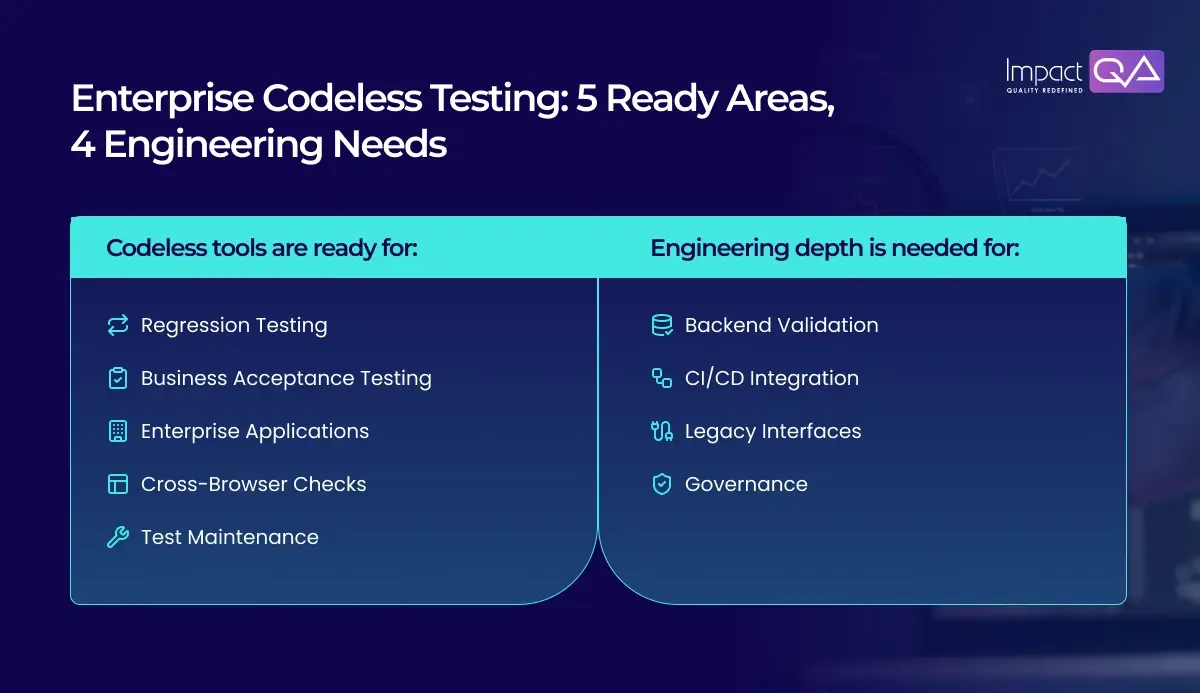
Software functional testing covers many kinds of work, and codeless tools already handle a large share of it well.
1. Regression of Stable Business Flows
Repeatable flows such as order-to-cash are strong candidates. Reusable tests cover customer, pricing, credit and invoicing steps. Forrester’s customer research found AI features were associated with estimated automation increases of 21% to 30%. This is a customer-reported estimate, not a guaranteed outcome.
2. Business Users in Acceptance Testing
Finance or supply chain specialists understand the exceptions that matter in their workflows. Codeless authoring lets them describe acceptance scenarios, while QA reviews coverage, test data and expected outcomes. Business participation must not replace QA governance.
3. Packaged Enterprise Applications
Standard SAP, Oracle and Salesforce workflows may suit codeless automation. Custom extensions, integrations and version-specific behavior need platform expertise. Oracle Fusion’s quarterly updates also require regression planning. See how AI-powered test case generation can support scenario design.
4. Cross-Browser and Visual Checks
A single flow may run across supported browsers and screen sizes. Visual validation identifies layout shifts, hidden controls and overlapping text. Review differences to separate defects from expected rendering changes.
5. Test Maintenance
Leapwork’s 2026 study found 45% needed at least three days to update tests after a critical-system change. Self-healing can use alternate attributes or visual matching to suggest repairs. But a similar-looking control may perform a different action. Require human approval for changes to payment, financial and other high-risk tests.
4 Areas Where Enterprises Still Need Engineering Depth
Codeless tools simplify visible workflows, but enterprise systems also depend on backend logic and controls.
1. Data and Backend Validation
A purchase order may appear correct on screen while its tax calculation is wrong in a backend service. Codeless platforms may support standard REST requests and response assertions; complex API orchestration, database reconciliation, batch processing and EDI validation can still require engineers. FALCON currently lists codeless REST API automation, so API testing should not be described as universally outside codeless capability.
2. Version Control and Pipelines
Ask whether tests support version history, branching, peer review and CI/CD triggers. Check how the platform handles parallel execution, environment configuration, secrets and readable exports. Proprietary formats can make migration difficult, so assess portability before committing.
3. Custom and Legacy Interfaces
Mainframe terminals, remote desktop applications, Oracle Forms, canvas-rendered controls and custom desktop software may expose limited page structure or accessibility information. Visual recognition can help, but resolution, themes and screen changes need careful control.
4. Autonomy and Governance
Forrester’s enterprise customers rated full autonomy 2.2 out of 5, indicating that autonomous testing still needs oversight. Evaluate role-based access, masked data, credentials, audit trails, evidence retention, version control and approval of self-healing changes. Exploratory testing still needs human judgment.
How to Judge Enterprise Readiness in 3 Metrics
Run a four-to-six-week pilot across three critical workflows, including an application change to evaluate maintenance.
Codeless Automation Feasibility (%) = (Selected Tests Automated Without Code ÷ Selected Pilot Tests) × 100
For example, if 68 of 80 selected pilot tests are automated without code, feasibility is 85%. This measures authoring feasibility, not functional coverage.
Maintenance Ratio = Hours Updating Tests ÷ Hours Creating Tests
If a team spends 40 hours updating tests against 160 hours creating them, the ratio is 0.25. Measure real application changes; without them, the pilot cannot show maintenance performance.
Defect Detection Contribution (%) = (Unique Confirmed Defects First Found by Pilot Suite ÷ All Unique Confirmed Defects Found in Pilot) × 100
If the suite first identifies 18 of 24 unique confirmed defects, its contribution is 75%. This is not 75% of all possible defects. Also track severity, false positives, flaky runs and escaped defects.
Then check five practical items:
- Portability: Tests have version history and usable exports.
- Depth: UI tests can connect with supported API and data checks.
- Pipelines: Suites integrate with CI/CD and environment controls.
- Governance: Access, audit logs, data privacy and approvals are covered.
- Cost: Pricing includes licenses, execution, training and maintenance.
Most enterprises need a blend: manual testers handle exploratory and acceptance work, codeless suites cover regression, and coded frameworks address complex integrations. An experienced AI-powered functional testing provider can help determine where each approach fits.
ImpactQA combines API, integration and UI testing to validate complex enterprise workflows.
Final Say
Codeless tools are ready for selected enterprise work, not as a replacement for every testing method. Strong adoption combines accessible authoring, engineering depth, governance and human review.
ImpactQA’s functional testing services include smoke, regression, integration, exploratory, UI and acceptance testing. Its published capabilities include 350+ certified testers, 30+ domain-specific frameworks, AI test generation and Smart RCA with Visual AI. FALCON supports plain-English automation for web, real Android devices, REST APIs and AI chatbot testing, with additional platforms listed as coming soon.
Download the full case study and see how it works in action.
Frequently Asked Questions (FAQs)
Share this post


Related Posts
Our Case Studies