Why Are Leading Retailers Shifting from Manual to Automated Functional Testing?

Quick Summary:
Retailers face growing pressure to deliver flawless customer experiences across e-commerce, mobile apps, and physical stores. The complexity of modern retail platforms, combined with the need for frequent updates, has pushed many companies to move beyond manual testing. This blog explores how automated functional testing in retail enables faster releases, higher accuracy, and seamless customer journeys across platforms.
Table of Contents:
- Introduction
- What is Functional Testing in Retail?
- The Need for Accuracy and Speed in Retail
- Functional Testing vs Manual Testing in Retail
- Key Drivers for Automation in Retail
- Use Cases of Automated Functional Testing in Retail
- Overcoming Challenges in Automation
- How ImpactQA Delivers Business-Specific Testing Solutions
- Conclusion
The retail industry is in a phase of constant reinvention. From in-store kiosks to voice-enabled shopping and app-based loyalty programs, digital touchpoints are growing rapidly. According to a 2023 report by Gartner, 63% of retail CIOs are prioritizing investments in automation to streamline operations and improve customer satisfaction.
This shift extends to how businesses validate their systems and features. Functional testing that was once carried out entirely through manual efforts is now being reengineered using automation. Automated functional testing in retail enables organizations to test quickly, repeatedly, and more reliably than ever before. The goal is no longer to just find bugs but also to prevent them from reaching customers in the first place.
ImpactQA’s end-to-end functional testing covers every scenario that matters.
What is Functional Testing in Retail?
Functional testing in retail validates whether every function within a retail application works as expected. It simulates real-world customer actions such as browsing, purchasing, applying coupons, or initiating returns to confirm that systems respond correctly under varied conditions.
These tests are executed across various platforms that retailers use:
Before diving into bullet points, it’s important to understand the depth and diversity of systems that exist in retail. Businesses operate in hybrid environments that combine mobile apps, web platforms, and legacy POS systems. Each layer must be tested for accuracy, security, and performance, individually and together.
- E-commerce websites: Testing product search, navigation, cart, and checkout.
- POS terminals: Verifying real-time sync with inventory and transaction logs.
- Mobile apps: Testing features like push notifications, barcode scanners, and offline access.
- Inventory & warehouse systems: Ensuring real-time stock updates and fulfillment accuracy.
- Loyalty systems: Validating points accumulation, redemption, and user history.
Functional testing in retail plays a critical role in confirming business logic and ensuring that user-facing features align with backend processes.
The Need for Accuracy and Speed in Retail
Retailers operate under tight schedules, especially during peak seasons or promotional campaigns. A small delay or functionality error, like a discount not applying correctly or inventory not updating, can cost both revenue and brand trust.
When manual QA is used exclusively, businesses encounter limitations that automation is designed to overcome. Here’s why precision and agility have become non-negotiable in testing workflows.
- Customer expectations are rising: Users expect seamless, responsive digital experiences.
- Frequent deployments: Weekly or even daily releases need rapid validation.
- Integrated platforms: Each part of the retail stack must communicate flawlessly.
- Data accuracy: Even minor mismatches in pricing or order details create friction.
Automation ensures that each function, whether backend or user-facing, is tested accurately across different devices, user scenarios, and geographies.
Functional Testing vs Manual Testing in Retail: A Shift in Approach
Understanding the shift requires comparing manual and automated approaches. The decision is no longer about which method is “better,” but about how scalable and efficient the process is for modern retail use cases.
The following table shows why leading companies are leaning toward automated testing.
Sr. No. |
Criteria |
Manual Testing |
Automated Testing |
| 1. | Execution Time | Slower due to human dependency | Rapid and scalable |
| 2. | Accuracy | Subject to human error | Consistent across cycles |
| 3. | Regression Testing | Time-intensive | Fast and repeatable |
| 4. | Long-Term Cost | Higher due to labor hours | Lower with reusable scripts |
| 5. | Test Coverage | Limited by team size | Broader with parallel runs |
Automation allows teams to shift from repetitive validation to strategy-oriented QA. It supports testing at scale, covering use cases like multi-device compatibility, real-time sync, and AI-driven features that manual testing can’t reliably handle.
Key Drivers for Automation in Retail
The retail domain is undergoing a structural shift in how QA is managed. Automation has now become foundational to performance and growth. Several operational and strategic reasons are pushing this shift.
Before jumping into the details, let’s understand what’s truly at stake. Retail success is built on speed, consistency, and user experience. When these break down, even briefly, business continuity and customer loyalty are threatened.
- Complex omnichannel workflows: Apps, stores, kiosks, and websites must operate in sync.
- Rapid releases and updates: Agile and DevOps models demand continuous testing cycles.
- Dynamic personalization: AI-based recommendations and user history require data-aware tests.
- Third-party integrations: Retail apps often rely on external payment gateways, chat tools, or CRM platforms.
- Global reach: Multi-region setups need localization testing across tax, currency, and content.
These drivers make it clear that the complexity of modern retail systems is best handled with automation frameworks designed for scale and flexibility.
Use Cases of Automated Functional Testing in Retail

Automation isn’t applied randomly; it targets specific workflows that benefit most from speed, consistency, and repeatability. These use cases form the core of any modern retail QA strategy.
Each retail module, such as checkout, product discovery, and loyalty systems, has dependencies and hidden edge cases. Automation ensures these are validated end-to-end without human error or delays.
- Checkout Flows: Testing various user paths (guest vs. logged-in, wallet vs. card, coupon usage) across devices and browsers.
- Search and Filtering: Validating relevance, filter logic, auto-suggestions, and tag-based recommendations.
- Order and Returns Management: Automating workflows from order placement through delivery, cancellation, and refunds.
- Loyalty Program Operations: Ensuring correct point accrual/redemption during purchases, events, and campaigns.
- Internationalization Testing: Verifying tax, shipping, currency, and language settings for global rollouts.
- POS Device Sync: Testing offline/online sync between store POS systems and central servers in real time.
These scenarios highlight how automation reduces QA effort while improving test reliability.
Overcoming Challenges in Automation
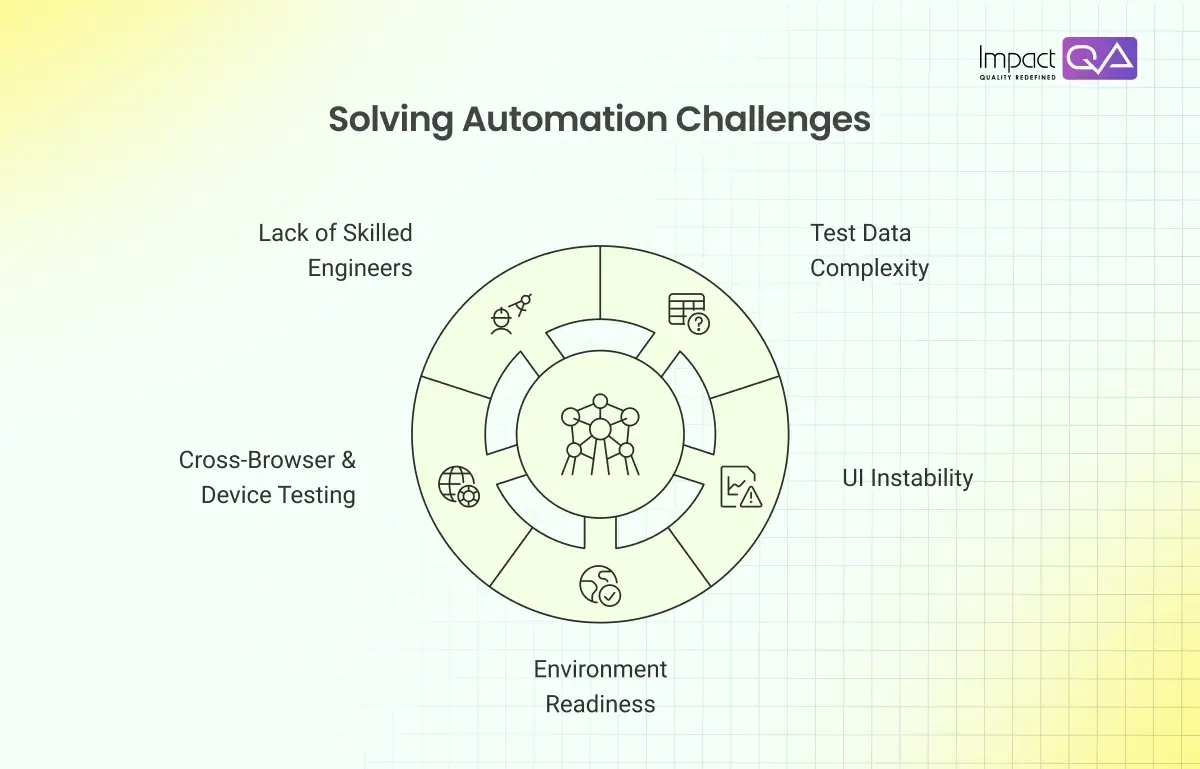
Despite the benefits, automation in retail QA comes with its own set of hurdles. Many businesses face initial setbacks due to tooling gaps, poor test data, or inflexible frameworks.
Implementing automation requires more than just writing scripts. It’s about building a reliable infrastructure that supports frequent changes, integrated systems, and realistic user journeys.
- Test Data Complexity: Creating, managing, and isolating test data aligned with real inventory and promotions.
- UI Instability: Regular design updates can break automated scripts unless frameworks use intelligent locators.
- Environment Readiness: Inconsistent staging setups often lead to false positives or missed bugs.
- Cross-Browser & Device Testing: Ensuring tests run accurately across a wide matrix of OS, browser versions, and screen sizes.
- Lack of Skilled Automation Engineers: Building a team with retail QA knowledge and hands-on tool proficiency is a growing challenge.
These problems require strategic investment in QA planning, tooling selection, and test maintenance frameworks.
How ImpactQA Delivers Business-Specific Testing Solutions
ImpactQA brings years of experience in helping retail businesses modernize their QA operations. Our functional testing in retail services is tailored to align with business objectives, seasonality, and customer expectations.
Retailers looking to automate functional testing need more than a plug-and-play tool. They need a partner who understands how shopping carts, loyalty engines, OMS, and third-party plugins interact under real-world conditions.
- Retail-Specific Testing Frameworks: Built with reusable components for rapid test execution and minimal maintenance.
- Omnichannel Testing Expertise: Covering mobile, web, POS, and integrations to simulate customer journeys.
- Cloud-Based Test Execution: Run tests across devices, browsers, and locations using cloud infrastructure.
- API and Integration Testing: Ensures backend systems like CRMs, ERPs, and inventory management work without sync errors.
- Dedicated QA Teams: Scalable, agile teams embedded into your SDLC with domain knowledge and automation expertise.
ImpactQA’s solutions are built not just to detect bugs, but to help retail businesses maintain speed, scale, and customer trust.
ImpactQA helps validate load and functionality across key workflows.
Conclusion
Retail businesses are no longer asking whether to automate QA – they’re asking how fast they can do it. Automated functional testing in retail allows retailers to validate new features, system integrations, and user workflows with speed and confidence.
Manual testing still plays a role, but it’s no longer the backbone. Businesses are adopting automation to stay ahead of feature releases, security patches, and customer expectations. The result? Lower QA costs, faster go-to-market cycles, and more stable applications.
ImpactQA supports this transformation with purpose-built testing frameworks, automation-first strategies, and a dedicated focus on the retail domain. By integrating with your development teams and workflows, ImpactQA ensures you never miss a release window or deliver a broken experience to your users.