Quick Summary:
There is no universal price tag for security testing. The final cost depends on what is being tested, how deeply it must be assessed, how complex the environment is, and what evidence the business needs afterward.
For 2027, AI-enabled applications add another pricing variable. Testing an LLM-powered feature or an autonomous AI agent can require validation of prompts, data access, model behavior, tool permissions, APIs, and action paths alongside conventional application security.
Table of Contents:
- Introduction
- How Security Testing Services Are Priced
- What Drives Security Testing Services Pricing?
- How AI Changes Security Testing Costs in 2027
- How to Build a Realistic 2027 Security Testing Budget
- How to Compare Security Testing Services Quotes
- Final Say
- Frequently Asked Questions
When a procurement lead sets two quotes for security testing services side by side and finds the same application priced far apart, the natural question is which vendor misread the brief. Both read it correctly. Each priced a different slice of the attack surface at a different depth.
That is the whole mystery of security pricing, and it has an answer. IBM’s 2026 Cost of a Data Breach Report puts the global average breach at $4.99 million, the yardstick any testing budget gets measured against. Gartner expects spending on securing AI to climb to almost $4.8 billion in 2027. This guide explains what moves a quote and what is new for 2027, then shows how to size a budget before the first call.
ImpactQA scopes each security engagement around your application and release rhythm.
How Security Testing Services Are Priced
Security testing services are priced under one of three models, and the model decides who carries the risk when scope shifts mid-engagement. The table below sets the models side by side, so a quote can be read for what it commits the provider to deliver.
Pricing Model |
Best Fit |
Who Absorbs Scope Change |
Worth Confirming |
| Fixed fee | Stable, well-defined scope | Provider, through priced change request | A written scope boundary |
| Time and materials | Discovery-heavy or evolving work | Buyer, through added hours | A weekly burn report |
| Managed subscription | Teams releasing every sprint | Shared, per the agreed cadence | Retest allowance per cycle |
The model matters as much as the number. A low quote often reflects a narrow scope boundary, so the first question for any quote is what sits inside it.
What Drives Security Testing Services Pricing?
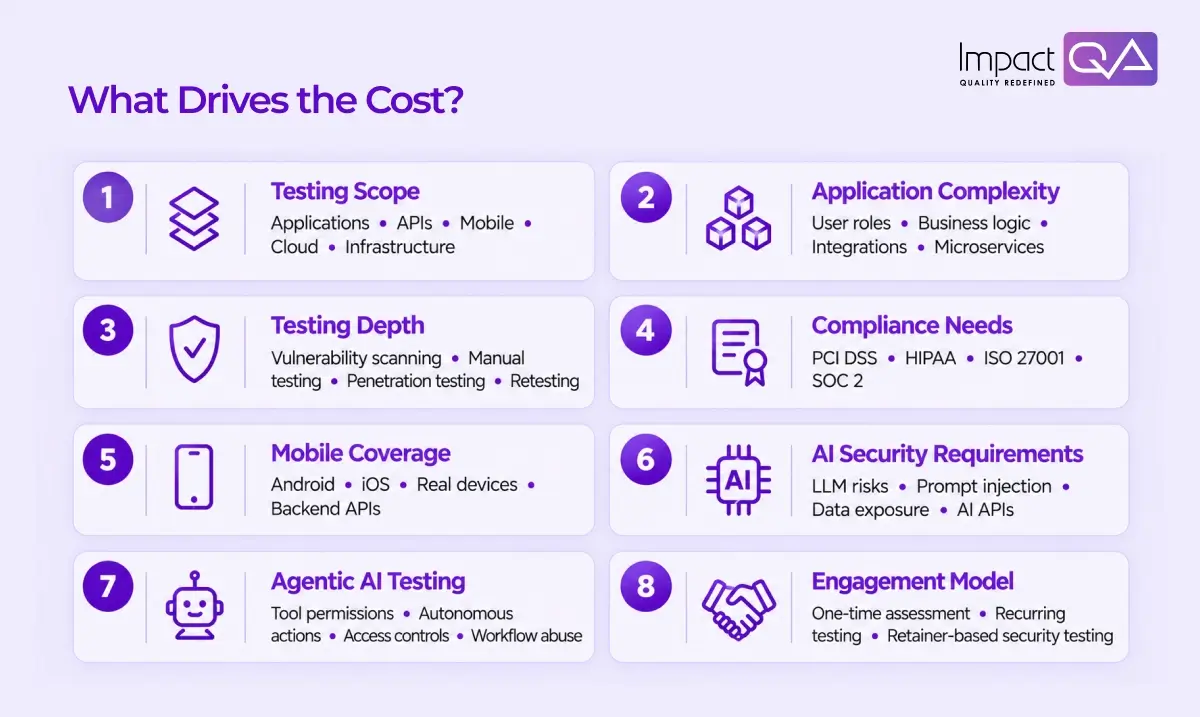
Security testing services pricing usually changes most with scope, technical complexity, test depth, access requirements, compliance expectations, and the amount of expert analysis required. A low quote may reflect a smaller test rather than a cheaper version of the same assessment.
1. Scope Comes First
The number of applications, APIs, environments, IPs, endpoints, mobile platforms, and user roles directly affects effort.
Testing one customer-facing application is very different from assessing a platform with separate admin, partner, support, and customer journeys. The same applies to APIs: endpoint count matters, but so does what those endpoints are allowed to do.
This is why a detailed scope document is one of the strongest predictors of a useful quote.
2. Testing Depth Changes the Price
Automated vulnerability scanning is faster than a manual penetration test. A deeper assessment may include authenticated testing, business-logic validation, source-code review, attack-path analysis, manual exploitation, and remediation testing.
The deeper the assessment, the more specialist time it requires.
A scan may tell you that a weakness exists. A skilled security tester may need to establish whether it can actually be exploited, what access it enables, and what business process it could affect.
3. Application Architecture Matters
Modern applications don’t live in one layer.
Microservices, APIs, cloud services, third-party platforms, identity providers, payment systems, containers, and mobile clients can all become part of the attack surface.
This is particularly relevant to application security testing. A seemingly modest application may require substantially more testing when sensitive workflows cross several systems or when authorization decisions are distributed across services.
4. Roles, Authentication, and Business Logic Add Effort
A public login page is relatively straightforward compared with a platform containing privileged administrators, internal users, partners, delegated access, tenant-level permissions, SSO, MFA, and complex transaction rules.
Security testing needs to confirm not only that authentication works, but that each role can access exactly what it should.
Business-logic testing can therefore become one of the most valuable (and time-intensive) parts of an assessment.
5. Compliance Can Expand the Engagement
PCI DSS, HIPAA, ISO 27001, SOC 2, DORA, and other requirements can introduce additional testing, evidence, documentation, or reporting expectations. A test designed around a specific compliance objective may therefore cost more than a general vulnerability assessment.
The cost is not simply for “more testing.” It can also reflect the need for specific evidence and a reporting structure that auditors or security stakeholders can use.
6. Mobile Testing Can Multiply Coverage
Mobile application security testing becomes more complex when both Android and iOS are in scope, particularly when applications use device storage, biometrics, certificate pinning, offline functionality, or sensitive backend APIs.
A 2026 benchmark places mobile penetration testing at roughly $5,000–$30,000, with platform coverage and backend API scope among the factors affecting the final cost.
ImpactQA’s mobile security guidance similarly treats authentication, storage, APIs, networks, and platform-specific controls as distinct areas of assessment.
7. Reporting, Retesting, and Remediation Support Count Too
The assessment itself is only part of the engagement.
A detailed executive report, technical findings, root-cause analysis, remediation guidance, retesting, or ongoing advisory support can all affect the final cost. Some providers include one round of fix validation, while others charge for it separately.
That makes the statement “retesting included” far more useful than simply comparing headline prices.
How AI Changes Security Testing Costs in 2027
AI security testing can cost more than conventional application assessments when the system introduces model behavior, retrieval, external data, AI APIs, tools, or autonomous actions that must be validated. The key cost driver is not AI itself; it is the additional attack surface and testing depth created by the AI architecture.
A conventional web application may have predictable request-response behavior. An AI-enabled system can add prompts, model APIs, retrieval pipelines, external data sources, agent tools, and probabilistic outputs to the security equation.
OWASP’s current guidance specifically treats AI/LLM applications as a broader security-testing problem because untrusted inputs can affect model behavior and model outputs can influence tools or external actions.
That creates several additional cost areas:
S. No. |
AI Security Area |
What May Need Testing |
| 1. | AI & LLM security testing | Prompt injection, data leakage, unsafe outputs, model behavior |
| 2. | RAG systems | Retrieval controls, document access, sensitive-data exposure |
| 3. | AI APIs | Authentication, authorization, input handling, data exposure |
| 4. | Agentic AI security testing | Tool permissions, action boundaries, privilege misuse, workflow abuse |
| 5. | AI in security testing | Automated discovery, prioritization, anomaly analysis, regression coverage |
The expanding verification surface is reflected in OWASP’s AI Security Verification Standard 1.0, released in 2026 with 191 requirements across 12 chapters and three appendices.
AI security testing tools can reduce manual effort in areas such as scenario generation, finding prioritization, and pattern analysis. They do not remove the need for expert validation, especially when a security finding depends on business context or an attacker’s ability to chain multiple weaknesses.
That distinction is likely to matter more in 2027 as enterprises move from AI assistants toward systems capable of taking actions.
How to Build a Realistic 2027 Security Testing Budget
A budget starts from an asset inventory and a risk ranking. List what needs testing and rank it by business impact, then decide which assets need annual depth and which need continuous coverage. Providers can then quote against a shared picture, which keeps quotes comparable.
Ask each provider to quote against the same written scope, so differences in price trace back to differences in method. Our guide to selecting a penetration testing provider covers the questions worth asking once the quotes arrive, including how findings are documented and handled.
How to Compare Security Testing Services Quotes
The best security testing quote is not necessarily the lowest one. Compare providers on identical scope, testing depth, tester expertise, deliverables, remediation support, and exclusions so that the numbers represent the same security outcome.
Before comparing proposals, make sure each provider answers the same questions:
S. No. |
Pricing Question |
Why It Matters |
| 1. | What assets are included? | Prevents hidden scope differences |
| 2. | Are authenticated tests included? | Determines how deeply access controls are assessed |
| 3. | Is API coverage included? | Avoids testing only the visible application layer |
| 4. | Is mobile coverage per platform? | Clarifies Android and iOS costs |
| 5. | Are manual tests included? | Separates scanning from expert assessment |
| 6. | Is retesting included? | Shows the true cost of closing findings |
| 7. | Are AI features in scope? | Important for LLM and agentic applications |
| 8. | What will the final report contain? | Determines how actionable the deliverable is |
Also ask what is not included. Exclusions often explain price differences better than the quoted amount itself.
ImpactQA's managed security testing delivers assessments on a regular cadence.
Final Say
Security testing pricing in 2027 will be shaped less by a generic market rate and more by the engineering reality of the system being tested.
A clear scope makes costs easier to predict, while modern architectures and AI capabilities make shallow comparisons less useful. The smartest budget is the one that buys meaningful coverage where risk actually lives.
ImpactQA opens every security engagement with threat modeling and a test strategy that names priorities and required resources, so each line of a quote traces back to an asset. Its security testing services pair static and dynamic application analysis with penetration testing, delivered by a certified team of 50+ experts. A managed option brings assessments to teams that release often. LLM agent security testing extends the same discipline to AI workflows.
Download the full case study and see how it works in action.
Frequently Asked Questions (FAQs)
Share this post


Related Posts
Our Case Studies