Quick Summary:
SAP rollouts often appear technically successful but still create business disruptions after go-live due to process gaps, integration failures, data issues, and regression defects. Dedicated SAP functional testing validates complete business workflows before deployment, reducing operational risk across complex enterprise environments. This blog explains why independent SAP testing services are essential for stable, reliable, and business-ready SAP implementations.
Table of Contents:
- SAP Rollouts Fail When Business Processes Are Tested in Isolation
- Dedicated SAP Testing Identifies Integration Risks Earlier
- SAP Regression Testing Services Protect Existing Business Operations
- Agentic AI Is Changing the Way SAP Testing Can Be Performed
- Data Migration Requires More Than Technical Reconciliation
- Why Dedicated SAP QA Testing Services Are Necessary
- A Practical Framework for SAP Rollout Testing
- Final Say
SAP rollouts are becoming more complex as enterprises move across S/4HANA, cloud ERP, hybrid environments, industry extensions, and connected business applications. Gartner forecasts that 62% of cloud ERP spending will be directed toward AI-enabled solutions by 2027. This implies that ERP environments are changing, with embedded AI, automation, integrations, and distributed data becoming part of core business operations.
However, an SAP rollout can fail even when the platform is technically deployed as planned. A configuration may work in isolation but produce incorrect results when connected to finance, procurement, supply chain, HR, external applications, or custom developments. Dedicated SAP testing services are therefore necessary to validate business processes, integrations, data, security, and regression risks before the new environment becomes operational.
ImpactQA identifies business, integration, and regression risks before go-live.
SAP Rollouts Fail When Business Processes Are Tested in Isolation
An SAP rollout is not simply a software installation. It changes how business transactions are initiated, processed, approved, recorded, and reported. Therefore, testing must examine complete business processes rather than validating individual screens or transactions.
SAP functional testing is particularly important because a single transaction can trigger multiple downstream activities. A purchase order may affect inventory, goods receipt, invoice verification, accounting entries, tax calculations, and reporting. If one configuration change disrupts this chain, the initial transaction may still appear successful while creating errors elsewhere.
This is why SAP QA testing services must begin with business process mapping. Test scenarios should reflect actual workflows, user roles, organizational structures, master data, approval rules, and exception conditions.
1. End-To-End Process Validation
SAP functional testing should validate complete workflows from initiation to final business outcome. This helps identify failures between connected transactions that isolated module testing may not reveal.
2. Configuration Verification
Changes to pricing, tax, workflow, authorization, or organizational structures can affect multiple processes. Dedicated testing validates whether configuration produces the intended business result.
3. Role-Based Testing
Different users may access different transactions, approvals, and data. Testing must verify whether each role can perform the correct activities without receiving excessive access.
4. Exception Scenario Testing
Business processes do not always follow the standard path. Rejected invoices, failed payments, incomplete master data, and cancelled orders must also be validated.
Dedicated SAP Testing Identifies Integration Risks Earlier
Modern SAP environments rarely operate as standalone systems. They connect with CRM platforms, payroll applications, warehouse systems, banking networks, tax platforms, procurement tools, data warehouses, and third-party APIs.
This makes SAP integration testing services a critical part of any rollout. A transaction can be functionally correct inside SAP and still fail when data moves to another system. Problems may involve incorrect field mapping, data transformation, timing, authentication, duplicate messages, or failed acknowledgements.
For example, a sales order may be created correctly in SAP but fail to reach a warehouse management system. Similarly, a payment file may be generated but rejected by a banking platform because of an incorrect data format.
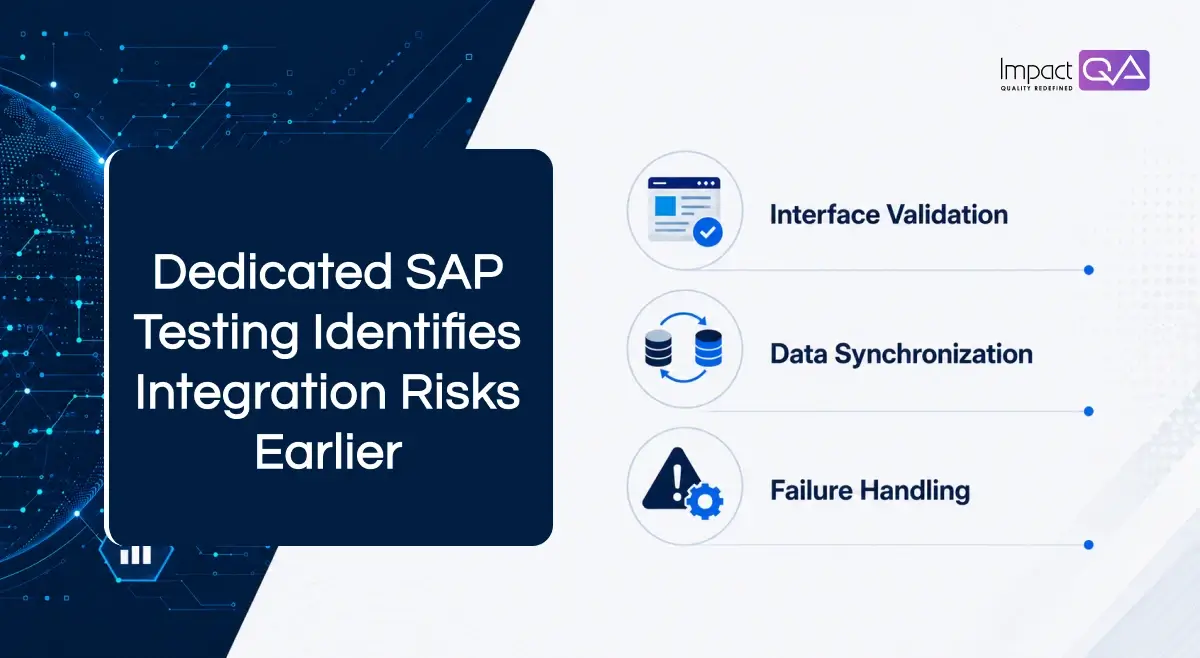
Dedicated SAP testing services examine these connections as complete data flows. This helps identify whether information is transmitted accurately, processed correctly, and returned to SAP without data loss or duplication.
- Interface Validation: Testing verifies whether data moves correctly between SAP and connected systems. Field mapping, data formats, mandatory values, and response handling must be checked across each interface.
- Data Synchronization: Master and transactional data must remain consistent across systems. Testing identifies missing records, duplicate entries, delayed updates, and incorrect transformations.
- Failure Handling: Integration testing must examine what happens when an external system is unavailable or returns an error. Retry logic, alerts, and recovery processes require validation.
SAP Regression Testing Services Protect Existing Business Operations
A rollout often introduces new configurations, modules, integrations, custom developments, and migrated data. These changes can affect business functions that were not part of the original implementation scope.
This is why SAP regression testing services are essential. Regression testing verifies that existing business processes continue to work after changes are introduced.
However, SAP regression testing should not mean executing every available test case without prioritization. Large SAP environments can contain thousands of transactions and business scenarios. A dedicated testing strategy should identify high-risk processes, frequently used functions, connected workflows, and areas affected by the latest changes.
Automation can make this process more practical. SAP test automation services can execute repeatable scenarios across different data sets, roles, and system configurations. This is especially useful for finance postings, procurement workflows, order processing, inventory movements, and other high-volume processes.
- Risk-Based Regression: Test cases should be prioritized according to business criticality, change impact, transaction frequency, and historical failure patterns.
- Automated Repetition: SAP test automation services can repeatedly validate stable workflows after configuration changes, upgrades, patches, and integration modifications.
- Data Variation: Regression testing should use different master data, organizational units, currencies, roles, and transaction conditions to identify failures that a single data set may miss.
- Release Impact Analysis: Changes should be mapped to affected business processes. This helps determine which regression scenarios require deeper validation.
Agentic AI Is Changing the Way SAP Testing Can Be Performed
The growing use of agentic AI in SAP is introducing new possibilities for test design and execution. Unlike basic automation, agentic systems can interpret a task, reason through multiple steps, interact with applications, and adapt to changing conditions.
In SAP testing, this can support activities such as test case generation, business process exploration, test data preparation, and failure analysis. An AI agent may examine a business requirement and identify the transactions, roles, data conditions, and integrations required for validation.
However, agentic AI in SAP should not be treated as an independent replacement for testing expertise. SAP processes contain complex business rules, regulatory requirements, customizations, and organization specific configurations. AI-generated scenarios still require review against actual business requirements.
The strongest approach combines agentic AI with SAP QA testing services. AI can assist with repetitive analysis and test generation, while experienced QA professionals validate business logic and interpret complex failures.
- AI-Assisted Test Generation: Agentic systems can interpret requirements and suggest test scenarios covering standard, negative, boundary, and exception conditions.
- Intelligent Process Navigation: AI agents can navigate multi-step SAP workflows and identify unexpected behavior across connected transactions.
- Failure Analysis: AI can analyze failed test results, application changes, and historical defects to identify recurring patterns and probable causes.
- Human Validation: Business and QA experts must review AI-generated tests and findings to ensure that they reflect actual process requirements.
Data Migration Requires More Than Technical Reconciliation
Data migration is one of the most sensitive areas of an SAP rollout. Historical data may move across systems, structures, formats, and master data models. A successful technical migration does not automatically mean that the information is business-ready.
Testing must verify whether migrated data is complete, accurate, consistent, and usable within business processes. A customer record may exist in the new system but contain incorrect tax information. A material may be migrated but assigned to the wrong organizational unit.
Dedicated SAP testing services therefore combine data validation with functional testing. The objective is to confirm not only that data has moved, but also that it supports actual business transactions.
- Completeness Checks: Testing verifies whether required records, fields, and historical information have been migrated successfully.
- Accuracy Validation: Migrated values are compared against source data to identify incorrect transformations, truncation, or formatting problems.
- Business Usability: Data must be tested within actual SAP processes. A record that appears correct in a database may still fail during a business transaction.
Why Dedicated SAP QA Testing Services Are Necessary
SAP rollouts involve multiple teams, vendors, modules, integrations, and business functions. Without an independent testing structure, implementation teams may focus heavily on configuration completion while overlooking process quality.
Dedicated SAP QA testing services create a separate quality layer that evaluates the system from the perspective of business operations. This is particularly important when testing complex environments with multiple implementation partners.
A dedicated team can also maintain traceability between requirements, test scenarios, defects, retesting, and final validation. This provides clearer visibility into unresolved risks before deployment.
- Independent Validation: A dedicated testing team can evaluate the implementation separately from the teams responsible for configuration and development.
- Cross Module Coverage: Testing can examine how finance, procurement, sales, supply chain, HR, and external systems work together.
- Defect Governance: Issues can be classified according to severity, business impact, root cause, and remediation status.
- Requirement Traceability: Business requirements can be linked to test scenarios and results, making coverage easier to evaluate.
Partner with ImpactQA for AI-driven SAP functional, integration, and regression testing.
A Practical Framework for SAP Rollout Testing
An effective SAP testing strategy should begin early. Waiting until the system is fully configured can leave too little time to address complex defects.
The first step is to define business-critical processes and identify the systems connected to them. Next, testing teams should create scenarios that cover standard transactions, exceptions, integrations, data migration, roles, and security conditions.
Automation should then be applied where repeatability provides clear value. SAP test automation services are particularly useful for regression suites and high-volume workflows.
Finally, testing should continue through deployment preparation and post-rollout stabilization. New defects may emerge when real users, real data, and real transaction volumes interact with the system.
- Plan By Business Process: Organize testing around complete business workflows rather than isolated transactions or individual modules.
- Prioritize High-Risk Areas: Focus early testing on finance, order processing, procurement, supply chain, compliance, and integrations with significant operational impact.
- Automate Repeatable Scenarios: Use automation for stable, frequently executed workflows that require repeated validation after system changes.
- Validate Realistic Data: Use representative data conditions to test organizational structures, roles, currencies, master data, and transaction variations.
- Continue After Deployment: Post-rollout testing should monitor business-critical workflows and address defects emerging from actual operational usage.
Final Say
A successful SAP rollout requires more than technical implementation. It demands rigorous validation of business processes, integrations, migrated data, custom developments, user roles, and regression risks. SAP functional testing, SAP regression testing services, and SAP integration testing services each address different failure points across the enterprise system. At
ImpactQA, we combine SAP QA testing services, SAP test automation services, and intelligent approaches including agentic AI in SAP to validate complex business workflows and connected environments. Our dedicated SAP testing services help enterprises identify functional and integration risks earlier, supporting more stable and reliable SAP rollouts.
Share this post


Related Posts
Our Case Studies