Quick Summary:
Enterprise migration to complex cloud environments like SAP S/4HANA demands a shift toward continuous, automated quality engineering. This blog explores why large-scale organizations are investing heavily in intelligent SAP regression testing services powered by artificial intelligence. By mitigating high-risk deployment errors and stabilizing customized integrations, these validation frameworks secure mission-critical business continuity.
Table of Contents:
- Introduction
- Core Technical Challenges in Legacy SAP Environments
- Strategic Advantages of Intelligent SAP Regression Testing Services
- Essential Components of an Enterprise SAP Test Strategy
- Conclusion
- Frequently Asked Questions (FAQs)
Modern corporate IT frameworks are experiencing massive architectural updates, driving legacy, on-premise transactional systems toward heavily integrated cloud environments. Current 2026 market data from global analysis firms highlights the scale of this shift, revealing that the global SAP testing market has scaled to a valuation of USD 831 million this year, expanding at an aggressive CAGR of 8.1%. As corporations rush onto the cloud migration bandwagon to implement complex SAP S/4HANA platforms, the massive influx of custom code extensions, daily API modifications, and continuous vendor updates introduces extreme operational vulnerability.
Compounding these architectural risks, recent Gartner research indicates that by 2027, more than 70% of recently implemented ERP initiatives risk failing to meet their original business goals due to poor post-migration validation and understated data risks. To mitigate these severe deployment errors, forward-thinking enterprises are rapidly shifting from human-dependent checks to specialized SAP testing services. By embedding autonomous impact analysis and continuous validation directly into the software lifecycle, large-scale organizations can maintain absolute processing accuracy across deeply interconnected financial, logistics, and supply chain modules.
ImpactQA utilizes advanced automated tools to eliminate cross-application defects and streamline major cloud releases.
Core Technical Challenges in Legacy SAP Environments
Managing a complex ERP architecture introduces severe operational friction due to custom configurations and distributed database dependencies. Legacy verification routines struggle to isolate hidden code defects, leaving business-critical workflows highly susceptible to sudden processing failures during unexpected system modifications.
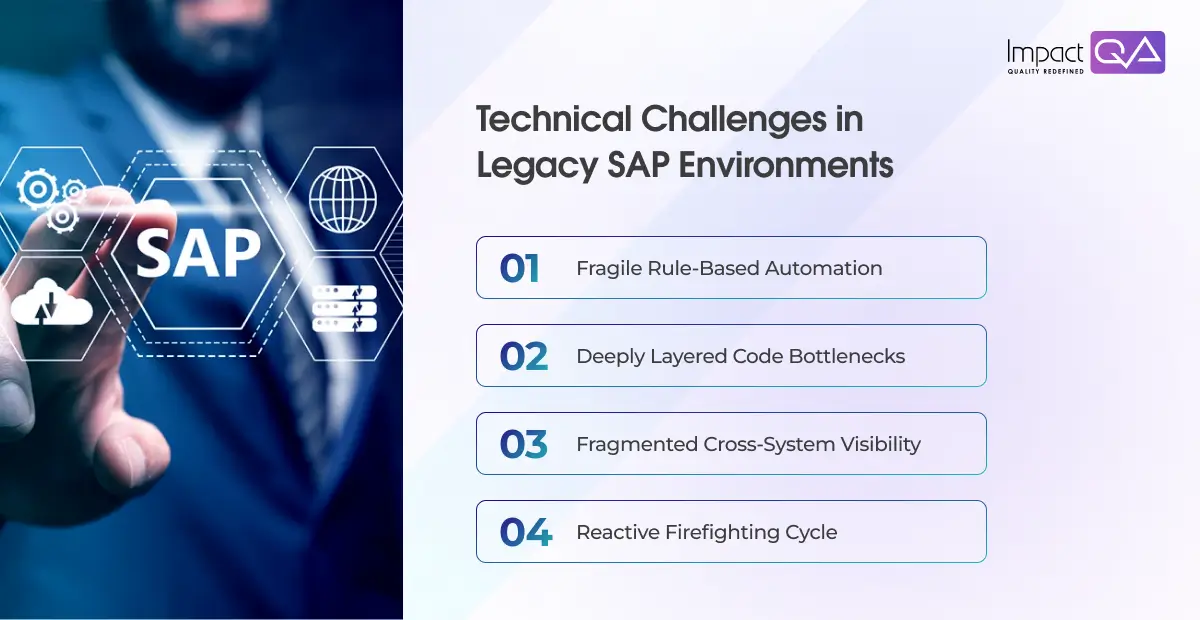
Fragile Rule-Based Automation: Standard regression scripts rely heavily on fixed UI paths and static data values. Consequently, these outdated routines are highly susceptible to breaking whenever a minor module update or custom patch modifies the underlying entry fields.
Deeply Layered Code Bottlenecks: Human verification teams quickly encounter a massive operational bottleneck during major system upgrades. Moreover, manual tracing is simply unable to keep pace with isolating processing defects across thousands of customized transaction paths and deeply layered business logic.
Fragmented Cross-System Visibility: Older QA strategies focus exclusively on isolated transactional fields rather than tracing the complete end-to-end user journey. As a result, this fragmented approach leaves critical external cloud integrations vulnerable to silent data corruption and broken API transfers.
Reactive Firefighting Cycle: Corporate IT departments remain trapped in an expensive cycle of fixing severe production bugs after they disrupt daily operations. This ongoing operational risk persists because teams lack specialized SAP QA testing services capable of automatically mapping out real-time code impacts.
Strategic Advantages of Intelligent SAP Regression Testing Services
Investing in advanced SAP regression testing services provides substantial benefits by turning software verification from a slow operational chore into a fast, proactive risk-reduction tool. Modern validation platforms use machine learning models to study historical system usage, identify high-risk code changes, and automatically update scripts without manual work. This intelligent automation removes the risk of “happy path bias,” where testing teams only verify ideal scenarios and miss complex edge-case errors. Additionally, these systems quickly review thousands of data combinations to ensure deep test coverage and catch hidden issues before they reach production.
Operational Metric |
Legacy Verification Method |
Intelligent Automated Method |
| Defect Detection Timing | Reactive (Post-deployment tracking) | Proactive (Predictive impact analysis) |
| Test Script Maintenance | Manual script rewrites | Self-healing autonomous updates |
| Data Variation Coverage | Limited to basic validation fields | Broad multi-point combinatorial data sets |
| End-to-End Visual Scope | Fragmented application views | Full cross-application process tracing |
Additionally, moving to modern SAP test automation services helps enterprises lower their long-term operational costs while running validation suites much faster. By using autonomous execution engines, companies can run complete regression suites overnight, cutting down release cycles from weeks to just a few hours. This fast feedback loop allows software teams to fix bugs early in the development lifecycle and prevent small errors from turning into costly system failures.
Choosing the best SAP testing services provider gives enterprises the tools they need to protect their primary business operations, lower overhead costs, and ensure consistent system availability across all global business units.
Essential Components of an Enterprise SAP Test Strategy
A resilient quality framework must deploy a broad spectrum of automated tools to safeguard modern, highly interconnected business processes. By embedding these continuous verification layers directly into the deployment pipeline, organizations ensure absolute data consistency and system performance during frequent platform updates.
Deep Modular Validation: Incorporating specialized SAP functional testing helps companies verify complex processing rules across core financial and supply chain modules. Additionally, this rigorous verification ensures that customized order-to-cash or procure-to-pay lifecycles match strict compliance standards without manual oversight.
End-to-End Interoperability: Utilizing dedicated SAP integration testing services ensures that transactional data transfers remain completely stable across the entire corporate architecture. Moreover, this comprehensive approach systematically validates complex API communication paths between the central ERP layer and external cloud applications.
Risk-Aligned Planning: Companies must collaborate with experienced quality specialists who deliver comprehensive SAP test strategy services to map validation efforts against real business risks. Consequently, this strategic alignment helps software teams prioritize high-impact business pathways and eliminate redundant test executions.
Self-Healing Execution Engines: Deploying advanced SAP automated testing tools allows enterprises to build highly resilient verification suites that feature autonomous script maintenance. As a result, these avantgarde systems automatically adapt to sudden user interface changes to prevent false test failures without human intervention.
ImpactQA applies intelligent SAP cloud automated testing to reduce risk and accelerate releases.
Conclusion
Modern enterprise platforms require highly resilient software verification methods to protect critical data flows and ensure non-stop operational availability. As corporate networks grow more complex with multi-cloud setups and custom integrations, old-school manual checking cannot keep pace with frequent software updates. Embracing intelligent SAP regression testing services allows large organizations to confidently manage platform changes, keeping core business workflows secure against sudden technical disruptions.
To achieve this level of operational resilience, global enterprises regularly partner with us at ImpactQA. We are a leading provider of comprehensive software validation solutions. By delivering our specialized SAP testing services, we help organizations transition smoothly from slow, legacy processes to fast, intelligent automation. Our advanced testing frameworks combine deep technical insight with automated precision to help businesses reduce deployment risks and cut maintenance costs. Partnering with us ensures your core ERP infrastructure stays secure, stable, and ready to support continuous business growth.
Frequently Asked Questions (FAQs)
Share this post


Related Posts
Our Case Studies