SAP Integration Testing Services for Seamless Enterprise Workflows

Quick Summary:
Modern enterprises operate through deeply connected SAP ecosystems where a single workflow often moves across multiple interconnected systems and business functions. In such environments, even minor integration failures can disrupt operational continuity and affect enterprise-wide processes. This blog explores how SAP integration testing services help organizations identify integration risks early and support resilient digital operations through intelligent testing and automation-driven validation strategies.
Table of Contents:
- Introduction
- Why Modern SAP Ecosystems Require Advanced Integration Testing
- Hidden Workflow Risks Affecting SAP Enterprise Operations
- Intelligent Automation Approaches Strengthening SAP Integrations
- Operational Advantages of SAP Integration Testing Services
- Best Practices for Building Reliable SAP Workflows
- Final Thought
SAP ecosystems, once viewed primarily as transactional business engines, have now evolved into the operational backbone of modern enterprises. From procurement operations to financial reconciliation, these environments continuously manage interconnected workflows that demand precision, speed, and uninterrupted data exchange across business functions. As organizations accelerate digital transformation initiatives, ERP modernization has become a strategic priority across industries. Recent market research by Grand View Research estimates that the global ERP software market, valued at nearly USD 77 billion in 2025, is projected to exceed USD 157 billion by 2033, reflecting the growing enterprise focus on cloud adoption, intelligent automation, and connected digital operations.
However, increasing integration across SAP ecosystems has significantly elevated operational complexity. Modern enterprise environments now depend on continuous synchronization between cloud platforms, APIs, analytics systems, and external applications. Traditional validation approaches often struggle to identify workflow disruptions, integration failures, and data inconsistencies before deployment. This is where SAP integration testing services become essential, helping organizations validate connected business processes across enterprise systems. Combined with structured SAP functional testing and intelligent SAP regression testing services, businesses can support resilient digital operations through intelligent testing and automation-driven validation strategies.
ImpactQA strengthens workflow stability across APIs, middleware, and connected SAP environments.
Why Modern SAP Ecosystems Require Advanced Integration Testing
Enterprise systems no longer operate through isolated applications handling independent business tasks. Modern SAP infrastructures continuously exchange transactional data across procurement systems, warehouse applications, CRM platforms, finance tools, external vendor networks, analytics engines, and cloud services. Every process initiated inside SAP often triggers multiple downstream actions across connected enterprise systems. This level of interdependency has significantly increased the complexity of enterprise operations.
As organizations continue modernizing enterprise infrastructure, the number of integrations inside SAP environments continues to expand rapidly. Businesses now depend on APIs, middleware layers, cloud-native services, and third-party applications to support operational continuity. However, as these interconnected environments grow larger, even a minor integration issue can disrupt several dependent workflows simultaneously. A delayed API response, incomplete data transfer, or failed synchronization process can affect procurement accuracy, reporting consistency, inventory visibility, and customer operations within minutes.
This growing operational complexity has elevated the importance of SAP testing services across enterprise transformation programs. Businesses can no longer rely only on isolated functional validation because modern enterprise workflows operate through synchronized communication between multiple applications at the same time. SAP QA testing services now focus heavily on validating workflow continuity, transaction consistency, API communication, and operational stability under real production-like conditions.
Critical Integration Challenges Enterprises Commonly Encounter
Fragmented Data Synchronization
Enterprise workflows rely on continuous data movement between interconnected systems. Delayed synchronization often creates duplicate transactions, incomplete records, inconsistent reporting data, and operational confusion across departments.
API-Level Communication Failures
Modern SAP ecosystems depend heavily on APIs to exchange operational data. Unstable APIs can interrupt procurement workflows, delay financial processing, or disrupt order management operations.
Release-Level Workflow Disruptions
Frequent SAP upgrades, cloud deployments, and middleware changes often introduce hidden workflow dependencies. Without proper SAP regression testing services, organizations may overlook critical operational disruptions before deployment.
Cross-System Validation Complexity
Connected enterprise systems continuously process large transactional volumes across different platforms simultaneously. This complexity demands intelligent SAP integration testing services capable of validating end-to-end operational behavior rather than isolated functionality alone.
The rapid expansion of hybrid enterprise ecosystems has made integration testing a strategic operational requirement instead of a post-development activity. Enterprises now require structured validation capable of identifying workflow vulnerabilities before they affect large-scale business operations.
Hidden Workflow Risks Affecting SAP Enterprise Operations
Many enterprise integration failures remain invisible during early testing cycles because they emerge only under live operational conditions. Businesses often assume workflows are stable when individual modules execute correctly. However, SAP integrations rarely operate independently. Instead, they function through interconnected transactional chains where one delayed response or synchronization failure can trigger operational disruptions across multiple departments simultaneously.
One of the most common enterprise risks involves inconsistent workflow dependencies between connected systems. For example, procurement systems may successfully process purchase orders while warehouse platforms fail to receive updated inventory information in real time. Similarly, finance applications may generate incomplete reporting data due to delayed synchronization between billing and payment systems. Such issues often remain undetected during isolated testing activities because the operational risk appears only when workflows interact continuously under production conditions.
Another growing challenge involves dynamic enterprise architectures. Organizations regularly introduce new cloud services, APIs, middleware platforms, and analytics systems into existing SAP ecosystems. This creates integration layers that continuously evolve over time, increasing workflow sensitivity significantly. Traditional testing methods frequently struggle to keep pace with these rapid infrastructure changes.
Enterprise Risks That Demand Structured Validation
Middleware Transformation Errors
Middleware systems coordinate communication between enterprise applications. Even small mapping inconsistencies inside transformation logic can affect downstream workflows and distort operational data movement.
Workflow Timing Instability
Enterprise integrations depend heavily on synchronized execution timing. Delayed processing queues or unstable response behavior can interrupt procurement, inventory, billing, and financial workflows.
High Transaction Volume Failures
Enterprise workflows often behave differently under large transaction loads. Without structured SAP functional testing, businesses may fail to identify performance bottlenecks affecting workflow continuity.
Insufficient Regression Visibility
Frequent SAP modifications introduce new workflow dependencies that can unintentionally affect connected systems. This is why SAP regression testing services play a significant role in maintaining operational consistency during releases.
Intelligent Automation Approaches Strengthening SAP Integrations
Modern enterprise ecosystems generate massive transactional activity across interconnected systems every second. Manual validation approaches often struggle to monitor workflow dependencies, synchronization behavior, API communication, and transactional consistency across distributed infrastructures. This limitation has significantly accelerated the adoption of intelligent automation within SAP enterprise testing programs.
Modern SAP test automation services extend far beyond repetitive execution scripts. Enterprises now use automation-driven frameworks to validate business rules, transactional dependencies, middleware logic, API stability, and end-to-end workflow behavior continuously throughout release cycles. This becomes especially important during cloud migrations, SAP upgrades, infrastructure modernization initiatives, and enterprise-wide digital transformation programs where workflows constantly evolve.
Automation also improves testing scalability. Large enterprise systems often process thousands of interconnected workflows simultaneously across procurement, finance, logistics, customer management, and reporting environments. Intelligent automation frameworks help organizations validate these workflows faster while improving visibility into hidden operational risks.
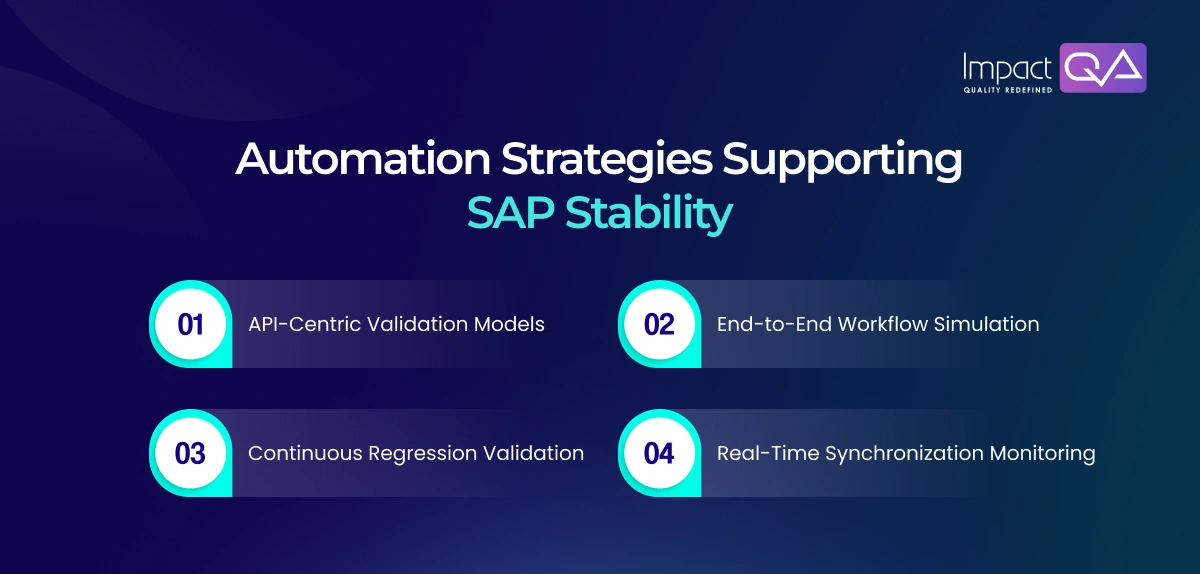
Advanced Automation Strategies Supporting SAP Stability
API-Centric Validation Models
Modern enterprise systems rely heavily on APIs for transactional communication. Automated API validation helps identify unstable endpoints, delayed responses, payload inconsistencies, and communication breakdowns before deployment.
End-to-End Workflow Simulation
Automation frameworks simulate real business operations across interconnected enterprise systems. This helps organizations validate workflow continuity under production-like operational conditions.
Continuous Regression Validation
Frequent SAP updates can unintentionally affect connected workflows. Structured SAP regression testing services continuously validate integration stability during release cycles and infrastructure changes.
Real-Time Synchronization Monitoring
Automation-driven testing frameworks continuously monitor transactional behavior, synchronization timing, and middleware communication across enterprise ecosystems.
Operational Advantages of SAP Integration Testing Services
Organizations investing heavily in SAP modernization expect stable workflows, uninterrupted operations, and consistent communication across interconnected enterprise systems. However, these outcomes become difficult to achieve when integrations remain insufficiently validated. SAP integration testing services help enterprises identify critical workflow and synchronization issues before they affect operational performance. As organizations expand APIs, middleware, cloud platforms, and third-party applications, integration reliability becomes essential for maintaining workflow continuity and operational scalability across connected enterprise environments.
Business Benefits Enterprises Commonly Achieve
Reduced Operational Downtime
Integration testing identifies workflow disruptions and synchronization failures before deployment. This reduces the probability of production-level operational interruptions across critical enterprise business functions.
Improved Data Consistency
Continuous workflow validation strengthens synchronization accuracy across procurement, finance, warehouse, reporting, and interconnected enterprise systems. It also minimizes risks associated with fragmented or inconsistent transactional data movement.
Better Enterprise Scalability
Reliable integrations allow organizations to expand cloud infrastructures, APIs, middleware environments, and operational ecosystems with stronger confidence. At the same time, enterprises can maintain stable workflow synchronization and enterprise-wide operational continuity.
Stronger API and Middleware Stability
SAP integration testing services validate API behavior, middleware communication, and cross-platform transaction flows under varying operational conditions. This improves interoperability across connected enterprise applications and reduces integration failure risks.
Improved Regression Validation Efficiency
Automated regression validation helps enterprises assess the impact of configuration changes, SAP updates, and integration modifications across dependent business workflows. This improves release predictability and reduces validation complexity during large-scale deployments.
ImpactQA delivers automation-driven validation that improves integration stability and reduces operational risk.
Best Practices for Building Reliable SAP Workflows
Successful enterprise integration testing requires far more than executing predefined test cases before deployment. Organizations must adopt continuous validation strategies capable of monitoring workflow dependencies, transactional behavior, synchronization timing, and API communication throughout the software lifecycle.
One of the most effective approaches involves prioritizing business-critical workflows rather than validating isolated applications independently. Enterprise systems operate through interconnected processes where procurement, finance, inventory, reporting, and customer management continuously exchange operational data. Testing these workflows collectively provides better visibility into hidden transactional dependencies.
Another important practice involves integrating automation early within enterprise delivery pipelines. Continuous validation helps businesses identify workflow disruptions faster while improving release confidence during SAP upgrades, cloud deployments, and infrastructure modernization initiatives.
Validate Real Operational Scenarios
Testing environments should simulate production-level workflows, transaction spikes, and enterprise dependencies instead of relying only on isolated functional scripts.
Strengthen Workflow Monitoring
Organizations should continuously monitor synchronization timing, API communication behavior, and middleware stability across enterprise systems.
Adopt Continuous Regression Validation
Frequent SAP modifications can unintentionally affect connected workflows. Continuous SAP regression testing services improve operational predictability during release cycles.
Integrate Intelligent Automation
Enterprises managing distributed infrastructures increasingly rely on SAP automated testing tools to improve testing scalability and workflow visibility.
Final Thought
SAP-driven enterprises now operate in tightly interwoven environments where system behavior is defined by continuous data exchange rather than isolated processing. As workflows extend across modules, interfaces, and external applications, even subtle inconsistencies can escalate into operational slowdowns and execution gaps. This shift has made structured validation through SAP testing services and SAP QA testing services essential for sustaining predictable enterprise performance across evolving systems.
In this context, ImpactQA delivers specialized SAP integration testing services and SAP test automation services designed to strengthen validation depth across enterprise workflows. Through structured SAP test strategy services and scalable execution models, it helps organizations improve reliability, streamline release cycles, and maintain consistency across complex SAP ecosystems.
Share this post


Related Posts
Our Case Studies