Quick Summary:
Many organizations struggle to maintain software quality as applications become more interconnected and testing complexity increases. The answer is not choosing between manual testing and AI but combining their strengths. This blog explores how quality engineering has progressed through this balanced approach, helping teams improve business validation, testing efficiency, and software reliability.
Table of Contents:
- Introduction
- Why Manual Testing Continues to Shape Modern Quality Engineering
- How AI Is Transforming Testing Without Replacing Human Expertise
- Building a Balanced Quality Engineering Strategy
- Final Thought
- FAQs
Every major technology shift brings the same prediction that the previous generation of practices will soon become obsolete. Software testing has been no exception. As artificial intelligence becomes deeply embedded in quality engineering, many assume manual testing is steadily losing relevance. The reality inside enterprise environments tells a very different story. Faster execution does not automatically translate into better software, especially when applications support complex business operations, interconnected platforms, and customer experiences where context matters as much as code.
This is precisely where modern quality engineering has evolved. AI has transformed the way testing teams analyze risks, prioritize execution, and maintain automation. Yet, the responsibility of validating business intent, interpreting user behaviour, and questioning unexpected system responses still belongs to skilled testers. Organizations are no longer deciding between manual testing and AI. They are combining intelligent automation with human judgment to build resilient, scalable, and business-focused quality engineering strategies that keep pace with today’s digital ecosystems.
ImpactQA combines AI-driven quality engineering with expert manual testing to help enterprises test smarter.
Why Manual Testing Continues to Shape Modern Quality Engineering
Artificial intelligence has introduced remarkable efficiencies into software testing, yet software quality cannot be measured by execution speed or automation coverage alone. Enterprise applications support interconnected business processes, regulatory requirements, customer interactions, and operational workflows that demand human interpretation. This is why manual testing remains a strategic discipline within modern quality engineering rather than a legacy activity.
Manual software testing services allow teams to validate software from a business perspective instead of simply confirming predefined outcomes. Experienced testers assess application behaviour under realistic operating conditions, investigate usability concerns, challenge workflow consistency, and evaluate scenarios that scripted automation may never encounter. As enterprise systems become increasingly integrated, this analytical approach becomes even more valuable.
Several capabilities continue to demonstrate the long-term value of manual testing. Together, these capabilities demonstrate why manual testing services continue to provide business assurance that extends well beyond functional verification.
Business Workflow Validation
Enterprise applications involve multi-step business processes, conditional logic, financial calculations, and exception handling. Manual functional testing services validate complete business journeys, confirming that processes function accurately across interconnected systems instead of isolated transactions.
Investigative Defect Discovery
Not every software defect follows a predictable pattern. Exploratory testing services encourage adaptive investigation. This allows testers to uncover hidden issues, inconsistent behaviors, and undocumented risks beyond predefined test cases.
Interface and Service Validation
Modern applications exchange significant volumes of information through APIs and connected services. Manual API testing services provide deeper visibility into request structures, response accuracy, authentication mechanisms, data integrity, and exception handling before automation suites mature.
How AI Is Transforming Testing Without Replacing Human Expertise
Artificial intelligence has significantly expanded the capabilities of quality engineering. Rather than spending valuable effort on repetitive validation, organizations increasingly use AI to analyze application changes, generate test scenarios, predict defect-prone modules, and optimize execution priorities. This improves operational efficiency while allowing testing professionals to focus on activities that require business understanding and engineering judgment.
As a result, the relationship between manual testing and automation testing has become increasingly complementary. Automation consistently validates repetitive regression scenarios, while AI strengthens execution intelligence, script maintenance, and defect analysis. Human testers continue validating business outcomes, interpreting evolving requirements, and investigating unpredictable user behaviour that extends beyond algorithmic decision-making.
Several developments illustrate this collaborative model.
Intelligent Test Prioritization
AI evaluates historical defects, production trends, and application changes to identify the areas that require immediate testing attention. This helps teams allocate resources more effectively.
Predictive Defect Analysis
Machine learning models recognize recurring defect patterns and identify application components with a higher probability of failure before production deployment.
Smarter Regression Maintenance
AI reduces the effort required to update automation scripts after application changes, making regression suites more sustainable as software evolves.
Building A Balanced Quality Engineering Strategy
Organizations often invest heavily in automation, expecting it to eliminate manual effort. Sustainable quality engineering, however, depends on assigning testing responsibilities according to business value rather than technological preference. High-performing engineering teams recognize that automation, AI, and manual testing each address different dimensions of software quality.
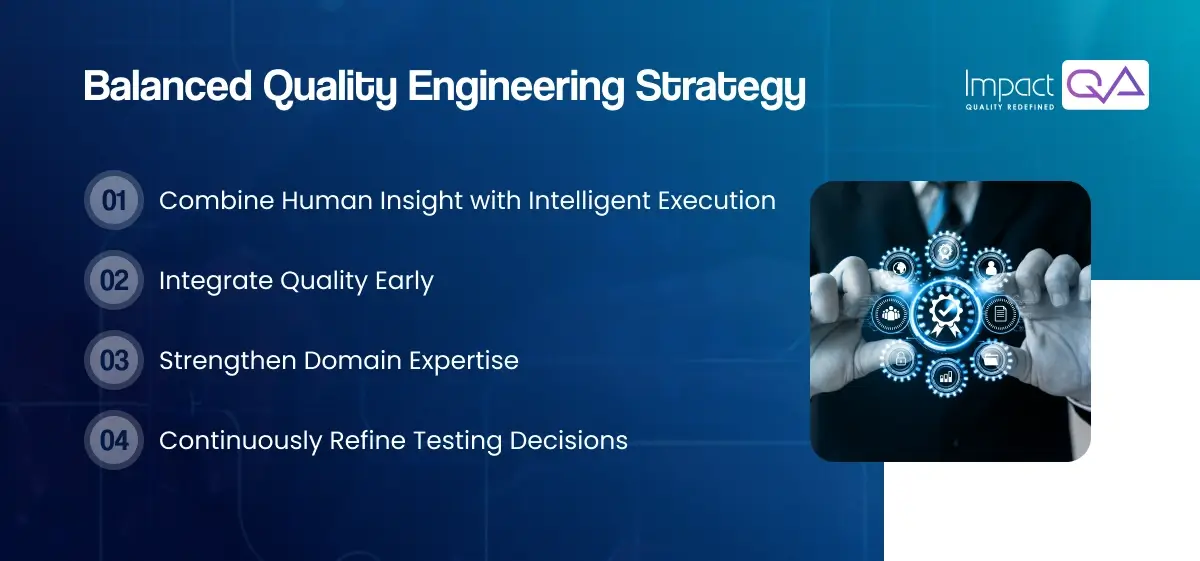
Several practices consistently strengthen long-term testing maturity:
Combine Human Insight with Intelligent Execution
Automation efficiently validates repetitive scenarios, while manual QA testing services evaluate usability, business logic, accessibility, and unexpected application behaviour that cannot always be anticipated during script development.
Integrate Quality Early
Testing should begin alongside requirement analysis and continue throughout development. Early validation reduces downstream defects, shortens remediation cycles, and strengthens collaboration across business, development, and QA teams.
Strengthen Domain Expertise
Applications supporting banking, healthcare, manufacturing, energy, and retail require testing teams with industry knowledge as well as technical expertise. This combination improves validation accuracy and supports better business outcomes.
Continuously Refine Testing Decisions
AI recommendations should complement engineering judgment rather than replace it. Human validation remains essential for confirming business accuracy, operational readiness, and production reliability before deployment.
Organizations searching for the best manual testing services increasingly recognize that quality engineering is not measured by the number of automated scripts. It is defined by the ability to validate technical performance, business processes, and customer expectations through a unified testing strategy. Choosing an experienced manual testing service provider, therefore, becomes a strategic investment in long-term software reliability.
Our AI-powered quality engineering and manual testing services help enterprises deliver dependable software faster.
Final Thought
The conversation around software testing has gradually shifted from manual versus AI to manual with AI, and for good reason. Sustainable software quality depends on both. AI improves testing efficiency, while manual testing brings business context, technical judgement, and domain expertise to software validation. Together, they create a balanced quality engineering strategy for modern enterprise applications.
At ImpactQA, we combine AI-powered quality engineering with specialized manual testing services to address complex enterprise testing challenges. Our expertise covers functional testing, exploratory testing, API testing, intelligent automation, and domain-led QA. We build practical testing strategies that improve software quality, simplify testing operations, and support business-critical applications across every stage of the software lifecycle.
Frequently Asked Questions (FAQs)
Share this post


Related Posts
Our Case Studies