Designing a Scalable Manual Testing Strategy for Enterprise Applications

Quick Summary:
Designing a scalable approach to manual testing is critical for enterprises managing complex applications and frequent releases. Without a structured strategy, manual testing often becomes fragmented, leading to inconsistent coverage, redundant effort, and missed defects across release cycles. This article explains how to build an effective manual software testing framework, address scaling challenges, and align testing efforts with enterprise goals while maintaining quality across large systems and distributed teams.
Table of Contents:
- Introduction
- Foundations of a Scalable Manual Testing Strategy
- Key Challenges in Scaling Manual Testing for Enterprises
- Structuring an Enterprise-Grade Manual Testing Framework
- Best Practices to Strengthen Manual Testing Outcomes
- Conclusion
Enterprise applications operate across interconnected systems, handling large volumes of data and business-critical workflows. In such environments, manual testing in software testing continues to play a significant role despite the rise of automation. While automation addresses repetitive validation, manual testing remains essential for validating complex user journeys, exploratory scenarios, and business logic that require human judgment. This makes it necessary for enterprises to design a structured and scalable approach rather than relying on ad hoc testing efforts.
Scaling manual software testing is not about increasing team size alone. It requires a well-defined strategy that aligns with release cycles, system complexity, and organizational goals. Without this structure, testing efforts become inconsistent, leading to gaps in coverage and increased production risks. A robust framework ensures that manual testing in software testing adapts to growing application demands while maintaining accuracy, traceability, and efficiency across teams and geographies.
ImpactQA’s expertise in manual testing in software testing ensures consistent and reliable outcomes.
Foundations of a Scalable Manual Testing Strategy
A scalable manual testing strategy begins with clarity in scope and objectives. Enterprises must first identify which areas require manual validation and why. Not every test case should be automated, especially those involving complex workflows, usability validation, or unpredictable user interactions. This is where manual software testing proves indispensable, offering flexibility and deeper insight into application behavior.
To build a strong foundation, organizations should focus on the following components:
Clear Test Scope Definition
A defined scope ensures that manual testing in software testing is applied where it delivers the most value. This includes business-critical workflows, UI validation, and edge-case scenarios that automation may not fully capture.
Standardized Test Design
Consistency in test case creation is essential. Well-documented test scenarios enable teams to execute manual software testing services efficiently across multiple releases. Standard templates and guidelines reduce ambiguity and improve collaboration.
Skilled Resource Allocation
The effectiveness of manual testing depends on the expertise of testers. A skilled manual QA tester understands business logic, identifies hidden defects, and adapts testing approaches based on application behavior.
Controlled Test Environment
Reliable environments ensure accurate results. Without proper configuration, manual testing in software testing may produce inconsistent outcomes, affecting decision-making during releases.
Supporting Tools and Documentation
Although manual processes rely on human intervention, the use of manual software testing tools such as test management platforms improves traceability, reporting, and collaboration across teams.
By establishing these foundational elements, enterprises can ensure that manual software testing scales in a structured and controlled manner rather than becoming fragmented across projects.
Key Challenges in Scaling Manual Testing for Enterprises
As organizations expand their digital systems, scaling manual testing introduces several operational and strategic challenges. These challenges must be addressed proactively to maintain efficiency and quality.
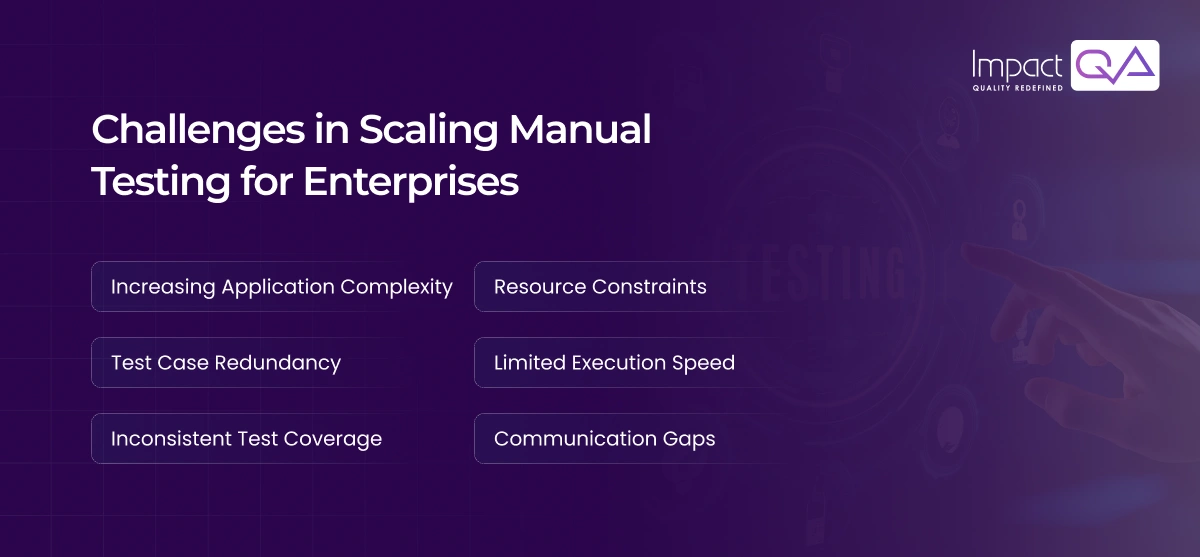
Increasing Application Complexity
Enterprise systems often integrate multiple platforms, APIs, and third-party services. This complexity makes manual software testing more demanding, requiring testers to understand interconnected workflows and dependencies.
Resource Constraints
Scaling manual testing often leads to increased demand for skilled testers. However, hiring and training resources take time, and inconsistent skill levels can impact testing outcomes.
Test Case Redundancy
Without proper management, test cases can become repetitive and outdated. This reduces the effectiveness of manual software testing services, leading to wasted effort and missed defects.
Limited Execution Speed
Unlike automation, manual testing requires human execution, which can slow down release cycles. Enterprises must balance speed with thorough validation to avoid compromising quality.
Inconsistent Test Coverage
When teams operate across regions, maintaining uniform testing standards becomes challenging. Variations in execution approaches can create gaps in manual testing in software testing, increasing the risk of production issues.
Communication Gaps
Large teams often struggle with coordination. Misalignment between developers, testers, and stakeholders can affect the accuracy of manual software testing efforts and delay issue resolution.
Structuring an Enterprise-Grade Manual Testing Framework
To scale effectively, enterprises must design a framework that supports consistency, traceability, and adaptability. A well-structured framework transforms manual testing from a reactive activity into a strategic function.
Modular Test Design
Breaking test cases into reusable modules improves efficiency. This approach ensures that manual software testing can adapt quickly to changes without requiring complete rework.
Risk-Based Testing Approach
Prioritizing high-impact areas ensures optimal use of resources. By focusing on critical workflows, manual testing in software testing delivers maximum value with limited effort.
Centralized Test Management
Sr. No. |
Component |
Purpose |
| 1. | Test Repository | Stores all test cases for consistency and reuse |
| 2. | Execution Tracking | Monitors progress and identifies bottlenecks |
| 3. | Defect Management | Ensures proper logging and resolution of issues |
| 4. | Reporting Dashboard | Provides visibility into testing performance |
Centralized systems improve the effectiveness of manual software testing services by enabling better coordination and visibility.
Integration with Development Cycles
Aligning manual testing with development timelines ensures timely validation. Continuous collaboration between teams reduces delays and improves release confidence.
Scalable Workforce Model
Enterprises should adopt flexible staffing strategies, combining in-house teams with external manual QA testing services when needed. This ensures scalability without overburdening internal resources.
Knowledge Management
Documenting test scenarios, outcomes, and lessons learned strengthens manual software testing practices over time. This reduces dependency on individual expertise and ensures continuity.
Best Practices to Strengthen Manual Testing Outcomes
A scalable strategy must be supported by best practices that ensure consistency and continuous improvement. These practices help organizations maximize the value of manual testing across enterprise applications.
Focus on Exploratory Testing
Exploratory approaches allow testers to uncover unexpected defects. This enhances the depth of manual software testing beyond predefined test cases.
Maintain Updated Test Cases
Regular updates ensure relevance. Outdated test cases reduce the effectiveness of manual testing in software testing, leading to gaps in validation.
Encourage Cross-Functional Collaboration
Close coordination between teams improves understanding of requirements and reduces miscommunication during the execution of manual software testing services.
Use Data-Driven Testing
Incorporating real-world data scenarios improves accuracy. This strengthens the reliability of manual testing outcomes and aligns them with actual user behavior.
Continuous Skill Development
Training programs ensure that testers stay updated with new technologies and methodologies. Skilled teams improve the efficiency of manual software testing.
Balance Manual and Automated Testing
While manual approaches are critical, integrating them with automation ensures optimal coverage. This hybrid approach strengthens manual testing in software testing without compromising speed.
Performance Monitoring
Tracking metrics such as defect detection rate, test coverage, and execution efficiency helps improve manual software testing services over time and enables more informed decision-making across release cycles.
Adoption of Tailored Solutions
Enterprises can benefit from specialized manual QA testing solutions that address specific industry requirements, system complexities, and unique business workflows for more accurate and relevant validation.
By following these practices, organizations can ensure that manual testing remains effective, even as application environments grow in scale and complexity.
ImpactQA combines skilled testers with proven manual testing strategies to support scalable quality assurance.
Conclusion
A scalable approach to manual testing is essential for enterprises aiming to maintain quality across complex systems. While automation continues to expand, manual software testing provides the depth and adaptability required for validating critical workflows and user experiences. A structured strategy ensures that testing efforts remain consistent, efficient, and aligned with business goals, even as applications grow in size and complexity.
Organizations looking to strengthen their testing capabilities can benefit from specialized manual software testing services that combine domain expertise with structured methodologies. ImpactQA offers comprehensive solutions designed to address enterprise-scale challenges and ensure thorough validation across applications. Our approach to manual testing in software testing focuses on accuracy, scalability, and business alignment to help enterprises reduce risk and maintain reliable system performance.
Share this post


Related Posts
Our Case Studies