
Quick Summary:
Hiring a manual testing service provider is a different exercise than approving an automation vendor, and treating the two the same is how weak providers slip through. This checklist covers 7 things worth confirming about manual software testing services before signing anyone: certification, domain depth, exploratory skill, reporting quality, hybrid integration, engagement flexibility, and coverage across API and compatibility testing.
Table of Contents:
- Introduction
- Why Manual Testing Is Still Relevant (And Always Will Be)
- 7 Things to Look for Before Hiring a Manual Testing Service Provider
- Manual Testing and Automation Testing: Where Each One Actually Fits
- Final Say
- Frequently Asked Questions
A checkout flow can pass every scripted assertion and still confuse a real user within the first thirty seconds. That gap, between a script that runs clean and software that actually makes sense to a person, is the entire case for manual testing services.
Choosing who does that work matters more than most buyers treat it. Strong automation credentials tell you something about tooling. They tell you less about exploratory investigation, domain-specific business logic, or the quality of defect evidence your development team receives.
A useful hiring process therefore needs more than a service list. It needs proof.
These seven checks help you examine the people assigned to the work, the way they investigate software, the scope they can cover, and how well their findings connect with the rest of your QA process.
Why Manual Testing Is Still Relevant (And Always Will Be)
Manual testing remains important because software behaviour still needs human interpretation.
That distinction has grown even more pronounced as applications have gotten more complex. Recommendation engines, adaptive workflows, and AI-driven features now produce outcomes that shift across environments and sessions, the kind of behavior a fixed assertion was never built to evaluate. Regulated industries add another layer. A failed test tells a team something broke. It rarely explains why the failure matters to the business, and auditors tend to ask for the second part.
Manual QA testing services fill that gap directly. A tester investigating a workflow in real time catches logic gaps, usability friction, and edge cases that only show up when someone is genuinely trying to break the thing, not just execute a predefined path. Our article on why manual testing still matters in an AI world covers this shift in more depth. Automation and manual testing answer genuinely different questions, and a provider worth hiring should be able to say clearly which question each one answers.
7 Things to Look for Before Hiring a Manual Testing Service Provider
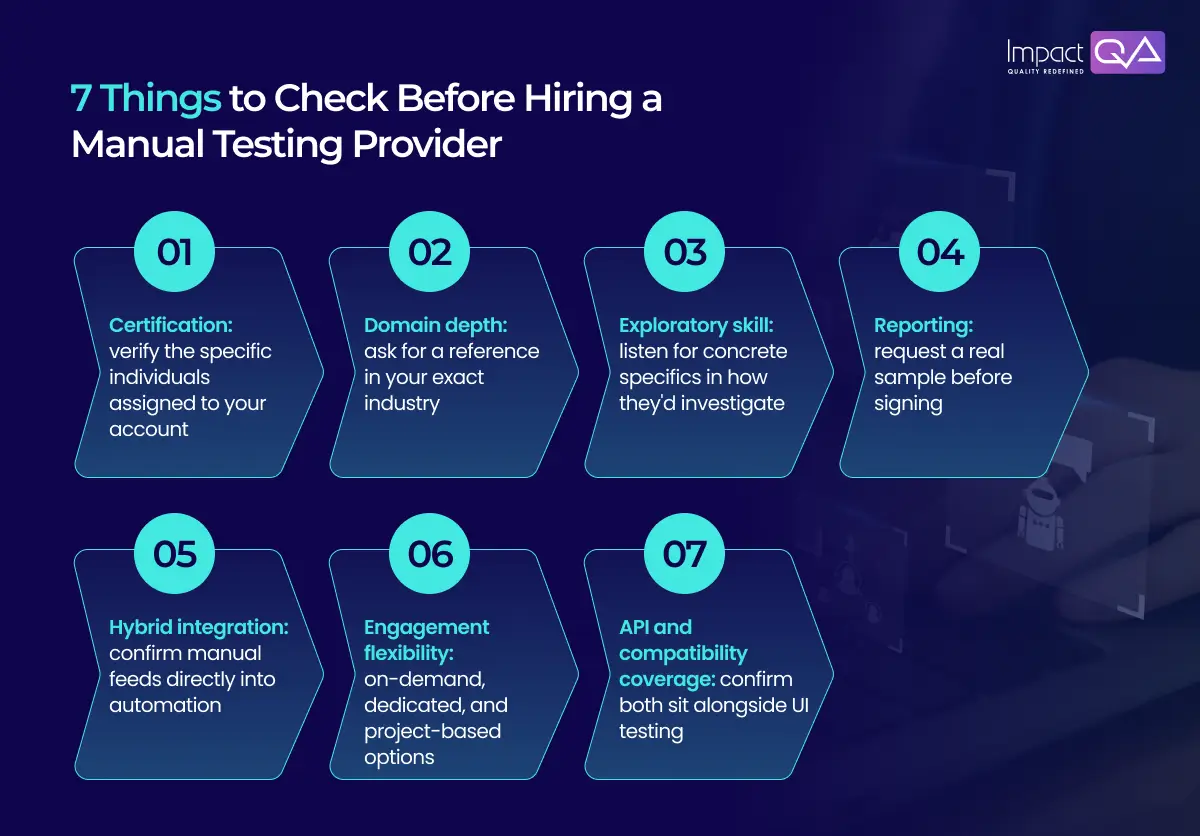
A capable manual testing service provider should demonstrate tester expertise, industry understanding, exploratory ability, clear reporting, hybrid QA integration, flexible engagement options, and broader coverage across APIs, browsers, and devices.
These seven checks give buyers concrete evidence to evaluate before the first testing cycle begins.
Checklist #1: Genuine Certification, Not Just a Claim on the Website
ISTQB and Agile Testing certification shows that a tester has completed structured methodology training. The more useful question is who on your account actually holds those credentials.
Ask for the certifications of the engineers assigned to your project. A company-wide percentage can look impressive while providing little insight into the team doing your testing.
Also look at experience alongside certification. A qualified tester with strong project exposure can bring more practical value than a credential viewed in isolation.
Checklist #2: Domain Depth in Your Specific Industry
Industry context changes how a tester interprets defects.
A healthcare application may involve regulated health data, access controls, consent flows, and privacy-sensitive workflows. In BFSI, transaction integrity, authorization, reconciliation, and fraud-related scenarios can shape the test strategy. Energy systems bring their own business processes and dependencies.
A tester can execute a functional flow correctly and still miss a business-risk scenario without the right context.
Ask for a project reference in your industry. Then ask what domain-specific scenarios the team tested. The answer should show practical familiarity, rather than a list of industries on a corporate website
Checklist #3: Real Exploratory Testing Skill, Demonstrated
Exploratory testing services depend heavily on tester judgment.
Give a candidate provider an unfamiliar application and ask how the tester would approach it before formal test cases exist. Listen for specifics.
Which workflows would they examine first? What assumptions would they challenge? How would they probe edge cases, unexpected inputs, permissions, error states, or unusual user paths?
A specific description of how they’d probe edge cases and unusual user paths is what genuine skill sounds like, the same kind of investigation we have broken down in why manual testing still matters for UX.
Checklist #4: Structured, Traceable Reporting
Good defect reporting saves time after the test itself is over.
A report that says “checkout failed” leaves the development team searching for context. A useful report identifies the exact scenario, expected behaviour, actual behaviour, environment, evidence, severity, and relevant business impact.
Ask to see a real sample report before signing. Check how clearly another team could reproduce the issue from the information provided.
Reporting quality also matters for audit trails, release decisions, trend analysis, and conversations between QA, engineering, product, and business teams.
Checklist #5: Manual and Automation Working Together, Not Siloed
Manual functional testing services and automation can strengthen each other when findings flow between them.
A tester may discover a recurring edge case during exploratory work. That scenario could become an automated regression check once the behaviour stabilizes. Automation results can also point manual testers toward areas that deserve deeper investigation.
Look at how the provider connects manual QA with CI/CD, test management, defect tracking, and regression workflows. The goal is a testing process where human investigation generates useful automation candidates and automated results inform the next round of investigation.
Checklist #6: Flexible Engagement Models
Testing requirements change with product maturity, release schedules, and business priorities.
A short sprint may call for on-demand support. A major enterprise platform may require a dedicated team. A large release or migration may need project-based coverage for a defined period.
The engagement model should fit the testing workload, communication needs, release cadence, and expected level of continuity.
Ask how the provider handles changes in scope. You should know how additional testers, specialist coverage, or a temporary increase in testing capacity would be handled before the need appears.
Checklist #7: Coverage Across API and Compatibility Testing
UI testing covers only part of the application surface.
Manual API testing services can examine request-response logic, authentication behaviour, validation, error handling, data accuracy, and integration scenarios that remain outside a typical UI workflow. Compatibility testing services add another layer by checking how the application behaves across the devices, browsers, and operating systems used by real customers.
Ask for the provider’s coverage matrix. It should show where manual API testing, UI testing, browser coverage, device coverage, and compatibility testing fit into the overall engagement.
Manual Testing and Automation Testing: Where Each One Actually Fits
Manual testing and automation testing get pitted against each other constantly, and the framing misses the point. They’re built for different kinds of validation.
Question Being Answered |
Manual Testing |
Automation Testing |
| Does this behave the way a real user expects? | Strong fit | Weak fit |
| Does this still work after 500 regression runs? | Weak fir | Strong fit |
| Can this handle an input nobody scripted for? | Strong fit | Weak fit |
| Does this scale across thousands of test cycles? | Weak fit | Strong fit |
| Does this make genuine business sense? | Strong fit | Weak fit |
A mature QA strategy runs both, each aimed squarely at the questions it actually answers. Our breakdown of manual testing use cases automation can’t replace walks through this split in more detail.
Final Say
The best manual testing services are built around people who can investigate software with context, discipline, and curiosity.
Before signing with a manual testing service provider, verify the credentials of the assigned team, examine its domain experience, and test its exploratory thinking. Then look at the evidence around reporting, integration, engagement models, API coverage, and compatibility testing.
One final check matters just as much: ask how the provider would adapt its testing approach when your product, release cycle, or risk profile changes.


