Building an AI-Based Automation Testing Framework for SaaS Platforms

Quick Summary:
AI-driven automation is redefining SaaS testing by enabling intelligent systems to adapt to rapid releases, dynamic architectures, and evolving user behavior. This blog presents a structured approach to building AI-led frameworks, covering core architecture, implementation challenges, and scaling strategies. It further connects AI in Performance with AI in Quality Engineering to establish resilient, self-improving testing ecosystems for modern cloud-native applications.
Table of Contents:
- Introduction
- Core Architecture of an AI-Based Automation Testing Framework
- Key Challenges in Implementing AI-Driven Testing
- Strategic Benefits and Business Impact
- Best Practices for Scaling AI-Driven Test Automation
- Conclusion
SaaS platforms operate in environments defined by continuous releases, multi-tenant architectures, and deeply connected integrations that demand constant validation. Each update introduces new dependencies, making even small inconsistencies capable of affecting performance, data flow, and user experience. In such conditions, testing must evolve into a continuously adaptive function that can validate complex workflows with accuracy while keeping pace with rapid change.
At the same time, the rise of autonomous testing and agentic AI in quality engineering is transforming testing into an intelligent, decision-driven process. Instead of relying on predefined scripts, frameworks now analyze production data, identify risk-prone areas, and generate meaningful test scenarios. When combined with AI in Performance and AI in Quality Engineering, organizations can move from reactive defect detection to predictive quality assurance. This transition is not incremental; it represents a structural change in how SaaS applications are validated at scale.
ImpactQA integrates advanced AI into your testing strategy for scalable outcomes.
Core Architecture of an AI-Based Automation Testing Framework
Designing a scalable framework for SaaS platforms requires a layered approach where intelligence is embedded across the testing lifecycle. AI-based test automation acceleration plays a central role in reducing script dependency and introducing adaptive execution models.
At the foundation lies a data ingestion layer that collects inputs from production logs, user behavior analytics, and historical test runs. This data becomes the training ground for AI models. Unlike static frameworks, this layer continuously feeds insights into the system, ensuring that testing evolves alongside application changes.
Next is the intelligence layer, where agentic AI in quality engineering operates. These AI agents are designed to perform specific tasks such as:
- Test Case Generation: AI models analyze user journeys and automatically generate test cases aligned with real-world usage patterns. This reduces dependency on manual test design.
- Self-Healing Mechanisms: When UI elements or APIs change, the framework adapts by identifying alternative locators or endpoints, minimizing test failures caused by minor changes.
- Risk-Based Prioritization: By analyzing defect history and code changes, the system prioritizes high-risk areas, ensuring efficient execution cycles.
The execution layer integrates autonomous testing, where tests run with minimal human intervention. This layer supports dynamic scheduling, parallel execution, and intelligent reruns based on failure patterns. It ensures that testing pipelines align with CI/CD workflows without becoming bottlenecks.
Another critical component is the performance intelligence module, which leverages AI in Performance and AI in performance testing. Instead of predefined load scenarios, AI predicts traffic spikes, identifies bottlenecks, and simulates real user behavior. This approach aligns closely with generative AI in performance testing, where new test scenarios are created dynamically based on system usage trends.
Finally, the feedback loop ensures continuous learning. Results from execution feed back into the system, refining models and improving accuracy. This is where AI in Quality Engineering becomes impactful, as it connects insights across functional, regression, and performance testing.
To summarize the architecture:
Sr. No. |
Layer |
Function |
| 1. | Data Layer | Collects logs, user data, and execution history |
| 2. | Intelligence Layer | Enables agentic AI decisions and test generation |
| 3. | Execution Layer | Drives Autonomous Testing workflows |
| 4. | Performance Layer | Applies AI in Performance for predictive analysis |
| 5. | Feedback Loop | Continuously improves test accuracy |
Key Challenges in Implementing AI-Driven Testing
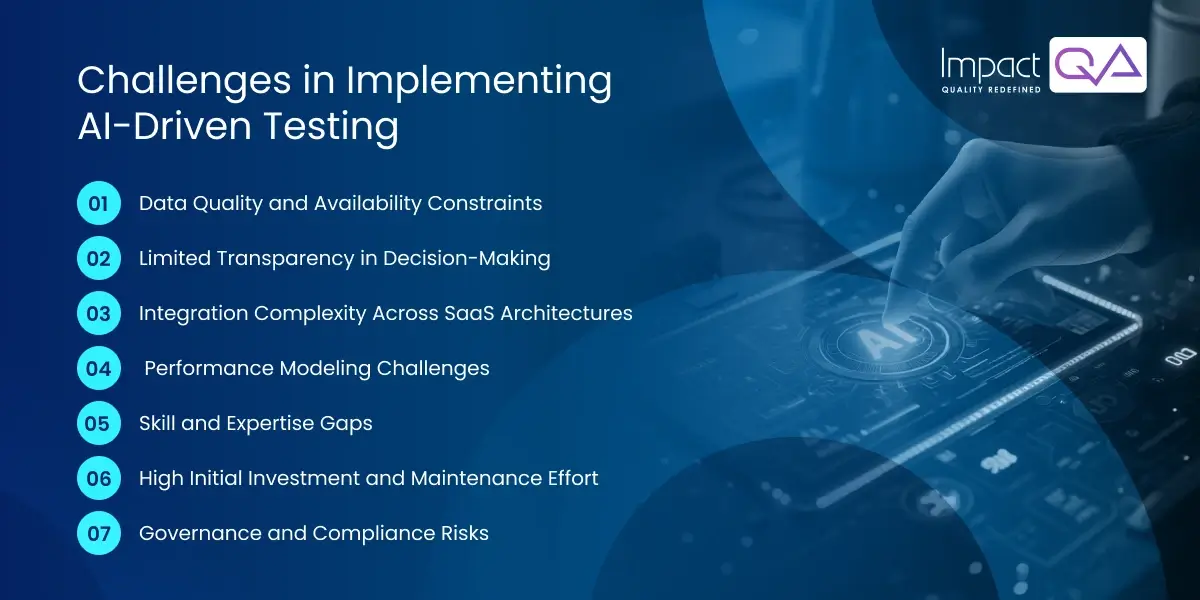
Implementing AI-led testing frameworks within SaaS ecosystems introduces structural and operational complexities that extend beyond traditional automation. These challenges often arise from integrating intelligent systems into distributed architectures while ensuring consistency, accuracy, and governance across testing workflows.
Data Quality and Availability Constraints
AI models rely on historical execution data, user behavior patterns, and system logs. In many organizations, this data is fragmented or inconsistent, leading to inaccurate predictions and reduced reliability of test outcomes.
Limited Transparency in Decision-Making
When systems driven by agentic AI in quality engineering make autonomous decisions, teams often require clarity on how those decisions are derived. A lack of interpretability can slow adoption and create resistance among stakeholders.
Integration Complexity Across SaaS Architectures
SaaS platforms involve multiple microservices, APIs, and third-party integrations. Embedding AI in Quality Engineering across such distributed environments requires alignment with CI/CD pipelines and existing automation layers.
Performance Modeling Challenges
While AI in Performance introduces predictive capabilities, it also demands accurate model tuning. Poorly trained models can generate unrealistic load conditions, leading to incorrect performance insights.
Skill and Expertise Gaps
Implementing AI-based test automation acceleration requires knowledge of data engineering, machine learning, and advanced automation frameworks. Many teams lack this combination of skills.
High Initial Investment and Maintenance Effort
Developing intelligent testing frameworks involves infrastructure setup, tool integration, and continuous model retraining. These factors increase upfront and operational costs.
Governance and Compliance Risks
AI-driven testing must align with security standards and regulatory requirements, especially when handling sensitive SaaS data across environments.
Strategic Benefits and Business Impact
AI-driven testing frameworks redefine how quality contributes to business outcomes within SaaS ecosystems. Rather than focusing only on execution efficiency, these systems embed intelligence into decision-making, enabling precise risk targeting, continuous validation visibility, and faster issue resolution. The result is a more controlled release cycle, reduced production exposure, and a testing function that directly supports system reliability, scalability, and business continuity.
The following capabilities highlight how this intelligence translates into measurable impact across testing and release processes:
Risk-Aware Test Execution: AI-based test automation acceleration enables systems to identify high-risk modules based on code changes, defect history, and usage patterns. This ensures that critical areas are always validated first, reducing the chances of high-impact failures in production.
Continuous Quality Visibility Across Releases: AI in Quality Engineering provides real-time insights into application health, defect trends, and test effectiveness. This visibility allows stakeholders to make informed release decisions without relying on fragmented reports.
Adaptive Test Coverage Aligned with User Behavior: Instead of relying on static test suites, frameworks dynamically adjust coverage based on actual user journeys. This ensures that testing remains relevant as SaaS applications evolve.
Early Detection of System Instability Patterns: By analyzing execution data over time, AI models identify recurring instability signals such as intermittent failures or performance degradation. This allows teams to address issues before they escalate.
Precision in Performance Validation: AI in Performance shifts testing from generic load simulation to context-aware modeling. Systems can replicate real traffic behavior, enabling accurate identification of bottlenecks and capacity limits.
Reduction in False Positives and Noise: Autonomous testing filters out non-critical failures by analyzing patterns across executions. This helps teams focus only on genuine defects, improving productivity, and reducing investigation time.
Faster Recovery and Root Cause Identification: Intelligent systems correlate failures with recent changes in code, infrastructure, or configurations. This accelerates debugging and reduces mean time to resolution.
Scalable Quality Engineering Across Multi-Tenant Systems: SaaS platforms often operate across multiple tenants with varying configurations. AI in Quality Engineering enables consistent validation across these environments without duplicating effort.
ImpactQA enables predictive testing and continuous validation for modern SaaS platforms.
Best Practices for Scaling AI-Driven Test Automation
Scaling AI-driven testing frameworks requires a structured and disciplined approach to ensure long-term success. Organizations must align implementation strategies with business goals while maintaining flexibility to adapt to changing requirements.
Adopt a Phased Implementation Approach: Begin by integrating autonomous testing into specific workflows such as regression or performance testing. Gradual adoption reduces risk and allows teams to validate effectiveness before scaling.
Prioritize Data Readiness and Management: High-quality data is critical for AI accuracy. Establish centralized data pipelines to support consistent and reliable model training.
Design Modular and Scalable Frameworks: A modular architecture allows independent components to evolve without disrupting the entire system, improving flexibility and maintainability.
Integrate with CI/CD Pipelines: Seamless integration ensures that AI-driven testing aligns with continuous delivery processes, preventing bottlenecks from releasing cycles.
Establish Governance and Control Mechanisms: Define clear rules and validation checkpoints for AI-driven decisions to maintain compliance and accountability.
Continuously Monitor and Retrain Models: AI systems require regular updates to remain effective. Continuous monitoring ensures that models adapt to application changes.
Balance AI with Human Oversight: While autonomous testing reduces manual effort, human expertise remains essential for validating complex scenarios and refining strategies.
Leverage the Right Tools and Technologies: Selecting appropriate autonomous software testing tools ensures compatibility, scalability, and long-term efficiency.
Conclusion
Building an intelligent testing framework for SaaS platforms requires more than automation. It demands systems that learn, adapt, and make informed decisions. By combining AI-based test automation acceleration, autonomous testing, and agentic AI in quality engineering, organizations can create resilient testing ecosystems that align with continuous delivery models. The integration of AI in Performance and AI in Quality Engineering ensures that both functionality and scalability are validated with precision.
For enterprises looking to implement such advanced frameworks, partnering with the right service provider becomes critical. As one of the best test automation service providers, ImpactQA delivers AI-driven testing solutions tailored for complex SaaS environments. Our expertise in intelligent automation, performance validation, and quality engineering enables organizations to reduce risk and achieve consistent application reliability at scale.
Share this post


Related Posts
Our Case Studies