
Digital transformation has reshaped the way software is built, tested, and delivered. Frequent, incremental updates have become the standard, replacing significant, infrequent releases that can no longer meet the evolving expectations of users for speed and functionality. As a result, development and QA teams face mounting pressure to deliver high-quality applications within compressed timelines.
Traditional testing models, built on linear, phase-driven workflows, often struggle to keep pace with this accelerated demand. In response, Agile methodologies have introduced flexibility through short iterations and continuous improvement. DevOps complements this by automating processes and ensuring seamless coordination across development, testing, and operations.
Together, these approaches support a unified delivery model that is fast, reliable, and scalable. Integrating DevOps with Agile testing helps teams detect issues early, reduce manual overhead, and maintain consistent quality as systems scale.
This blog explores the key benefits of integrating DevOps and Agile testing, highlighting why it has become increasingly crucial for organizations seeking to deliver high-quality software at a rapid pace.
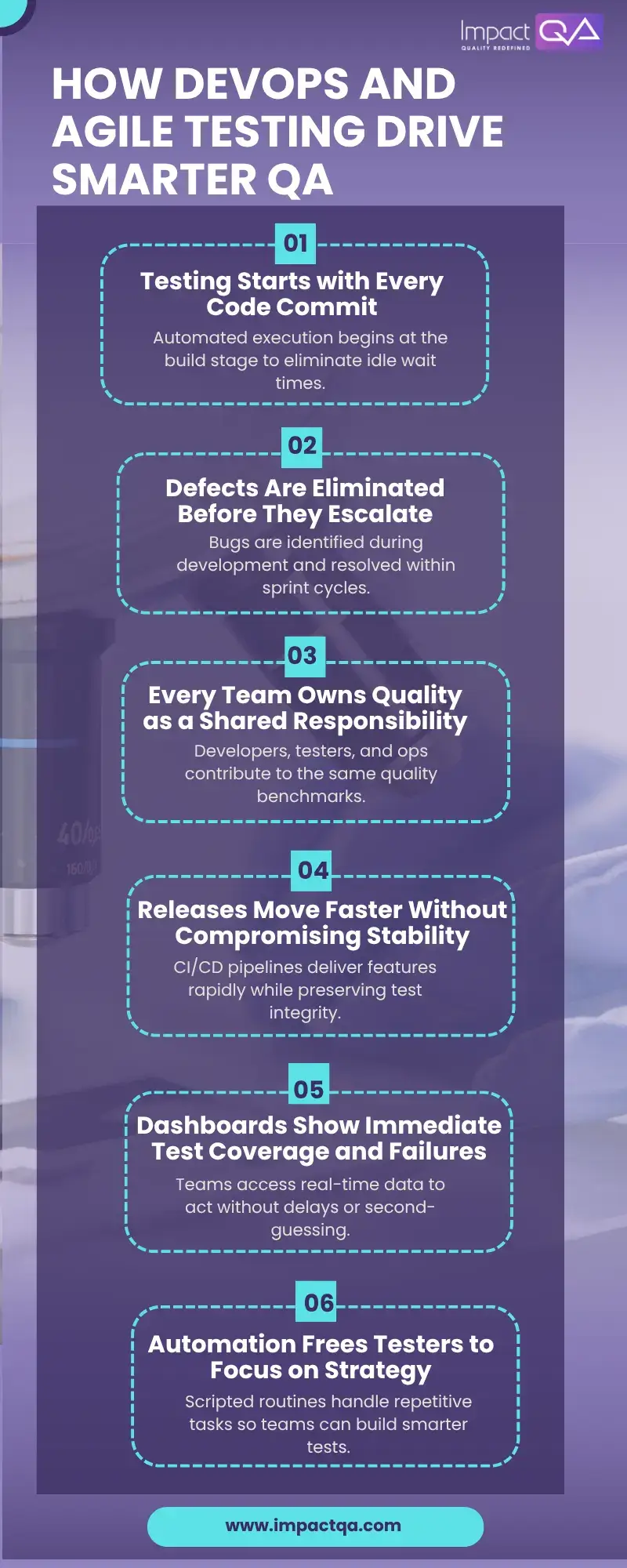
Why DevOps and Agile Testing Integration Is Gaining Traction
As development cycles become shorter, companies are working to meet market demands for speed without compromising quality. Agile testing and DevOps philosophies both support this shift, enabling code to move smoothly across environments with minimal friction. When used together, they help eliminate delays caused by broken workflows and silos within teams.
In modern development, testing is no longer treated as a separate phase that follows development. Instead, it runs in parallel throughout the cycle. This improves traceability and helps teams make faster, more informed decisions. Automated systems detect and resolve issues earlier in the process. With this collaborative model, developers, testers, and operations professionals stay aligned around shared quality goals.
Integrated workflows also improve visibility across the pipeline. Real-time dashboards and reports offer direct insights into building progress and test coverage. This level of transparency helps teams respond quickly and reduces the time spent investigating and resolving issues.
Core Benefits of DevOps and Agile Testing Integration
1. Continuous Testing Becomes Practical and Scalable
DevOps introduces CI/CD workflows, while Agile encourages rapid development cycles. When combined, they make continuous testing achievable across all development stages. Automated test cases are triggered with every code commit or build, validating changes in real time and keeping feedback loops short and actionable.
This setup also makes scalability manageable. Thousands of test cases can run simultaneously across platforms, devices, and environments. Manual effort decreases, release timelines shrink, and testing becomes a core part of development instead of being handled separately.
2. Improved Defect Detection and Resolution
Undetected defects that surface in later stages are expensive to fix and can negatively impact user experience. Integrated testing addresses this by catching issues early, whether they occur at the unit, integration, or system level. Tests run continuously, reducing the time between defect creation and detection.
Developers receive immediate feedback, making it easier to resolve issues while their context is still clear. This not only eliminates rework but also reduces production-level defects. Early feedback loops help prevent test escapes and guard against regressions.
By shifting quality checks earlier in the process, QA becomes proactive. This lowers the risk of critical failures and strengthens product reliability.
3. Better Collaboration Between Teams
Agile promotes collaboration among cross-functional teams. DevOps extends this by removing silos between development, testing, and operations. With integrated testing, quality is no longer the tester’s responsibility alone – it becomes a shared objective.
Everyone participates in planning, execution, and review activities. Release goals and criteria stay consistent across the team. QA input becomes central to daily stand-ups and retrospectives, reinforcing the shared commitment to quality.
When testers are involved from the outset, test cases align closely with acceptance criteria. This improves issue detection within sprint cycles and helps avoid surprises later in production.
4. Increased Release Speed Without Compromising Quality
Manual testing often slows release cycles. With automated tests embedded into CI/CD pipelines, delivery remains uninterrupted. Teams can release updates more frequently without sacrificing quality.
As code progresses from development to production, it’s validated at every stage. There’s no need for extended QA to hold periods. Features can move from development to release in weeks rather than months. These pipelines also reduce rollback rates. Their reliability stems from stronger test preparedness and well-structured validation processes.
5. Real-Time Feedback and Risk Reduction
In DevOps and Agile environments, feedback must be timely and actionable. Continuous testing pipelines deliver results quickly and enable teams to assess build performance, stability, and compatibility as soon as changes are made.
This fast turnaround removes uncertainty. Issues related to integration, functionality, or infrastructure are resolved immediately, reducing risk. With better visibility into the test lifecycle, teams can halt flawed releases before they reach users.
Access to real-time insights gives teams tighter control over test checkpoints and supports rapid adjustments when needed.
6. Better Test Coverage and Reliability
Integrated workflows allow teams to test all layers of an application. From unit to regression and performance tests, everything runs continuously to ensure changes don’t disrupt existing modules.
Automation frameworks cover APIs, microservices, and front-end layers. Centralized dashboards consolidate logs, screenshots, and metrics in one place, making it easier and quicker to analyze issues and resolve them. With everyone accessing the same data, collaboration becomes more effective.
This setup also strengthens reliability. Test scripts are version-controlled, reusable, and tied to pipeline triggers to ensure consistent execution and reduce the risk of errors caused by manual testing.
7. Efficient Resource Allocation
When repetitive tests are automated, human effort shifts to more strategic areas. Testers focus on designing complex cases, refining test scripts, and handling test data. Developers contribute to creating unit and integration tests, expanding early-stage coverage.
Shared accountability maximizes team skillsets. Manual testing is reserved for exploratory or high-impact validation. The rest is handled by automation, running continuously in the background. This change supports lean QA operations. Teams gain more coverage with fewer resources. Standardization of tools and alignment of roles further improve productivity.
Key Enablers That Drive Integration Success
Toolchain Compatibility
Successful integration depends on compatible tools. CI/CD platforms, such as Jenkins or GitLab, need to integrate seamlessly with automation tools like Selenium, Postman, or JUnit. Platforms such as Allure or TestRail centralize reporting, ensuring visibility and traceability throughout the testing process.
When tools don’t work well together, issues such as data loss or misalignment occur. A unified toolchain solves this by providing access to scripts, test logs, and results across teams.
Test Data Management
Automation relies on consistent, reliable data. Integrated systems help teams embed data provisioning within their pipelines. This includes using masked production data or generating synthetic data dynamically.
By automating this step, test consistency improves, and flaky results from outdated or mismatched data are avoided.
Infrastructure as Code (IaC)
With tools like Terraform and Ansible, environments can be created on demand and maintained as code. This supports consistent staging, testing, and performance environments that resemble production closely.
IaC also improves reproducibility. If a test fails, the exact environment can be rebuilt in minutes, simplifying debugging and speeding up resolution.
Common Challenges in Integration and How to Handle Them
Inconsistent Team Skills
Adopting DevOps and Agile requires both technical and soft skills. QA professionals may need to learn scripting, while developers must understand testing frameworks. Bridging these gaps is critical.
Training programs and mentoring help align teams. Promoting joint accountability encourages collaboration and builds confidence across roles.
Tool Fragmentation
When tools aren’t connected, workflows break down. Manual syncing is time-consuming and increases the risk of errors. Standardized, API-connected tools fix this.
An integrated toolchain improves process flow, provides shared visibility, and strengthens traceability across the pipeline.
Resistance to Change
Adopting an integrated approach is as much about culture as it is about tools. Teams used to isolated workflows may hesitate to take on new responsibilities. Change management is key here.
Clear communication, phased adoption, and strong leadership help ease the transition. Aligning incentives and performance metrics with quality outcomes further reinforces the shift.
Accelerate transformation with integrated test automation frameworks and skilled execution.
Key Takeaway
Integrating DevOps with Agile testing redefines how quality is embedded across the software delivery lifecycle. Testing moves from a standalone phase to an integrated, continuous activity supported by automation, real-time reporting, and synchronized toolchains. With CI/CD pipelines triggering tests at every stage, feedback loops tighten, defect resolution accelerates, and release cycles become more predictable. Automation reduces manual effort, while dynamic test data and consistent environments improve reliability.
This approach brings structure to speed. QA, development, and operations work with shared goals, clear accountability, and visibility into every test cycle. As teams adopt infrastructure as code and embed quality checks early, they reduce risk and raise delivery confidence. DevOps and Agile testing together create a scalable, future-ready testing foundation built for fast, high-quality releases.


