
In manufacturing, staying competitive means adapting to technological advancements that streamline operations and reduce inefficiencies. According to a recent report by MarketsandMarkets, the global RFID market is expected to grow at a compound annual growth rate (CAGR) of 9.1% from 2025 to 2033. This growth is largely driven by RFID’s ability to redefine two critical areas, i.e., quality control and traceability.
Have you ever wondered how major manufacturers ensure the highest level of product quality and trace every step of production with zero margin for error? RFID solutions for manufacturing industry provide the answer.
RFID technology is swiftly becoming a game-changer in the manufacturing sector, enabling organizations to maintain a higher standard of operations. From tracking raw materials to finished goods, RFID solutions are not just reshaping the production process – they’re setting a new benchmark for efficiency and accuracy. In this blog, we’ll delve into how RFID is transforming quality control and traceability while offering manufacturers an opportunity to stay ahead of the curve in a fiercely competitive industry.
Understanding RFID Technology
Before diving into its impact on manufacturing, let’s break down how RFID technology works. RFID uses radio waves to wirelessly transmit data between tags attached to items and readers installed at various points in the production environment. Each tag has a unique identifier, allowing it to be tracked in real-time without the need for manual scanning.
There are two main types of RFID tags:
- Active RFID tags: These have an internal power source and transmit signals periodically. They are ideal for tracking high-value assets over long distances.
- Passive RFID tags: These do not have an internal power source. Instead, they are powered by the RFID reader’s radio waves and are suitable for short-range tracking applications.
In manufacturing, RFID tags are embedded in products, tools, or machinery to track movements, inventory levels, and operational status. This allows for real-time visibility, faster decision-making, and more efficient management.
The Role of RFID in Quality Control
Quality control is one of the most critical functions in the manufacturing industry, and even minor discrepancies can have severe consequences. Ensuring that products meet specified standards while maintaining consistency is a key challenge for manufacturers. This is where RFID solutions for manufacturing industry step in.
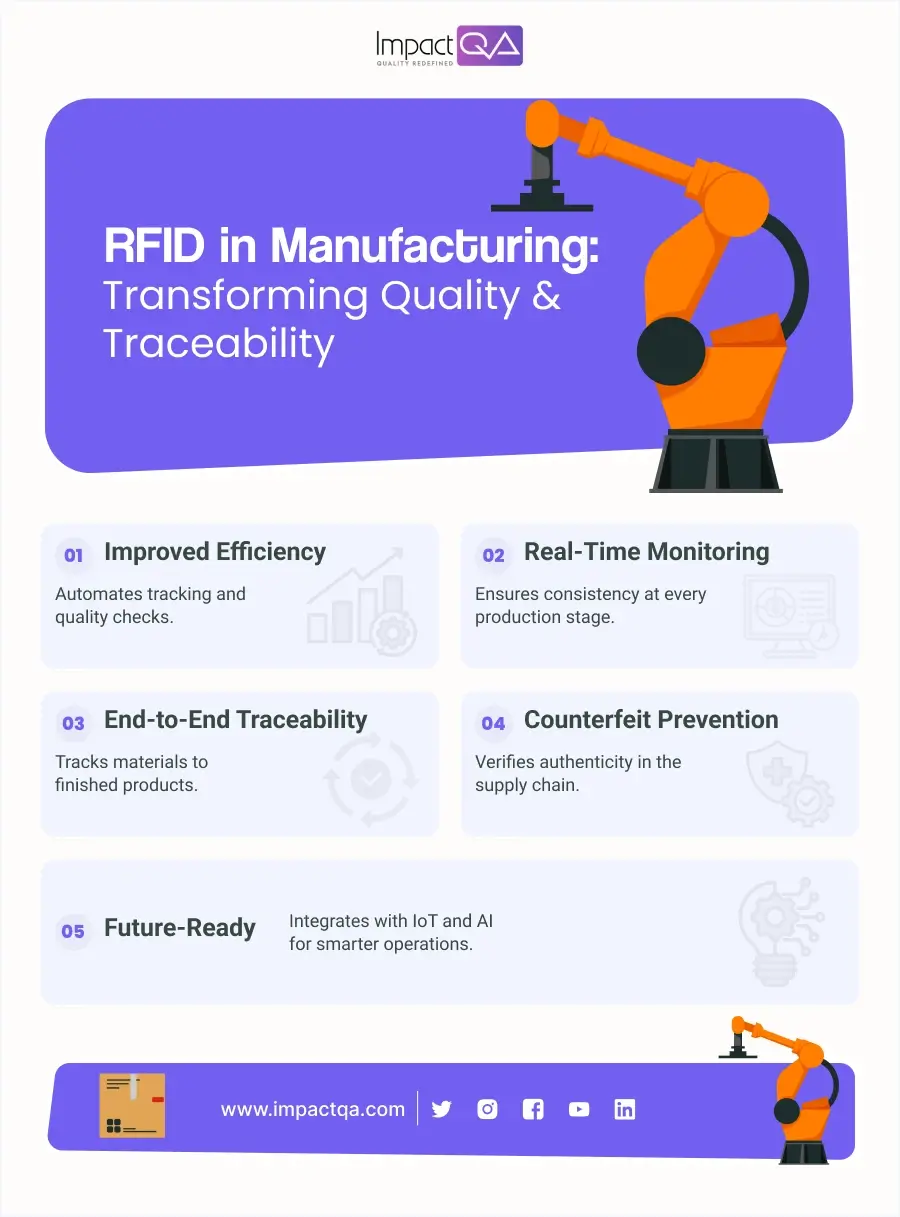
- Real-Time Monitoring: RFID systems allow manufacturers to monitor production processes in real time. With RFID, operators can track each component as it moves through different stages of production. This ensures that quality standards are met at every step.
- Automated Inspections: Manual inspections can be time-consuming and prone to human error. RFID-based quality control systems automate inspections by providing immediate feedback on the quality of products, components, or parts. This reduces reliance on human checks and minimizes the chances of defects making it through the production line.
- Preventing Errors and Defects: By providing visibility into every aspect of production, RFID helps detect issues before they escalate. RFID sensors can provide data on temperature, humidity, pressure, and other conditions that could affect the quality of products, ensuring that they are manufactured within optimal parameters.
- Compliance and Certification: Manufacturers in regulated industries often need to meet strict compliance standards. RFID solutions can document and trace every step of the production process to help manufacturers prove compliance during audits. This reduces the chances of recalls or legal issues due to quality failures.
RFID Solutions for Traceability in Manufacturing
Traceability is critical in the manufacturing industry, especially when it comes to tracking the movement of goods, managing inventory, and ensuring product authenticity. RFID solutions provide manufacturers with an easy and efficient way to track the entire lifecycle of a product – from raw material sourcing to the delivery of the finished product to the customer.
- Inventory Management: Traditional inventory systems are often slow and prone to human error. RFID tags automatically update inventory records in real time as products move through different stages of production or storage. This results in more accurate inventory counts and quicker stock-taking.
- Supply Chain Transparency: RFID technology enables end-to-end visibility in the supply chain. From suppliers to distributors, RFID allows manufacturers to track each product’s location at any given moment. This improves transparency and accountability, making it easier to spot inefficiencies, delays, or potential fraud.
- Product Authenticity: For industries like automotive and pharmaceuticals, product authenticity is a significant concern. Counterfeit parts or goods can jeopardize safety and performance. RFID tags help to validate the authenticity of products to ensure that only genuine items reach the market.
- Recalls and Liability Management: In the unfortunate event of a product recall, RFID systems allow manufacturers to quickly identify, and trace affected products. This minimizes damage to the brand and ensures that recalled products can be efficiently removed from the supply chain.
Real-World Benefits of RFID for the Manufacturing Sector
RFID solutions for the manufacturing industry are already showing impressive results across various sectors. Some of the tangible benefits include:
- Improved Efficiency: By automating tracking and monitoring tasks, RFID systems save time and reduce errors. As a result, workers can focus on higher-value tasks rather than manual inventory management or quality checks.
- Cost Reduction: While the initial investment in RFID infrastructure might seem high, the long-term cost savings are significant. With fewer errors and faster processes, manufacturers can lower operational costs, reduce waste, and increase profitability.
- Better Customer Satisfaction: Real-time data collected via RFID tags means manufacturers can quickly respond to customer demands and ensure timely deliveries. This leads to increased customer satisfaction and a stronger brand reputation.
- Scalability: RFID systems are scalable, meaning manufacturers can add more tags, readers, and sensors as their operations grow. Whether it’s a small-scale operation or a large factory, RFID solutions can easily be customized to meet specific needs.
Challenges of Implementing RFID in Manufacturing
Despite the clear benefits, there are challenges to implementing RFID systems in manufacturing.
- High Initial Cost: The setup of an RFID system requires investment in tags, readers, and infrastructure. For small and medium-sized manufacturers, this upfront cost may seem prohibitive.
- Integration with Legacy Systems: Many manufacturers use legacy systems that are not compatible with RFID technology. Integrating RFID solutions into existing workflows and software can be time-consuming and costly.
- Environmental Interference: In some environments, such as warehouses or factories with heavy machinery, signals from RFID readers may be disrupted. Manufacturers must carefully assess their environment to determine the most effective RFID deployment strategy.
- Data Overload: RFID systems generate massive amounts of data. Without proper analytics tools, it can be challenging to extract actionable insights from the data, which may reduce the effectiveness of the system.
The Future of RFID in Manufacturing
The future of RFID technology in the manufacturing industry is bright. As the technology becomes more advanced and cost-effective, we can expect the following developments:
- Integration with IoT: The integration of RFID with the Internet of Things (IoT) will allow for more comprehensive monitoring of equipment, machinery, and inventory. With IoT sensors, RFID systems will become even smarter while enabling predictive maintenance and better resource management.
- Use of AI and Big Data: By combining RFID data with artificial intelligence and big data analytics, manufacturers will be able to uncover patterns and trends that can inform smarter decision-making.
- Smart Packaging and Robotics: RFID technology will further advance the use of smart packaging, which can communicate with RFID readers in real time to provide detailed information about a product’s condition. Additionally, robots will likely be used to handle and process RFID-tagged items, automating production lines and reducing human error.
- Cloud-Based RFID Systems: Cloud computing will make RFID systems more accessible and cost-effective. Manufacturers will be able to access real-time data from anywhere, using cloud-based software to analyze and manage production and inventory.
Partner with ImpactQA for expert testing and seamless integration!
Final Say
Looking ahead, the impact of RFID solutions for the manufacturing industry will only continue to grow. With advancements in AI, IoT, and big data, RFID will play an even more integral role in enhancing operational efficiency and providing a clear, accurate record of product quality and traceability. For manufacturers looking to stay ahead of the curve, investing in RFID technology isn’t just a choice but an essential move towards the future of manufacturing.
Organizations like ImpactQA specialize in providing RFID testing services to ensure that your RFID systems are optimized and integrated seamlessly into your manufacturing processes. With our expertise in QA and testing, our experts can help you maximize the potential of your RFID solutions and ensure that quality control and traceability are always top-notch.


