
The global shift to digital platforms has significantly reshaped how commodity and energy trading systems are designed, operated, and maintained. According to recent research, more than half of commodity firms are planning to migrate their E/CTRM platforms to the cloud within the next two years. This transition, driven by the need for real-time data access, continuous regulatory alignment, and scalability, demands a complete overhaul of legacy testing methods.
Moving to the cloud is not just about infrastructure changes. Testing frameworks must evolve to keep pace with how trading, risk evaluation, settlements, and compliance workflows function in distributed environments. Whether the platform is a SaaS-based E/CTRM solution or a hybrid setup, testing must be structured, automated, and capable of maintaining quality without disrupting trade operations.
This blog explores cloud-focused testing strategies tailored for modern E/CTRM systems. It covers specific approaches for performance, compliance, integration, and automation, ensuring trading environments remain resilient across transitions.
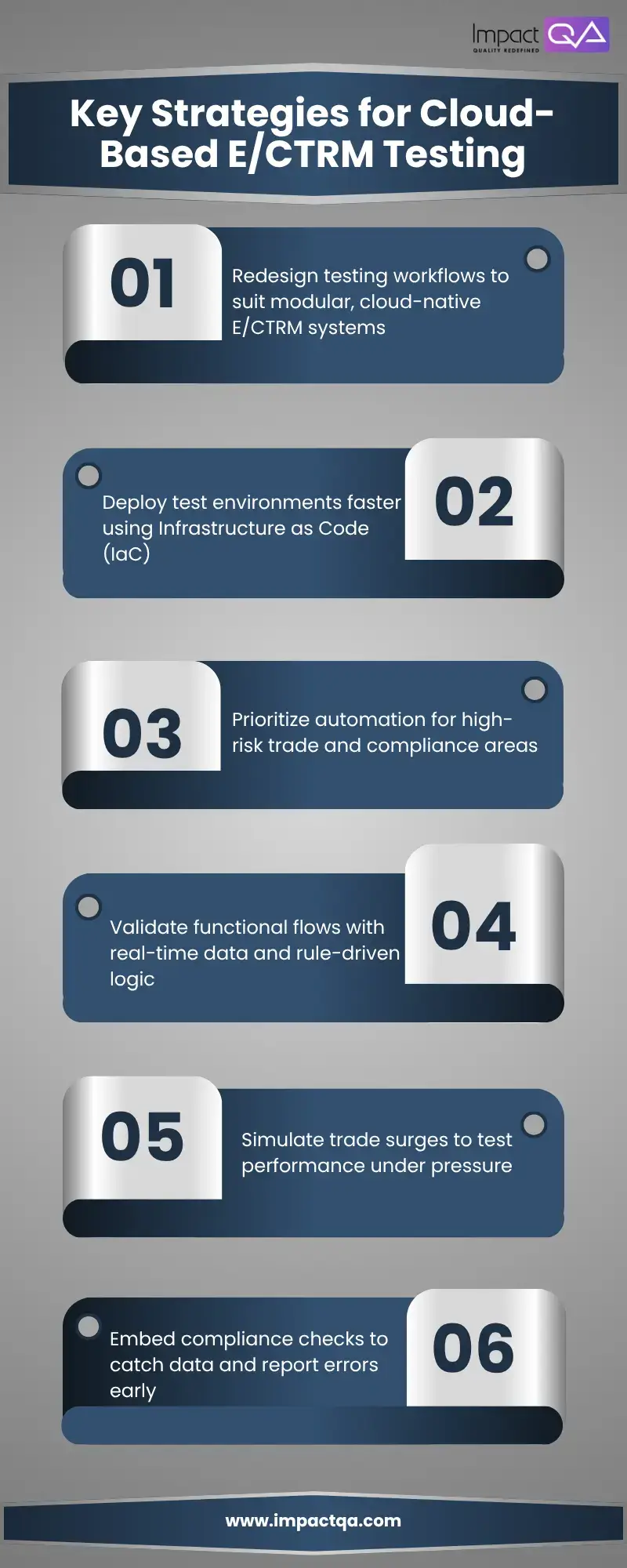
Cloud into E/CTRM: What Changes to Testing Teams?
Adopting a cloud-first E/CTRM architecture shifts how systems interact, scale, and are monitored. The move enables faster deployment, better cost control, and improved operational flexibility. However, these benefits can only be realized if testing adapts to the layered structure of modern systems.
Unlike traditional platforms that run in silos, cloud-deployed E/CTRM systems require multi-level validation, from API integrations to real-time performance metrics. Testing is no longer a back-end task done in batches, but a continuous, integrated function spanning development, staging, and production pipelines.
For example, trade capture and pricing engines in a cloud-native platform may function as independent microservices, each with its own update cycle. Testing must validate not only individual functions but also their interactions under different conditions and data loads.
This demands a shift from manual or static test practices toward scalable, continuous, and automated testing models built for the cloud.
Test Environment Replication Using Infrastructure as Code (IaC)
Creating reliable, production-like test environments in the cloud is a critical foundation for effective E/CTRM testing. Infrastructure as Code (IaC) enables automated provisioning of environments, minimizing configuration drift and manual errors.
Before executing test cases, teams must simulate:
- Market volatility with historical and real-time data feeds
- Service interdependencies, such as between risk calculation engines and trade valuation modules
- Cloud-native components like API gateways, containers, and orchestration tools
By using Infrastructure as Code (IaC) tools, test teams can replicate full-stack environments in minutes. Each test scenario, whether for a new release or a hotfix, runs in an isolated setup with accurate configurations.
Key practices include:
- Pre-configured test blueprints for pricing, scheduling, and invoicing modules
- Version-controlled environment definitions linked to release branches
- Automated teardown and cleanup to avoid cost overhead
IaC empowers consistent test execution across teams while supporting CI/CD release pipelines with reliable staging layers.
Continuous and Risk-Based Test Automation
With rapid updates being pushed to cloud-based E/CTRM platforms, testing must become a continuous function integrated into development workflows. Traditional regression cycles and manual testing models are insufficient.
Automated testing must prioritize risk-sensitive areas, such as:
- Trade lifecycle management workflows
- Credit exposure calculations
- Regulatory report generation under EMIR, REMIT, or CFTC rules
- Integration with pricing APIs and third-party market feeds
Each build or pull request can trigger automated suites based on scope and impact. For example, a change to the risk limits module should initiate relevant regression tests while skipping unrelated settlement flows. This reduces cycle time and ensures higher test coverage.
Automation also helps with executing negative test cases, like testing for incorrect pricing triggers or invalid counterparty data. Over time, historical defect patterns can be used to prioritize areas for early test coverage.
Automation tools to consider:
- Selenium + TestNG for UI
- REST Assured or Karate for API testing
- Jenkins or Azure DevOps for pipeline integration
By embedding tests early and running them often, teams prevent defect accumulation and reduce post-release issues.
Replacing Manual Dependencies with Automated Functional Testing in E/CTRM
Cloud-based E/CTRM platforms operate in time-sensitive, high-volume trading ecosystems. These systems need frequent releases, rule changes, and compliance updates – all of which require repeatable, scalable testing. Manual testing cannot match the speed, accuracy, or depth required across volatile trade flows, fluctuating commodity prices, and constantly shifting contract terms.
To maintain precision and availability, automated functional testing becomes critical across modules like trade capture, position management, scheduling, invoicing, and credit exposure. Each module must be validated not in isolation, but in coordination with external market data, regulatory constraints, and user-specific workflows.
Functional automation in cloud-based CTRM testing must account for:
- Configurable rule-based validations for different contract types and commodity classes
- API-level integration testing with market data providers and pricing services
- Seamless regression validation with each build, release, or patch
- Workflows triggered by intraday or batch data refresh cycles
Automation supports version control, reduces human dependency, and improves test coverage across business-critical trade scenarios. These gains are key to ensuring confidence in every release.
Scalable Load Testing for High-Volume Trading Events
Performance underload is a critical success factor for any E/CTRM platform deployed in the cloud. Commodity markets are volatile. During key economic or geopolitical events, trading volumes can spike significantly, putting strain on both front-end trading consoles and back-end processing services.
- To prepare for such spikes, cloud-based load testing must simulate:
- Trade spikes across asset classes like gas, power, metals, and emissions
- Concurrent users triggering deal capture and settlement processes
- Batch processing jobs for risk, reconciliation, and reports
- External data feeds from pricing vendors like Platts or ICE
Best practices:
- Define baseline performance SLAs for key flows (e.g., trade-to-invoice < 5 seconds)
- Identify bottlenecks in services or queues using telemetry data
- Schedule regular load tests post-major cloud infrastructure updates
When implemented consistently, load testing can prevent unexpected downtime and ensure a consistent user experience.
Integrated Compliance and Data Validation Workflows
Compliance is a moving target in energy and commodity trading. Regulatory updates, region-specific formats, and increased transparency expectations require testing strategies that continuously validate regulatory readiness.
In cloud-based E/CTRM systems, testing must include:
- Validation of trade attributes and classification against reporting rules
- Format and content checks for reports like EMIR, REMIT, or Dodd-Frank
- Simulation of cross-border transactions and their impact on disclosures
- Automated validation of credit limits and margin calculations
Data accuracy and integrity are central. Test data must represent valid market conditions, contract parameters, and risk inputs. This includes validating calculations for mark-to-market, exposure, or collateral against live market prices.
Strategies to adopt:
- Use synthetic data generators for edge case validation
- Implement data diffing scripts to compare output across releases
- Integrate test cases into GRC (governance, risk, and compliance) frameworks
Such a rigorous test approach ensures that compliance gaps are flagged and addressed before they reach regulators.
ImpactQA helps automate and integrate your entire E/CTRM test suite into CI/CD pipelines.
The Road Ahead
Cloud-based E/CTRM Testing requires rethinking traditional test frameworks. It involves creating scalable, modular, and data-driven strategies that can keep up with dynamic system updates, regulatory changes, and business demands.
Testing must start early, integrate tightly with CI/CD pipelines, and adapt to every service-level change, from pricing engines to user entitlements. Manual testing can still add value in UAT and exploratory phases but cannot drive quality at scale.
ImpactQA helps organizations implement targeted and future-ready testing frameworks for E/CTRM platforms deployed in the cloud. Their services support:
- Test environment provisioning using IaC tools
- End-to-end automation for functional, performance, and compliance testing
- Real-time data validation across integrations
- Security assessments aligned with financial industry standards
With expertise across energy, commodity, and utility verticals, ImpactQA delivers measurable outcomes in release reliability, compliance readiness, and trade accuracy.


