
Every new endpoint is a new door, and most attacks now arrive with a valid token. Salt Security found that 99% of analyzed attack attempts came from authenticated sources, so the key test question has shifted from “who are you?” to “what may you touch?” Here is a seven-step approach for growing SaaS teams.
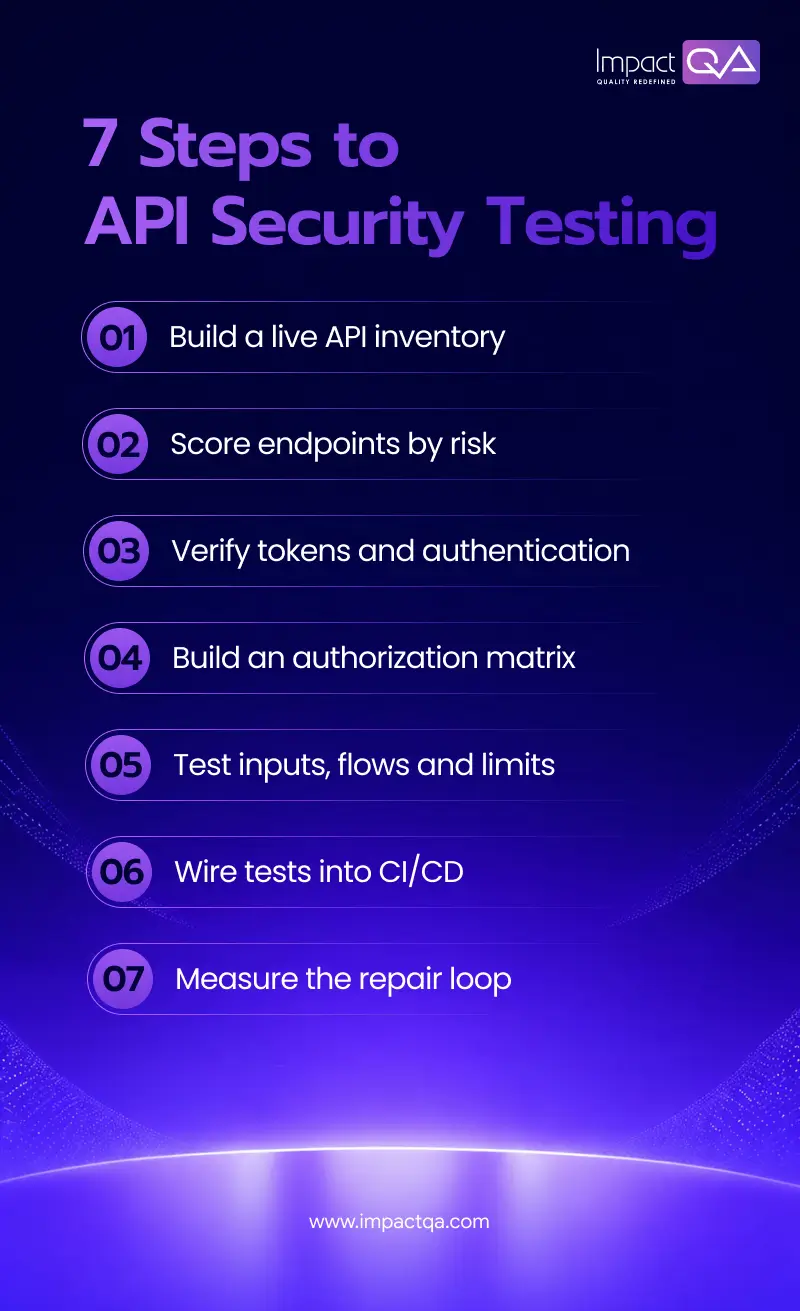
- Build a live API inventory by comparing OpenAPI specs with gateway logs to find shadow and zombie APIs.
- Score endpoints by risk using Exposure × Data Sensitivity × Business Impact, and prioritize anything above 60.
- Verify authentication and tokens, including JWT signatures, expiry, and refresh token rotation.
- Build an authorization matrix to catch broken object-level access between tenants.
- Test inputs, flows and limits with fuzzing, SSRF checks, and rate-limit validation.
- Wire tests into CI/CD using SAST, DAST, and nightly authorization runs, with a gate that blocks risky releases.
- Measure the repair loop through mean time to remediate and escape rate.
AI now speeds up testing and adds new surfaces to cover, including LLM endpoints, agents, and mobile clients. Authorization testing will remain the center of the work.
ImpactQA’s security testing team brings threat modeling, SAST, DAST, and penetration testing across REST, SOAP, and GraphQL, along with AI and LLM assurance.
Also read: A Step-by-Step Guide to API Security Testing for Growing SaaS Teams


