
SAP continues to be one of the dominant platforms for managing core business operations, particularly in large organizations. With its complex functionalities and crucial role in day-to-day operations, ensuring that SAP systems are tested thoroughly before deployment has always been a critical task. However, as businesses continue to scale and adapt to the ever-evolving digital world, so must the way we approach SAP test automation.
The traditional methods of SAP test automation were often cumbersome, time-consuming, and prone to human error. However, with advancements in artificial intelligence (AI) and machine learning (ML), the landscape of SAP test automation is changing drastically. The global AI-enabled testing market size was valued at USD 856.7 million in 2024. The market is projected to grow from USD 1,010.9 million in 2025 to USD 3,824.0 million by 2032, exhibiting a CAGR of 20.9% during the forecast period. This shift is expected to radically transform the testing strategies for SAP implementations, with AI playing a critical role in simplifying and accelerating processes.
As we enter 2025, businesses must stay on top of emerging trends that leverage AI and machine learning capabilities to optimize SAP test automation. From smarter test creation to improved bug detection, AI’s role is poised to reshape the entire testing pipeline. But what does this transformation look like, and why is it so important?
The Role of AI in SAP Automation: Why It’s a Game Changer
The role of AI in SAP automation is multifaceted, impacting everything from the design of test cases to the execution and analysis of results. Traditionally, SAP test automation involved labor-intensive tasks that often-required specialized knowledge and expertise in the SAP environment. These methods were often slow and susceptible to human error, with testers needing to manually create scripts, execute tests, and analyze results.
With the advent of AI, much of this manual effort can be eliminated. AI-driven test automation can now analyze SAP applications to predict the best test cases, identify issues, and even suggest improvements. These advancements make it possible to automate tests with much more precision and speed, enhancing both the quality and efficiency of SAP implementations.
Moreover, AI-driven testing tools can intelligently prioritize test cases based on business-critical processes, automatically adjusting test coverage as changes are made to the system. As a result, businesses can save time and resources while reducing the risk of defects slipping through the cracks.
Trends in AI and Machine Learning for SAP Test Automation in 2025
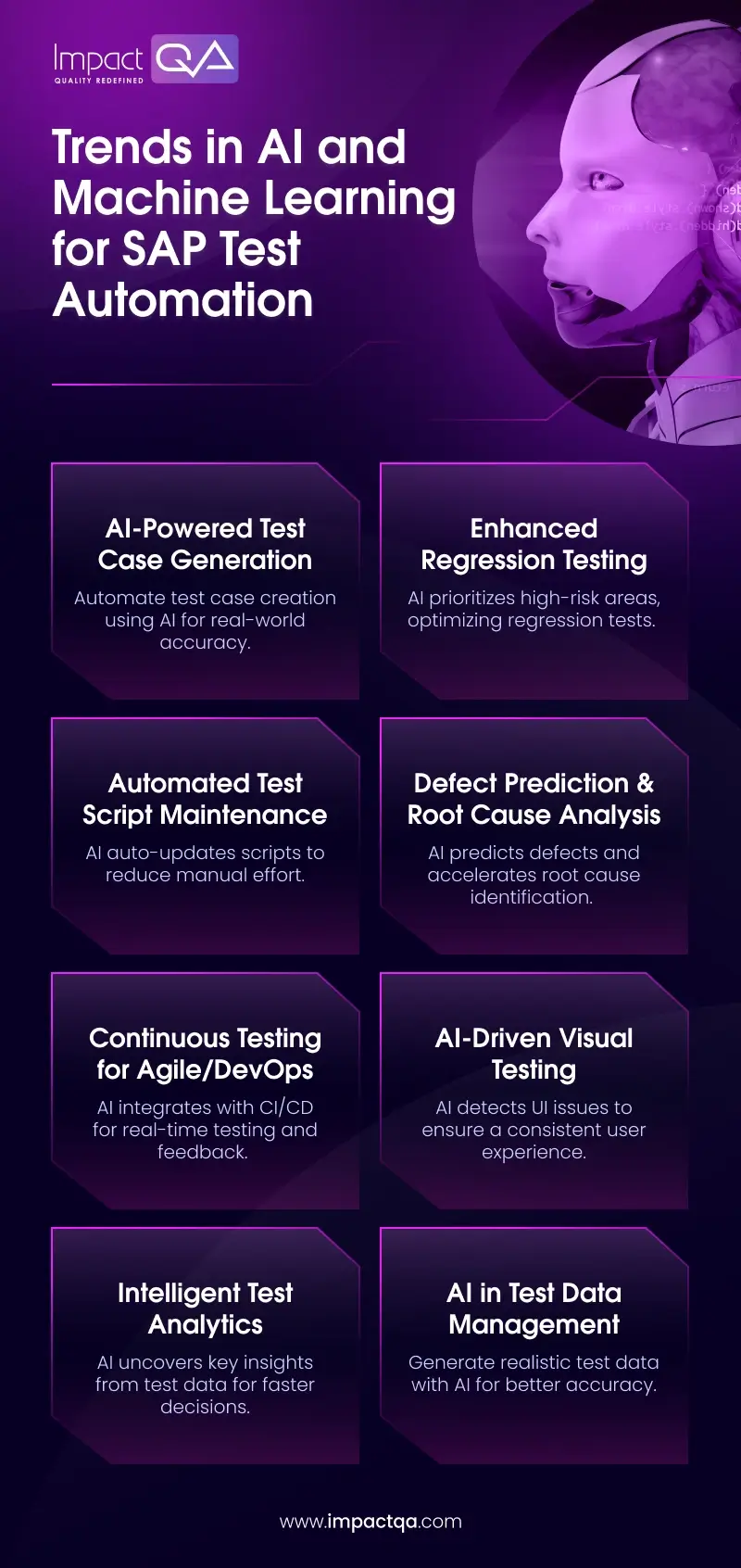
As we approach 2025, businesses should keep an eye on several key trends in AI and machine learning for SAP test automation. These trends will not only influence how SAP systems are tested but also how organizations can leverage AI to optimize their SAP testing strategy.
1. AI-Powered Test Case Generation and Execution
One of the most exciting trends in AI-driven SAP test automation is the automation of test case generation. With AI and machine learning, automated tools can now analyze historical data, user behavior, and system logs to generate test cases that are more aligned with real-world usage patterns. This capability significantly reduces the time spent writing and maintaining test scripts.
By utilizing machine learning models, these tools can also learn from previous test results, continuously refining their test generation process. As a result, organizations can ensure comprehensive test coverage without investing excessive time and resources in manual test creation.
2. Enhanced Regression Testing Through AI
Regression testing is crucial for SAP systems, especially when new updates or patches are introduced. Traditionally, this type of testing would involve running a large suite of tests to verify that new changes do not negatively impact existing functionality. However, with the implementation of AI, regression testing can be made smarter and more efficient.
AI-powered test automation tools are now capable of identifying which parts of the SAP system are most likely to be affected by changes and can prioritize those areas for testing. Additionally, machine learning can predict which tests have the highest probability of uncovering defects, making the testing process more targeted and efficient.
3. Automated Test Script Maintenance
Maintaining automated test scripts can be one of the most labor-intensive tasks in SAP test automation. As the system evolves, test scripts often need to be manually updated to account for changes in the user interface, business processes, or system configurations. This is where the role of AI in SAP automation becomes particularly valuable.
AI and machine learning algorithms can be used to identify changes in the SAP environment and automatically suggest updates to the test scripts. This eliminates the need for testers to manually rewrite scripts every time a change occurs, drastically reducing maintenance time and improving the longevity of automated test suites.
4. Intelligent Defect Prediction and Root Cause Analysis
AI and machine learning can be used to predict potential defects before they even occur. By analyzing historical defect data, AI can identify patterns and trends that may indicate an underlying issue. This allows organizations to address potential problems proactively, reducing the likelihood of defects making it into production.
In addition, when defects are found, AI-powered tools can perform root cause analysis by cross-referencing test results with historical data to identify the underlying cause of the issue. This capability significantly speeds up the debugging process, making it easier to fix problems and avoid costly delays.
5. Continuous Testing for Agile and DevOps Environments
In 2025, agile and DevOps methodologies will continue to dominate the way organizations build and deploy software. These methodologies emphasize the need for continuous integration and continuous delivery (CI/CD), meaning that testing must occur frequently and in parallel with development.
AI-powered SAP test automation tools are increasingly being integrated into CI/CD pipelines, enabling continuous testing and immediate feedback to developers. By automatically running tests on each new build and identifying issues early in the development cycle, AI ensures that defects are caught as soon as they arise, improving the overall speed and quality of software delivery.
6. AI-Driven Visual Testing for SAP Applications
As businesses become more customer-centric, delivering high-quality user experiences is essential. In SAP, visual consistency across different devices, browsers, and platforms is crucial for ensuring that end users have a seamless experience.
AI-driven visual testing tools can automatically identify visual discrepancies and UI issues in SAP applications. By using image recognition and machine learning algorithms, these tools can flag inconsistencies in layout, font sizes, colors, and other visual elements, ensuring that the user interface meets the highest standards.
7. Intelligent Test Analytics and Reporting
Once tests are executed, the data generated can often be overwhelming, making it difficult for testers to analyze and extract meaningful insights. AI-driven analytics tools are capable of processing large volumes of testing data, offering intelligent insights into test results and performance metrics.
These tools can highlight patterns, trends, and anomalies that testers might otherwise miss, making it easier for QA teams to prioritize issues and focus on the most critical areas. Additionally, AI-powered test reporting tools can automatically generate concise and actionable reports, reducing manual effort and ensuring that teams can make informed decisions quickly.
8. AI in Test Data Management
Effective test data management is essential for running accurate and reliable SAP tests. AI can be leveraged to automatically generate realistic and comprehensive test data, ensuring that tests reflect real-world usage. This is especially important when testing complex SAP applications with vast amounts of data.
AI-powered tools can analyze existing data and generate synthetic data sets that simulate a variety of scenarios, ensuring that SAP systems are thoroughly tested under different conditions. This improves the accuracy of testing while reducing the time spent on manual data preparation.
The Road Ahead
As organizations continue to embrace AI and machine learning in SAP test automation, we are witnessing a paradigm shift in how testing is conducted. By incorporating AI into every phase of the testing lifecycle – from test case generation to execution, analysis, and reporting – businesses can dramatically improve the speed, accuracy, and efficiency of their SAP testing efforts.
The role of AI in SAP automation is no longer just a trend; it is quickly becoming a necessity for organizations that want to stay competitive and deliver high-quality SAP solutions. In 2025, AI will play an even more integral role in driving continuous improvement, reducing time-to-market, and ensuring that SAP systems function flawlessly.
At ImpactQA, we are constantly pushing the boundaries of SAP test automation. Leveraging cutting-edge AI and machine learning technologies, our solutions are designed to optimize test processes, improve accuracy, and ensure seamless SAP system performance. We stay ahead of the curve by integrating AI-driven tools and methodologies, helping businesses to rapidly scale their SAP testing efforts while maintaining high standards of quality.


