Why ERP Testing for the Manufacturing Industry Matters for Everyday Business Operations
Quick Summary:
Manufacturing companies rely heavily on integrated systems to manage supply chains, inventory, production cycles, and workforce planning. However, even minor issues within an ERP system can lead to material mismanagement, production delays, or compliance risks. ERP testing for manufacturing industry operations becomes essential not just to prevent breakdowns but to support seamless business continuity, data accuracy, and regulatory adherence across the production lifecycle. This blog explores how systematic ERP testing strengthens core operations for manufacturers and reduces risk at every level.
Table of Contents:
- Introduction
- Why ERP Testing for the Manufacturing Industry Needs a Dedicated Focus
- Key Areas Covered in ERP Testing for Manufacturers
- Impact of Poor ERP Testing on Manufacturing Operations
- Role of Automation in ERP Testing for Manufacturing
- Best Practices for ERP Testing in Manufacturing Environments
- Aligning ERP Testing with Compliance and Traceability Goals
- Concluding Thoughts
What would happen if a minor error in your ERP system miscalculated your raw material inventory? Or worse – if a software glitch disrupted production scheduling, leaving your assembly line idle? For manufacturing enterprises, ERP systems function as the operational engine, linking procurement, production, inventory, distribution, and customer fulfillment. A flaw in any module can create ripple effects across the value chain. Ensuring the quality and stability of these interconnected modules requires a robust ERP testing framework designed specifically for the unique demands of manufacturing.
According to a 2024 IDC survey, 65% of manufacturers reported operational disruptions due to ERP software issues in the past year. These ranged from inventory misalignments to shipment delays and compliance lapses. The statistics reflect a clear shift in priorities as ERP testing becomes integral to maintaining business performance and reducing operational risk. The following sections dive into why ERP testing for manufacturing industry workflows deserves specialized attention and how a structured testing approach helps manufacturers maintain operational consistency, cost efficiency, and compliance assurance.
Our domain-driven QA framework supports traceability and regulatory compliance at scale.
Why ERP Testing for the Manufacturing Industry Needs a Dedicated Focus
ERP systems in the manufacturing sector are complex, often involving modules like supply chain management, bill of materials (BOM), shop floor control, quality inspection, product lifecycle management, and vendor integrations. Unlike other industries, manufacturing ERP is deeply process-driven, with time-sensitive dependencies and machine-data integrations.
Here’s why ERP testing demands special attention:
- High System Interdependencies: One change in the production module may impact inventory valuation, purchase requisitions, or even final invoicing. Testing these connections is important.
- Continuous Plant Operations: Downtime is expensive. Real-time testing ensures updates do not break down ongoing processes.
- Customized Workflows: Manufacturing ERPs are often tailored. Standard testing templates fall short in identifying defects in these custom workflows.
- Hardware-Software Sync: Many ERP systems interact with manufacturing execution systems (MES) and IoT devices on the shop floor. Testing must cover data integrity across software and machine logs.
Key Areas Covered in ERP Testing for Manufacturers
To ensure reliability, testing must go beyond validating core modules. ERP testing for manufacturing industry solutions needs to include industry-specific functions. Here’s a breakdown of the critical areas tested:
Sr. No. |
Test Area |
Focus |
| 1. | Procurement & Supply Chain | Vendor onboarding, procurement cycles, GRN validation, supplier payments |
| 2. | Production Planning | Work orders, capacity planning, scheduling accuracy |
| 3. | Inventory Management | Real-time inventory sync, stock valuation, barcode/RFID integration |
| 4. | Quality Assurance | Quality gate pass, inspections, batch traceability |
| 5. | Shop Floor Operations | Machine data inputs, MES interactions, job routing |
| 6. | Finance Integration | Cost accounting, production costing, inter-module GL reconciliation |
| 7. | Compliance & Reporting | GST/VAT calculations, e-way bills, audit trails |
Every module must be validated for data consistency, business rules, integration points, and UI performance across user roles and geographies.
Impact of Poor ERP Testing on Manufacturing Operations
Modern manufacturing runs on precision, speed, and data. But when ERP systems aren’t properly tested, precision can quickly erode. Defects buried in core workflows like procurement, production, inventory, and finance can silently damage performance across the value chain. What seems like a minor issue in QA can spiral into major business disruptions, affecting everything from cost to compliance.
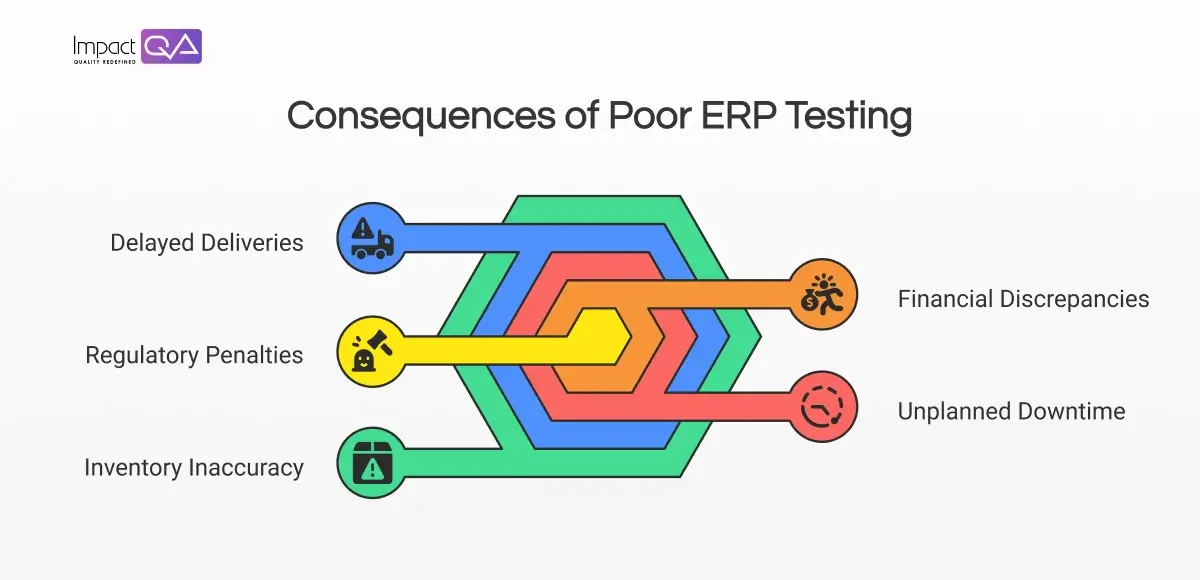
Poor ERP testing has measurable business consequences. Manufacturing enterprises can face:
- Inventory Inaccuracy: Unvalidated inventory logic can cause stockouts of critical components or overstocking of slow-moving items. This leads to increased holding costs, missed production targets, and poor demand forecasting. Over time, it impacts working capital and customer satisfaction.
- Delayed Deliveries: Defects in production scheduling, MRP runs, or supplier integration can disrupt timelines. Missed order fulfillment windows hurt SLAs and customer confidence. Recurring issues may force companies to incur expedited shipping costs or penalties.
- Unplanned Downtime: Faulty integration with MES or shop-floor equipment can halt operations during mid-cycle. Without accurate test cases for machine data inputs or outputs, automation fails silently. These disruptions cause missed output goals and operational inefficiencies.
- Financial Discrepancies: Inadequate test coverage in finance modules can cause mismatched invoices or incorrect GL postings. These errors skew P&L statements and create trust issues with vendors and customers. Late discovery may require manual corrections or even re-audits.
- Regulatory Penalties: Missing validations for tax logic, batch traceability, or digital documentation invite compliance risks. Manufacturing domains like pharma or food face strict audit trials and safety standards. Failure to comply can result in fines, recalls, or operational license suspension.
Role of Automation in ERP Testing for Manufacturing
In modern manufacturing ecosystems, ERP systems are dynamic and frequently updated with new features, security patches, and process changes to meet evolving business demands. Relying solely on manual testing is no longer sufficient to validate these rapid changes, especially in time-sensitive production environments and data-driven workflows. This is where test automation becomes essential for scaling quality efforts and minimizing operational risks.
Automation not only speeds up validation cycles but also ensures consistency across complex, multi-module ERP configurations. By integrating automation into QA pipelines, manufacturers can simulate real-world conditions, identify edge cases early, and allow testers to concentrate on critical business scenarios. Automated testing is particularly beneficial during rollouts, upgrades, and periodic compliance audits when repetitive tasks can consume significant manual effort.
Key Automation Opportunities:
- Regression Testing: Automated scripts validate frequent changes across critical paths.
- End-to-End Scenario Testing: Simulates production order creation to customer delivery.
- Data-Driven Testing: Ensures accuracy across varied SKUs, plant locations, and BOM combinations.
- Performance Testing: Validates ERP behavior under high transaction loads typical of month-end processing.
- Robotic Process Automation (RPA): Validates shop-floor reporting and system alerts with reduced manual oversight.
To maximize value, automation efforts should prioritize high-frequency workflows, high-risk integrations, and compliance-heavy modules. Choosing the right toolset is equally important. ERP platforms like SAP, Oracle, and Infor need test automation solutions that can easily connect with backend systems, custom configurations, and third-party integrations. A well-implemented automation framework for ERP testing can help manufacturers achieve both speed and control in their operations.
Best Practices for ERP Testing in Manufacturing Environments

ERP testing in manufacturing must be structured, context-aware, and business-aligned. Unlike standard testing approaches, manufacturing demands tighter coordination between QA teams and operations due to the high cost of errors in production, inventory, and supply chain workflows. Testing must anticipate disruptions and validate processes under real-world constraints, such as limited downtime windows and plant-specific workflows. Adopting proven best practices helps mitigate risks while accelerating deployment timelines.
Here are essential practices that drive quality and stability:
- Business Rule Mapping: Document all custom workflows before writing test cases to ensure each validation reflects how the process is used on the shop floor or in procurement.
- Role-Based Testing: Validate access controls, task assignments, and approval flows based on defined user roles – plant head, floor supervisor, QA lead, finance controller, and others.
- Mock Runs: Simulate full-cycle scenarios such as production runs, financial closings, or purchase order processing in a test environment. These dry runs surface timing issues, reconciliation gaps, or faulty dependencies.
- Change Impact Assessment: Evaluate upstream and downstream impacts of updates or patches across all connected modules, including inventory, MES, procurement, and finance.
- Data Validation: Conduct data integrity checks for unit conversions, lot numbers, batch IDs, and cross-plant inventory movements. Discrepancies here often go unnoticed without robust test cases.
- Defect Traceability Matrix: Map each test case to specific business risks. This ensures critical workflows are prioritized, and defect fixes are linked to operational impact, not just technical severity.
In addition, test cycles should be aligned with production downtimes and governed by clearly defined entry/exit criteria. Strong documentation, test data management, and involvement from plant-level SMEs further strengthen the test process. A disciplined, cross-functional approach ensures that ERP systems deliver consistent, error-free performance across manufacturing operations before going live and after every update.
Aligning ERP Testing with Compliance and Traceability Goals
In regulated manufacturing sectors like pharmaceuticals, aerospace, and food processing, compliance is non-negotiable. ERP testing in these industries plays a critical role in ensuring audit readiness, maintaining data integrity, and enabling end-to-end traceability.
Testing must include:
- Lot and Batch Testing: Validate the tracking of raw materials to finished goods using ERP and MES data. This is crucial for recalls, warranty claims, and root-cause investigations.
- Digital Audit Trails: Confirm that every action in the ERP system is logged correctly and remains tamper-proof to meet both internal and external audit requirements.
- Electronic Signature Testing: Ensure digital approvals comply with standards like FDA 21 CFR Part 11, and that role-based access governs who can authorize critical steps.
- Compliance Reporting: Test auto-generated reports for tax filings, customs documentation, sustainability disclosures, and vendor risk assessments. These reports must be accurate, timestamped, and audit friendly.
Without rigorous validation of these compliance features, businesses risk failed audits, loss of certifications, reputational damage, and regulatory penalties. ERP testing must therefore be viewed as a proactive compliance safeguard.
Our experts secure every integration to prevent disruptions during rollouts.
Concluding Thoughts
ERP testing in manufacturing requires precision, domain alignment, and the ability to scale across plant operations and integrated software environments. Validating critical systems like ERP, MES, and supply chain modules helps reduce non-compliance, improve production continuity, and support faster release cycles.
ImpactQA supports this with tailored ERP testing services focused on reliability, automation, and operational efficiency:
- AI-Powered Testing Frameworks to detect defects early across ERP and MES platforms
- Model-Based and Shift-Left Approaches to speed up QA cycles and increase coverage
- Full-Spectrum Testing across functional, integration, performance, mobile, and security areas
- IoT-Enabled Labs to simulate real-world conditions and validate machine-data interactions
- Cloud-Based Infrastructure and 24×7 testing support across onshore, offshore, and nearshore models
- Expertise in Manufacturing Workflows, including quality, logistics, invoicing, and compliance modules
Our approach helps manufacturers deliver software systems that are production-ready, traceable, and audit-compliant.
Share this post


Related Posts
Our Case Studies