
How ERP Testing Drives ROI by Reducing Risk and Improving Efficiency

Quick Summary:
ERP testing plays a critical role in improving ROI by reducing risk and enhancing efficiency across enterprise systems. This blog explores what ERP testing involves, key areas to improve ROI without replacing existing systems, and why structured testing is essential for business continuity. It further examines how ERP test automation and continuous testing accelerate validation, while structured ERP application testing minimizes risks related to data, performance, and integrations.
Table of Contents:
- Introduction
- What is ERP Testing?
- Key Areas to Improve ERP ROI Without System Replacement
- Why ERP Testing is Critical for ROI Realization
- Driving Efficiency Through ERP Test Automation and Continuous Testing
- Risk Mitigation Through Structured ERP Application Testing
- Final Thought
Enterprise resource planning systems are expected to keep operations aligned, data consistent, and decisions reliable. Yet, as business processes expand and integrations grow, many ERP environments begin to show gaps. What once supported efficiency can gradually introduce delays, inconsistencies, and operational strain. These issues often go unnoticed until they begin to affect financial accuracy or process continuity.
As organizations scale and adopt cloud-driven models, the margin for error becomes narrower. Release cycles accelerate, and system dependencies become more complex. In such conditions, ERP testing becomes essential to validate every change before it impacts operations. A structured approach, supported by ERP test automation and continuous ERP testing, helps organizations control risk while improving efficiency and overall system performance.
ImpactQA delivers structured ERP software testing to reduce risk and improve efficiency.
What is ERP Testing?
ERP testing refers to the process of validating enterprise resource planning systems to ensure that all integrated modules, workflows, and data flows function accurately and consistently. It involves verifying business processes such as finance, procurement, supply chain, and human resources to ensure that system behavior aligns with real-world operations. Unlike isolated application testing, ERP software testing focuses on interconnected environments where a single change can impact multiple functions.
Additionally, ERP application testing covers multiple layers, including functional validation, integration testing, data accuracy checks, and performance evaluation. This ensures that updates, customizations, and third-party integrations do not disrupt critical workflows. With the growing adoption of cloud platforms, cloud ERP testing solutions also validate system performance, security, and compatibility across distributed environments.
For example, consider an organization implementing an update in its procurement module. A minor configuration error may seem limited to purchase orders, but it can affect inventory levels, supplier payments, and financial reporting. Without proper ERP testing, such issues may only surface after deployment, leading to operational delays and financial inconsistencies. However, a structured ERP testing service ensures that these dependencies are validated in advance to identify defects before they impact business operations.
Key Areas to Improve ERP ROI Without System Replacement
Not all ERP challenges require system replacement. Many organizations can improve ROI by optimizing existing configurations, processes, and usage patterns. A focused evaluation helps uncover inefficiencies that limit system performance and business outcomes.
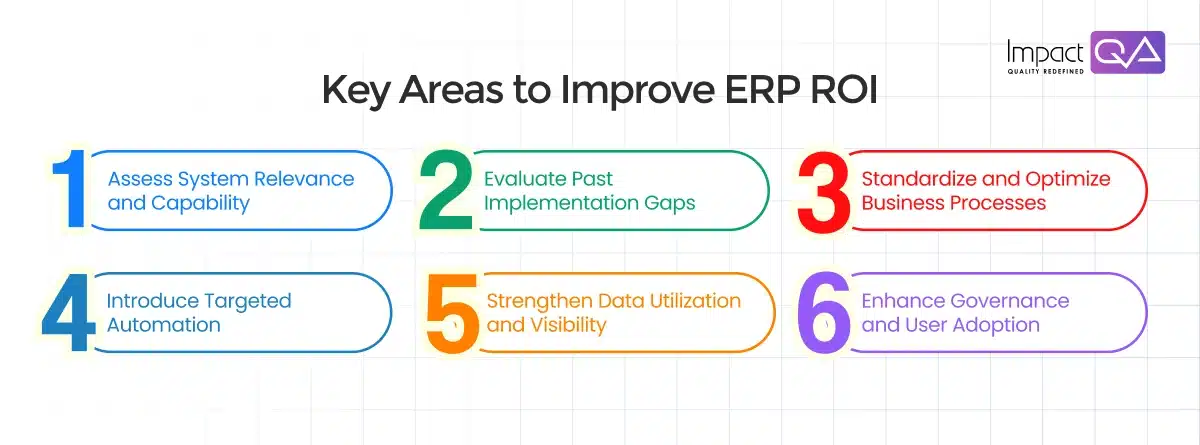
Assess System Relevance and Capability
ERP systems may lose alignment with evolving business needs over time. Evaluating system capabilities, upgrade paths, and compatibility with modern requirements helps identify whether targeted optimization can extend system value.
Evaluate Past Implementation Gaps
Reviewing initial ERP implementation outcomes highlights gaps in configuration, adoption, or execution. Identifying these gaps enables organizations to correct inefficiencies and improve system performance without significant reinvestment.
Standardize and Optimize Business Processes
Inconsistent workflows often reduce ERP efficiency. Aligning business processes with system capabilities ensures smoother operations, reduces manual interventions, and improves overall process consistency across departments.
Introduce Targeted Automation
Automating repetitive and rule-based tasks within ERP workflows reduces manual effort and improves accuracy. This approach supports efficiency gains while allowing teams to focus on higher-value operational activities.
Strengthen Data Utilization and Visibility
ERP systems generate valuable data, but their impact depends on effective usage. Improving data accessibility and analytics capabilities enables better decision-making, operational insights, and measurable business improvements.
Enhance Governance and User Adoption
Strong governance frameworks and well-trained users ensure consistent system usage. Clear roles, responsibilities, and ongoing training help organizations maximize ERP capabilities while reducing inefficiencies caused by improper system utilization.
Why ERP Testing is Critical for ROI Realization
ERP environments are inherently complex due to their interconnected modules and business-critical workflows. Even minor defects can spread across departments, resulting in financial discrepancies or operational inefficiencies. This is where ERP application testing plays a crucial role in protecting ROI by ensuring system reliability at every stage.
Understanding the Cost of Untested ERP Changes
Frequent ERP updates and integrations introduce risks when not validated properly. Without structured ERP testing services, defects in financial data, workflows, or integrations can lead to rework, delays, and increased operational costs.
Ensuring Business Continuity Through Validation
Stable ERP operations depend on accurate process validation. ERP application testing ensures critical workflows function consistently, while cloud ERP testing solutions support performance, security, and compliance across distributed environments without disruptions.
Aligning Testing with Business Outcomes
A focused ERP testing strategy connects validation efforts with business goals. By mapping testing to key performance indicators, organizations ensure measurable outcomes, while an experienced ERP testing company brings structured and result-driven validation frameworks.
Driving Efficiency Through ERP Test Automation and Continuous Testing
Efficiency is a key driver of ROI in ERP environments. Manual testing approaches often struggle to keep pace with frequent updates and complex integrations. This limitation leads to delays, increased effort, and inconsistent validation. ERP test automation addresses these challenges by introducing speed, accuracy, and scalability into testing processes.
Accelerating Validation Cycles with Automation
ERP test automation enables rapid execution of test cases across modules and environments, validating workflows and integrations with minimal manual effort. This reduces testing time while ensuring consistent, repeatable, and accurate validation across releases.
Improving Resource Utilization
ERP testing services integrated with automation reduce dependency on manual effort. This allows teams to focus on complex scenarios, while continuous ERP testing enables early defect detection during ongoing development cycles.
Enhancing Release Agility
ERP test automation supports faster release cycles by validating incremental changes efficiently. Continuous ERP testing ensures ongoing quality checks, while cloud ERP testing solutions enable consistent validation across multiple environments and configurations.
Reducing Operational Bottlenecks
Automated ERP software testing eliminates delays through parallel test execution, thereby speeding up validation cycles. As a result, early defect detection improves release stability, reduces production risks, and ensures smoother operations with measurable efficiency gains.
Risk Mitigation Through Structured ERP Application Testing
Risk reduction is a fundamental aspect of achieving ROI in ERP systems. These systems handle sensitive business data and critical operations, making them highly vulnerable to errors and disruptions. Structured ERP application testing ensures that risks are identified, analyzed, and mitigated effectively.
Validating Data Integrity and Accuracy
ERP testing ensures seamless data flow across modules by validating transformations, migrations, and integrations. At the same time, ERP software testing verifies financial accuracy and transactional consistency, thereby reducing risks related to compliance failures and reporting discrepancies.
Securing ERP Systems Against Vulnerabilities
Cloud ERP testing solutions identify security gaps across integrated systems, while continuous ERP testing ensures ongoing validation of updates and integrations. This reduces exposure to vulnerabilities and maintains a secure plus compliant ERP environment.
Ensuring Performance and Scalability
ERP testing evaluates system performance under varying workloads through load and stress testing, while ERP testing services assess scalability to ensure systems support business growth without compromising stability or operational efficiency.
Establishing a Comprehensive Testing Framework
A structured ERP testing strategy defines validation across functional, integration, regression, and user acceptance testing, while ERP application testing combined with automation and continuous validation ensures consistent quality and reduced operational risks.
ImpactQA enables scalable ERP application testing to minimize risks and improve performance.
Final Thought
ERP systems require consistent validation to maintain operational stability and financial accuracy, as even minor gaps can disrupt critical processes. In this context, ERP testing plays a key role in reducing risk while improving efficiency across interconnected business functions. Moreover, ERP test automation and continuous ERP testing support faster releases with controlled quality, while cloud ERP testing solutions enable flexibility across modern enterprise environments.
At ImpactQA, we strengthen this value with proven expertise across SAP, Oracle, and Infor LN systems. Our approach combines customized ERP testing services, risk-based validation, and advanced automation frameworks to ensure reliable ERP application testing. With strong coverage across complex workflows and integrations, we help organizations optimize system performance and achieve measurable ROI.


