Quick Summary:
Enterprise software testing requirements are changing as AI-generated code, agentic workflows and regulatory obligations reshape software delivery. These shifts are prompting businesses to reassess their testing partners, commercial models and quality assurance practices. This article examines six reasons behind the growing vendor reviews and six capabilities enterprises should prioritize when selecting their next software testing company, including early QA involvement, agentic test automation, AI assurance, performance engineering, outcome-based engagements and domain expertise.
Table of Contents:
- Introduction
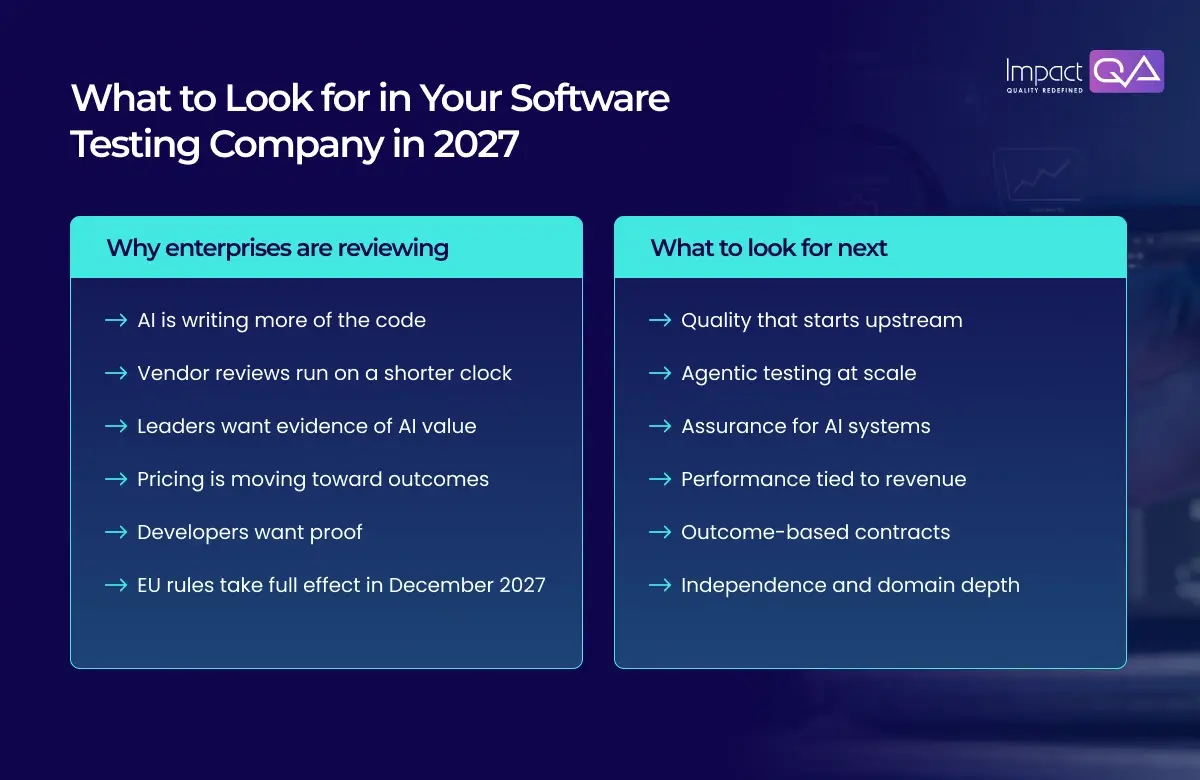
- 6 Reasons Enterprises Are Reviewing Their Software Testing Company in 2027
- 6 Things to Look for in Your Next Software Testing Company
- Final Say
- FAQs
Change is the only constant in life, and nothing defines it better than technology.
Just ask any enterprise that chose its software testing company three years ago, when the idea of AI-assisted development and autonomous agents was not a part of its engineering process.
Today, that choice is back on the table.
With worldwide IT spending forecast to reach $7.35 trillion in 2027, enterprises will continue investing in software, infrastructure and AI. More software, built faster, means more to verify before it reaches a customer.
As technology historian Melvin Kranzberg noted, “Technology is neither good nor bad; nor is it neutral.”
In the case of software quality, the value of the service is partially determined by the testing processes and skills. Meet the six forces behind the 2027 review, and the six qualities enterprises now want next.
ImpactQA tests LLMs, chatbots and autonomous agents for accuracy, bias, security and reliability.
6 Reasons Enterprises Are Reviewing Their Software Testing Company in 2027
Most of these reviews begin with a simple truth: the work itself has changed. The list is in no particular order:
1. AI Is Writing More of the Code
Code once arrived at the speed of an engineer’s fingers. Now, it arrives at the speed of a prompt.
Citizen developers, the business users who build apps with little formal coding training, can describe a tool and watch it appear. That freedom comes with a bill. Gartner predicts prompt-to-app approaches adopted by citizen developers will increase software defects by 2,500% by 2028.
It may consist of logic or architecture issues that regular tests do not detect. Automated software testing services must now account for higher release volumes and AI-generated code.
2. Buyers Are Reviewing Vendors on a Shorter Clock
In August, venture firm Madrona published a survey of 150 enterprise decision-makers. Some 74% plan to increase their AI spending in the next 12 months. Yet 77% re-evaluate their AI vendors at least every six months or on a rolling basis.
The firm writes that “switching costs are lower and the re-evaluation cadence is relentless.”
While the discovery applies to AI vendors, it also has relevance for software testing providers using AI. Enterprises will likely require more proof of tangible results from vendors.
3. Leaders Want Evidence of Value
In October, Gartner published its 2027 CIO agenda survey of 2,002 technology leaders.Some 13% of CIOs said their enterprise had realized significant or transformational value from AI.
Gartner’s strongest performers, which it calls vanguards, share a telling habit. They are more likely to set stop rules at both the pilot and production stages. A stop rule needs evidence, and that evidence usually comes from testing.
So software testing and QA services now feed a boardroom decision as well as a release decision.
4. Pricing Is Moving Toward Outcomes
For years, QA software testing services were sold by the hour or by the head. AI now automates parts of test creation, execution and maintenance.
ISG says AI is reshaping demand faster than managed services economics can adapt, which puts pressure on labor-based pricing. Forrester’s State of Technology Services 2026 report adds that technology leaders get more from providers by leaning into outcome-based pricing.
That leaves every renewal with a new question. What does an hour of testing buy when an agent did half the work?
5. Developers Want Proof
Stack Overflow’s 2026 Developer Survey drew more than 30,000 responses from 169 countries. Nearly half said they rely on AI output when they can verify it easily. Just 6.6% would rely on it for an important decision.
And 24% said their employer had published approved tools or formal guidance. Prashanth Chandrasekar, the company’s CEO, says “that skepticism now acts as a critical safeguard.”
A good testing partner validates AI-generated code and test cases before they enter production.
6. Regulation Now Has a Date
Enterprises selling into Europe have two dates circled for late 2027.
Under the revised EU AI Act timetable, requirements for high-risk AI systems covered by Article 6(2) and Annex III apply from 2 December 2027. The Cyber Resilience Act applies in full from 11 December 2027.
The CRA’s vulnerability and incident reporting obligations began on 11 September 2026. Testing partners can support compliance through traceable test evidence, security validation and documented verification.
6 Things to Look for in Your Next Software Testing Company
Buyers have plenty of room to choose. Technavio expects software testing services to add $27.61 billion between 2025 and 2030, growing at 11.7% a year, with North America contributing 42.8% of that growth.
The best software testing companies should be able to meet these six expectations.
1. Quality That Starts Upstream
Look for: Early involvement
Quality begins at the requirements stage. Frequently updated data pipelines and evolving models require validation throughout development, not just before release.
Strong partners define acceptance criteria before development begins and integrate automated tests into continuous integration and continuous delivery (CI/CD) pipelines to validate every change.
2. Agentic Testing That Works at Scale
Look for: Proof in your own stack
In October 2026, Gartner published its first Magic Quadrant for Agentic Software Quality Assurance Platforms.
An agent takes a plain goal and works out the test steps itself.
When a button moves, self-healing logic finds it again by comparing its other attributes.
Scale is the real test. The World Quality Report found 15% of organizations had taken generative AI in quality engineering to enterprise scale.
So ask for a live run on your own application, because every enterprise needs an AI-powered test automation strategy built on its real workflows.
3. Assurance for AI Systems
Look for: Testing of models and agents
Agents are arriving quickly.
Gartner research found 71% of technology leaders expect to deploy agentic AI within 12 months, while 21% have the governance capabilities in place.
AI also behaves differently from regular software, since the same input can return different answers.
Your partner should evaluate hallucination, where models generate unsupported or incorrect information.
It should also track drift, the slow change in model behavior over time, and confirm that agents stay within their permissions.
“We have to make sure that we have checks in place to validate what’s coming out,” says Nathen Harvey, who leads the DORA software delivery research program at Google Cloud.
4. Performance Engineering Tied to Revenue
Look for: Business-linked reliability
An hour of downtime is a board-level number.
ITIC’s 2024 survey found 41% of enterprises put that hour at between $1 million and more than $5 million.
Today’s software performance testing services reach well past load scripts. Look for service level objectives (SLOs), the reliability targets a business agrees to meet. Then look for chaos testing, which breaks parts of a system on purpose to prove it recovers. Also ask how it handles performance test automation for APIs, which carry much of the traffic between modern services.
5. A Commercial Model Built on Outcomes
Look for: Shared metrics
Agree on the numbers before signing.
Change failure rate shows how many releases cause trouble.
Escaped defect rate counts the bugs customers find first.
Time to restore service measures how quickly a team recovers from production failures.
Establish baselines within the first 30 days, then link part of the fee to agreed performance improvements. The reasons why enterprises outsource test automation have grown well beyond cost, and the contract should reflect that.
6. Independence and Domain Depth
Look for: Platform knowledge
Enterprise systems carry their own logic. A trade on a commodity platform and an order in SAP follow very different rules. Ask for engineers who have worked on your platforms. An independent partner tests code written by others, which keeps the verdict clean.
ImpactQA validates scalability, response times and system resilience through performance engineering.
Final Say
Technology will keep changing, and enterprise money is moving with it.
Gartner expects software spending to grow 14.6% in 2027 and IT services to grow 4.9%, so every services contract will need to show its worth.
The enterprises that review early will carry that clarity into the year.
ImpactQA supports them through AI-led quality engineering built on predictive analytics. Our products, FALCON and NeX-AI, support agentic test execution and test generation for SAP and commodity trading platforms, respectively. Our managed engagements can also be tied to outcomes.
Download the full case study and see how it works in action.
Frequently Asked Questions (FAQs)
Share this post


Related Posts
Our Case Studies