Quick Summary:
Does automation mean QA teams eventually run without manual testers? Not really, and the reason is different than “humans catch what machines miss.” QA spend breaks into five distinct cost centers, and automation compresses each one through a different mechanism, at a different rate. This piece pulls those mechanisms apart, shows the math behind the 15x defect-cost multiplier everyone cites without explaining, and works out where a 50% savings figure is earned versus where it’s aspirational.
Table of Contents:
- Introduction
- Where Does QA Spend Actually Go?
- Is 50% Realistic? What It Depends On
- How Automated Software Testing Cuts Cost — by Category
- What Automated Software Testing Services Actually Include
- Final Say
- Frequently Asked Questions
Here’s a question worth sitting with: if automated regression can run every night unattended, why do enterprise QA teams still budget for manual testers at all?
The answer is that automation and manual testing solve different problems. A script executes exactly what it’s told, at scale, without fatigue. It has no opinion on whether a checkout flow feels confusing, or whether an error message would make a real user panic. That judgment call is still a human one, and it’s precisely why “cutting QA costs” isn’t the same as “cutting QA headcount.”
What automation does change is the shape of the spend. Execution hours, defect-escape cost, release delays, maintenance, infrastructure, five cost centers, and automated software testing services move each one differently. Here’s the mechanism behind each.
ImpactQA automates repetitive regression cycles to accelerate releases and improve testing efficiency.
Where Does QA Spend Actually Go?
Most QA software testing services budgets are split across five cost centers: manual execution hours, the cost of defects that escape to production, release-delay cost, ongoing test maintenance, and testing infrastructure. Most budget reviews only track the first one, which is a problem, because it’s often not the biggest number on the list.
Sr. No. |
Cost Center |
What Drives It |
| 1. | Execution | Manual hours per regression cycle |
| 2. | Defect escape | Cost multiplier of bugs found post-release |
| 3. | Release delay | Revenue and opportunity cost of slipped dates |
| 4. | Maintenance | Script updates after UI or API changes |
| 5. | Infrastructure | Environments, devices, licenses |
Take that defect-escape multiplier seriously for a second, because the number everyone quotes (up to 15 times, per IBM’s Systems Sciences Institute) sounds abstract until you break down what actually happens after a bug ships.
A developer has to reproduce the issue, often on a production-like environment that doesn’t exist by default and has to be spun up. They context-switch out of whatever sprint work they were doing. QA re-verifies the fix, then re-runs regression to confirm nothing else broke. If the bug is customer-facing, there’s a hotfix deployment outside the normal release cadence, plus whatever support and comms cost comes with it.
None of that happens when the same bug gets caught by a test suite before merge. That’s where the multiplier comes from, and it’s also why defect-escape cost, not execution labor, is usually the real budget-eater hiding in plain sight.
Is 50% Realistic? What It Depends On
So, is 50% real, or is it a number that exists mainly in a pitch deck?
Both, depending on where you’re measuring.
Fifty percent is achievable, and even conservative, in execution and defect-escape cost specifically. As a blanket figure across the entire QA budget from day one, it’s a stretch, and here’s the technical reason why: test automation follows something like the classic Test Automation Pyramid — unit and API-level tests are cheap to write and cheap to maintain, while UI-level end-to-end tests are expensive on both counts and far more prone to the locator-drift problem described above.
Teams that automate a shallow layer of flaky UI tests instead of a deep base of unit and API tests end up with high maintenance overhead eating into whatever they saved on execution. The 50% number holds up when coverage is weighted toward the cheap, stable layers of that pyramid. It falls apart when it isn’t.
Most of the top software testing companies land around 25 to 35% in year one, with the fuller number arriving once test-pyramid shape and maintenance discipline both mature.
How Automated Software Testing Cuts Cost — by Category
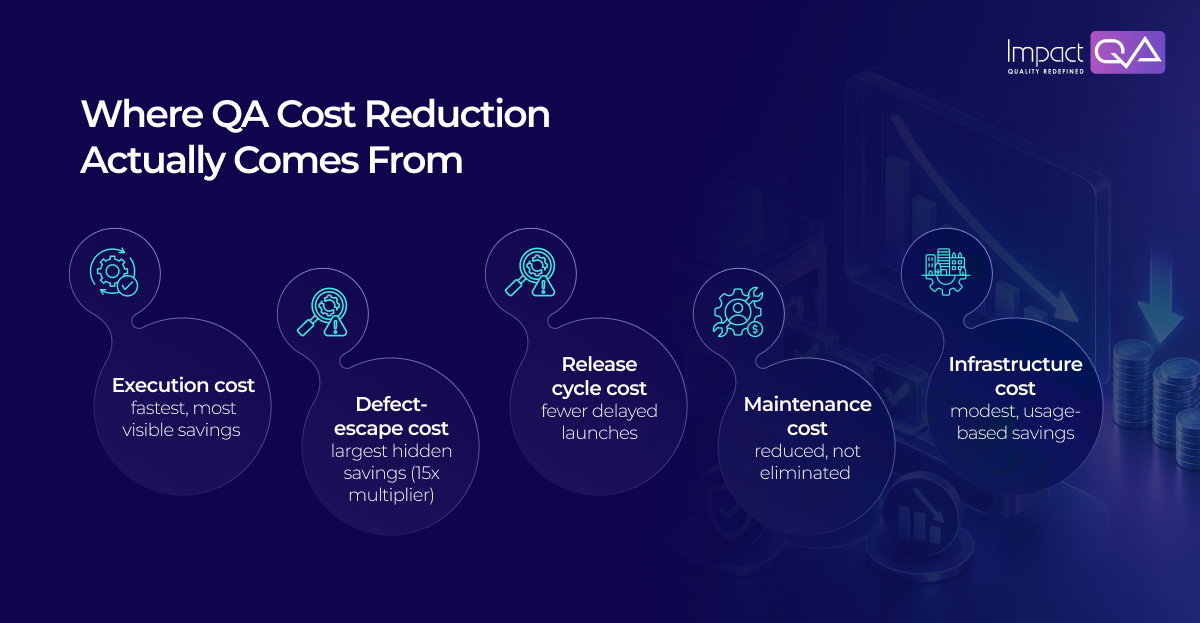
Automation works through five distinct mechanisms here
Category 1: Execution Cost
The obvious lever, and the one people picture first. But the “runs overnight” story undersells the actual mechanism: parallelization. A regression suite that takes 40 hours sequentially can run in under two if it’s distributed across a grid of containers or cloud devices, each executing a slice simultaneously. That’s not automation making tests faster individually; it’s automation making them run in parallel at all, which manual execution structurally can’t do.
Category 2: Defect-Escape Cost
Same logic as above, applied earlier in the pipeline. Automated regression on every commit or nightly build catches the bug before it merges, not after it ships.
Given the reproduction-and-hotfix chain described earlier, this is usually where the largest dollar savings sit, even though it never shows up as a line item the way execution hours do.
Category 3: Release Cycle Cost
Faster, more frequent test cycles shrink the gap between “code complete” and “safe to ship.” Capgemini’s World Quality Report found 56% of organizations cite reduced test costs as a direct benefit of automation, and cycle-time improvement tends to travel with it, since both come from the same root cause: less waiting on manual verification.
Category 4: Maintenance Cost
This is where the story gets honest, because it’s the category vendors tend to gloss over. Capgemini’s report puts ongoing test maintenance at 25 to 50% of QA budget, even in mature automation suites.
Why doesn’t automation kill this cost outright? Because most test failures aren’t logic failures, they’re locator failures: a button’s DOM ID changes, a CSS selector shifts, and the script breaks even though the feature works fine.
Self-healing frameworks address exactly this by using AI to re-anchor to the element via a similarity score across multiple attributes (text, position, structural context) instead of one brittle ID. That kills a large share of maintenance tickets. It doesn’t touch the other kind of maintenance: when the business logic itself changes, and someone has to rewrite what the test is actually asserting. No algorithm re-anchors around a requirements change.
Category 5: Infrastructure Cost
Cloud-based device labs and shared environments swap fixed hardware spend for usage-based billing. Real money saved, though modest next to what execution and defect-escape improvements deliver, since infrastructure was rarely the biggest line item to begin with.
What Automated Software Testing Services Actually Include
A software testing company worth hiring brings more than scripting speed to the table. At minimum:
- Test strategy and coverage planning: deciding what belongs in each pyramid layer, since automating the wrong layer is how “we automated everything” still ends up expensive
- Framework architecture: built with self-healing locators and modular design so a UI change breaks one component, not forty scripts
- CI/CD integration: tests triggered on every commit, catching regressions before merge instead of during a scheduled nightly run
- Test data management: synthetic and masked data that keeps tests realistic while keeping real customer records out of test environments
- Performance and API testing: software performance testing services built into the pipeline from day one, since a functionally correct feature that buckles under load is still a production incident waiting to happen.
ImpactQA helps you leverage AI to accelerate quality assurance, improve efficiency, and support continuous growth.
Final Say
The interesting shift coming is automation getting better at knowing what it shouldn’t touch. AI-assisted test generation is starting to distinguish locator-level noise (a button moved) from logic-level signal (a business rule changed), which is exactly the distinction that’s kept maintenance cost stubborn for years.
As that gets sharper, the 25-to-50% maintenance tax should start shrinking in a way self-healing alone never fully achieved. The best software testing companies worth paying attention to over the next few years will be the ones that can explain that distinction clearly, not the ones still selling automation as a single dial that turns QA cost down to zero.
Everything you need to know, in one download.
Frequently Asked Questions (FAQs)
Share this post


Related Posts
Our Case Studies