
Quick Summary:
ERP is evolving from a system of record into a more connected, AI-enabled business platform. Cloud releases are becoming continuous, integrations are multiplying, and AI is increasingly embedded inside ERP workflows. As a result, ERP testing is moving beyond periodic functional regression toward AI-augmented, continuous, risk-based quality engineering. The nine trends below examine how ERP software testing, automation, data validation, performance engineering, and AI testing are likely to shape enterprise QA strategies in 2027.
Table Of Contents:
- Introduction
- AI-Augmented ERP Testing Moves Into the Mainstream
- Agentic AI Starts Changing ERP Test Automation
- Continuous Testing Replaces Periodic ERP Validation
- Integration Testing Becomes Central to ERP Quality
- Data Testing Becomes a First-Class ERP Discipline
- Testing AI Embedded Inside ERP Becomes a New QA Requirement
- Hybrid and Composable ERP Require Modular Testing
- Risk-Based Regression Replaces “Test Everything”
- ERP Performance, Security, and Resilience Testing Become Continuous
- What These ERP Testing Trends Mean for 2027
- How Should Organizations Prepare for 2027?
- Final Say
- FAQs
Modern ERP environments are increasingly cloud-based, interconnected, continuously updated, and augmented with AI. Gartner forecasts that 62% of cloud ERP spending will be on AI-enabled solutions by 2027, up from 14% in 2024.
For QA teams, the shift changes what needs to be validated. An ERP now sits within a wider network of business processes, APIs, data, extensions, cloud services, AI capabilities, and external applications.
Gartner’s Market Guide for AI-Augmented ERP and CRM Testing Tools also points to increasing release cadence, customization, resilience, compliance, and test coverage as key forces shaping the market.
These nine trends show where ERP application testing is heading in 2027.
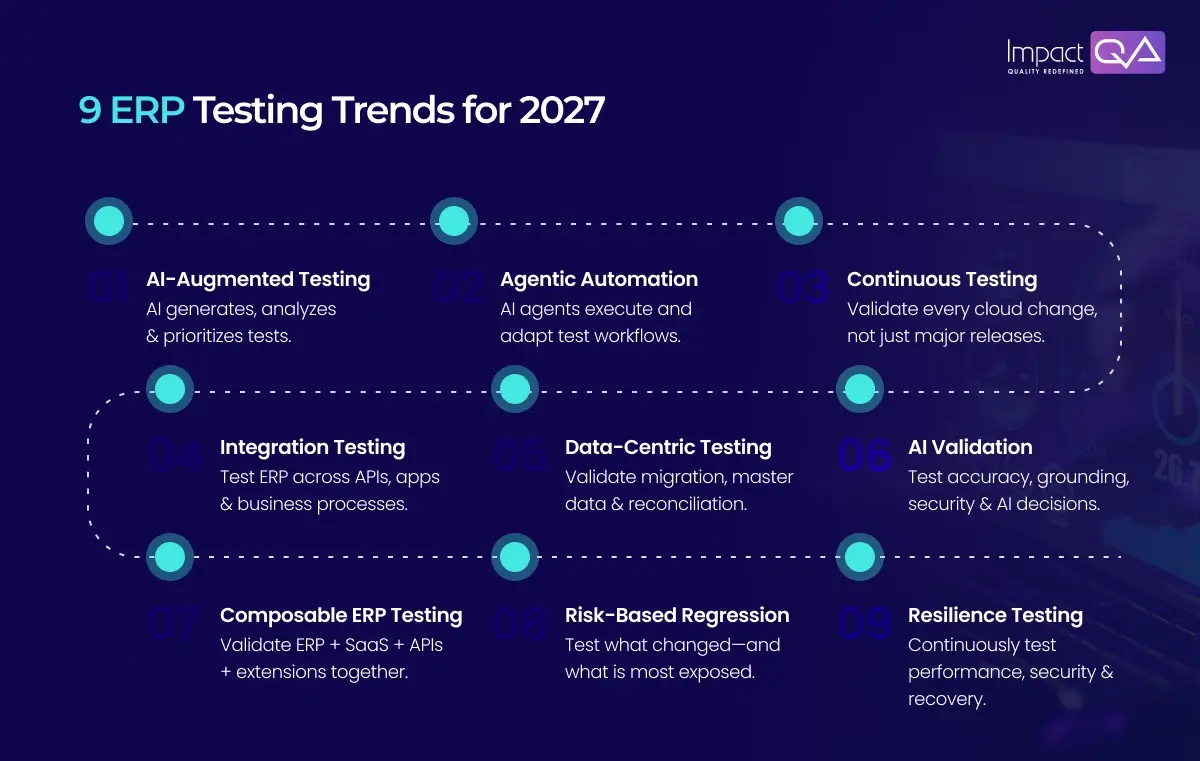
AI-Augmented ERP Testing Moves Into the Mainstream
AI is moving from an optional testing accelerator toward an increasingly integrated part of the ERP quality lifecycle.
Gartner defines AI-augmented software testing tools around capabilities such as test generation and maintenance, suite optimization, prioritization, analysis, and test-value scoring. These tools are designed to reduce manual intervention across the testing lifecycle.
In ERP environments, this can translate into AI-assisted test generation, change-impact analysis, regression selection, test-data creation, defect analysis, and result summarisation.
The important shift is that AI is beginning to support the testing lifecycle, not simply the creation of test scripts.
ImpactQA helps test AI-enabled ERP processes for accuracy, reliability, and business-rule compliance.
Agentic AI Starts Changing ERP Test Automation
The next step beyond AI assistance is AI that can execute multi-step testing tasks with greater autonomy.
Gartner’s 2026 research describes software testing moving toward agentic testing platforms, while its ERP research describes a broader evolution toward systems that can reason, act, and adapt with less human intervention.
For ERP test automation, agentic capabilities could include:
Understand the requirement → determine affected workflows → generate tests → execute → analyze failures → recommend next action
That does not eliminate human QA involvement. Instead, it changes the tester’s role from manually orchestrating every step toward supervising risk, coverage, business logic, and outcomes. For a deeper look at how agent-driven testing is being applied to SAP environments, see our guide to agentic AI for continuous testing in S/4HANA.
Continuous Testing Replaces Periodic ERP Validation
Cloud ERP has changed the release calendar. Oracle environments, for example, can receive frequent updates, patches, configuration changes, and integration modifications.
The traditional pattern:
Upgrade → Test → Go Live
is evolving into:
Change → Analyze Impact → Automate Validation → Release → Monitor
This makes ERP testing services relevant throughout the application lifecycle..
Integration Testing Becomes Central to ERP Quality
An enterprise workflow can pass through ERP, CRM, HCM, banking systems, supply-chain applications, APIs, middleware, data platforms, and third-party SaaS applications.
Forrester’s 2026 ERP research identifies AI-driven automation, APIs, interoperability, and increasingly federated application estates as important directions for ERP.
As a result, ERP software testing must increasingly validate the transaction across system boundaries.
Consider a procure-to-pay process:
Purchase Order → Goods Receipt → Invoice → Approval → Payment → General Ledger
For each individual application to work correctly, integration, API, middleware, event, and reconciliation testing needs to be central to ERP quality.
Data Testing Becomes a First-Class ERP Discipline
ERP quality ultimately depends on data quality.
Migration programs, master-data synchronization, integrations, reporting, analytics, and AI workflows all depend on accurate and consistent information.
Gartner identifies data quality and integration complexity as significant barriers to realizing the value of AI-enabled cloud ERP.
That puts greater emphasis on:
- Data migration validation
- Master-data testing
- Transaction reconciliation
- Data integrity
- Data lineage
- Cross-system consistency
- Historical-data validation
This trend is particularly important during ERP transformation, when organizations must prove that information moving from legacy environments into modern platforms remains complete, accurate, and usable.
Testing AI Embedded Inside ERP Becomes a New QA Requirement
As AI becomes part of ERP itself, testing the AI becomes as important as testing the ERP workflow around it.
Gartner’s 2026 ERP research identifies AI trust, risk, and security management as an emerging theme. Its research also recommends augmenting ERP with AI rather than attempting to replace the complete ERP foundation with custom AI systems.
AI-enabled ERP can support forecasting, recommendations, conversational assistance, predictive analytics, classification, and workflow decisions. These capabilities introduce testing questions around accuracy, consistency, grounding, security, and human oversight.
That creates a new layer of ERP application testing alongside conventional functional and integration validation.
Hybrid and Composable ERP Require Modular Testing
ERP architecture is becoming less monolithic.
Forrester’s 2026 ERP landscape describes cloud as the architectural standard while noting that hybrid remains common, particularly in regulated environments. It also highlights composability, APIs, interoperability, and autonomous orchestration as important market directions.
The implication for testing is significant.
A modern ERP environment may look more like:
Core ERP + SaaS Applications + Extensions + APIs + Data Platforms + AI Services + Legacy Systems
Testing therefore needs to move from isolated module validation toward ecosystem validation.
This also changes the role of ERP testing tools. A tool that works well for a single ERP interface may not be sufficient for testing a distributed business process spanning APIs, databases, cloud applications, and third-party services.
Risk-Based Regression Replaces “Test Everything”
Enterprise ERP regression suites can become too large to run in full for every change.
The future therefore belongs to regression strategies that ask not only what changed, but what business processes are exposed to that change.
AI can support:
- Change-impact analysis
- Risk-based test selection
- Business-process mapping
- Regression prioritization
- Predictive defect analysis
- Test-suite optimization
Gartner’s AI-augmented testing definition explicitly includes test-suite optimization, test prioritization, test analysis, and test-value scoring.
The result is a more targeted regression model:
Application Change → Dependency Analysis → Business Risk → Priority Tests → Focused Regression
For large ERP environments, that can be more sustainable than continually expanding a monolithic regression suite.
ERP Performance, Security, and Resilience Testing Become Continuous
ERP failures are rarely confined to a screen or transaction. Performance degradation, availability issues, security weaknesses, or integration failures can disrupt entire business operations.
That makes ERP performance testing increasingly important as organizations move more processes into cloud and interconnected ERP environments.
Modern resilience testing should examine:
- Response times
- Throughput
- Concurrent users
- Batch workloads
- API performance
- Resource utilization
- Peak transaction volumes
- Failover behavior
- Recovery scenarios
Security testing must extend beyond the ERP interface to include APIs, integrations, identity, authorization, databases, extensions, and sensitive business data.
The broader objective is not simply application performance. It is business resilience under operational pressure.
What These ERP Testing Trends Mean for 2027
The convergence of cloud ERP, AI, APIs, and continuous change is redefining enterprise quality engineering.
The testing model is shifting:
S. No. |
Traditional ERP Testing |
2027 ERP Testing |
| 1. | Periodic testing | Continuous validation |
| 2. | Module-focused | End-to-end ecosystem testing |
| 3. | Script-driven | AI-augmented and agentic |
| 4. | Manual regression selection | Risk-based prioritization |
| 5. | UI-centric | UI + API + data |
| 6. | Fixed automation | Adaptive automation |
| 7. | Deterministic applications | AI-enabled workflows |
| 8. | Defect detection | Risk and reliability intelligence |
Conventional functional, integration, security, performance, data, and exploratory testing remain part of the model. What changes is how those activities are orchestrated around business risk.
How Should Organizations Prepare for 2027?
Preparing for the next phase of ERP quality requires more than purchasing another automation platform.
Organizations should first map their critical business processes, identify dependencies across systems, and understand where ERP changes create the greatest operational risk.
From there, an effective strategy can combine:
Business-process coverage + ERP test automation + data validation + integration testing + AI-assisted regression + performance and security engineering
The right technology stack will depend on the ERP landscape.
For Oracle environments, Oracle ERP testing may need to cover Oracle EBS, Oracle Fusion, Oracle Cloud applications, configurations, customizations, integrations, and data flows. Our guide to building an automated Oracle testing strategy that scales explores how that strategy can evolve as the environment expands.
The same principle applies when evaluating Oracle ERP testing tools: the requirement is not simply automating a screen, but validating the business process and its dependencies.
Organizations evaluating ERP Testing Service Providers or comparing ERP Testing companies should therefore examine their capabilities across automation, data, integration, performance, security, cloud ERP, and AI-driven testing rather than looking only at functional test execution.
ImpactQA tests Oracle applications, configurations, customizations, integrations, and workflows release cycles.
Final Say
ERP is becoming an intelligent, connected operating layer. Cloud releases are accelerating, integrations are expanding, and AI is becoming part of everyday enterprise workflows.
That changes the role of ERP software testing. Quality now depends on validating the business process and the systems around it, including data, integrations, AI behavior, performance, security, and resilience.
For 2027, the strongest ERP testing strategies will be those that can respond to change with the right coverage at the right point in the lifecycle.
Download the full case study and see how it works in action.
Frequently Asked Questions (FAQs)
Share this post


Related Posts
Our Case Studies
