Quick Summary:
Gartner’s 2025 survey found that 97% of chief audit executives planned regulatory compliance coverage for 2026. For plants, that coverage lands on the software holding batch records, lot genealogy and approvals. This guide explains how manufacturing software testing turns traceability into evidence, which regulatory updates matter now, and what to expect from a testing partner.
Table of Contents:
- Introduction
- What Traceability and Audit-Readiness Mean for Manufacturing Software
- How Manufacturing Software Testing Builds Traceability
- Test Automation Services Keep Evidence Current
- What to Expect From a Manufacturing Software Testing Services Partner
- Final Say
- Frequently Asked Questions
On the morning when an auditor asks which raw material lot went into batch 4471 and who approved the recipe change that affected it, a plant has the time it takes to refill a coffee to answer.
Because the answer is already inside MES, ERP and shop-floor software. Manufacturing software testing has already checked this information.
Regulators are making the requirements, for this proof stricter. The new rules go directly into the software. This guide shows how testing makes traceability into a record that an auditor can read. It also explains which updates need attention now and helps you choose a partner who produces that evidence on schedule.
ImpactQA tests MES, ERP and shop-floor systems for traceability, so records are available on request.
What Traceability and Audit-Readiness Mean for Manufacturing Software
Traceability is like a trail that connects everything – the materials, the machines, the people operating them, and the approvals – to the final product. And then there’s audit-readiness, which means being able to show that trail, or record, whenever someone asks for it. In the software used for manufacturing, both things rely on data moving smoothly between the shop floor, the MES system, and the ERP system.
Three regulatory moves make that verification timely. The table lines them up.
Update |
Date |
What it asks of software teams |
| FDA final guidance on Computer Software Assurance | September 2025 | Risk-based confidence in automation used in production and quality systems |
| EU GMP draft updates to Annex 11 | Released 7 July 2025 | A clear shift toward audit trails, security and identity and access management |
| EU Cyber Resilience Act reporting | Live from 11 September 2026 | Early warning within 24 hours and full notification within 72 hours for exploited vulnerabilities in connected products |
Which rule applies depends on the sector, and each one points to the same asset: software that behaves predictably and leaves a readable trail.
How Manufacturing Software Testing Builds Traceability
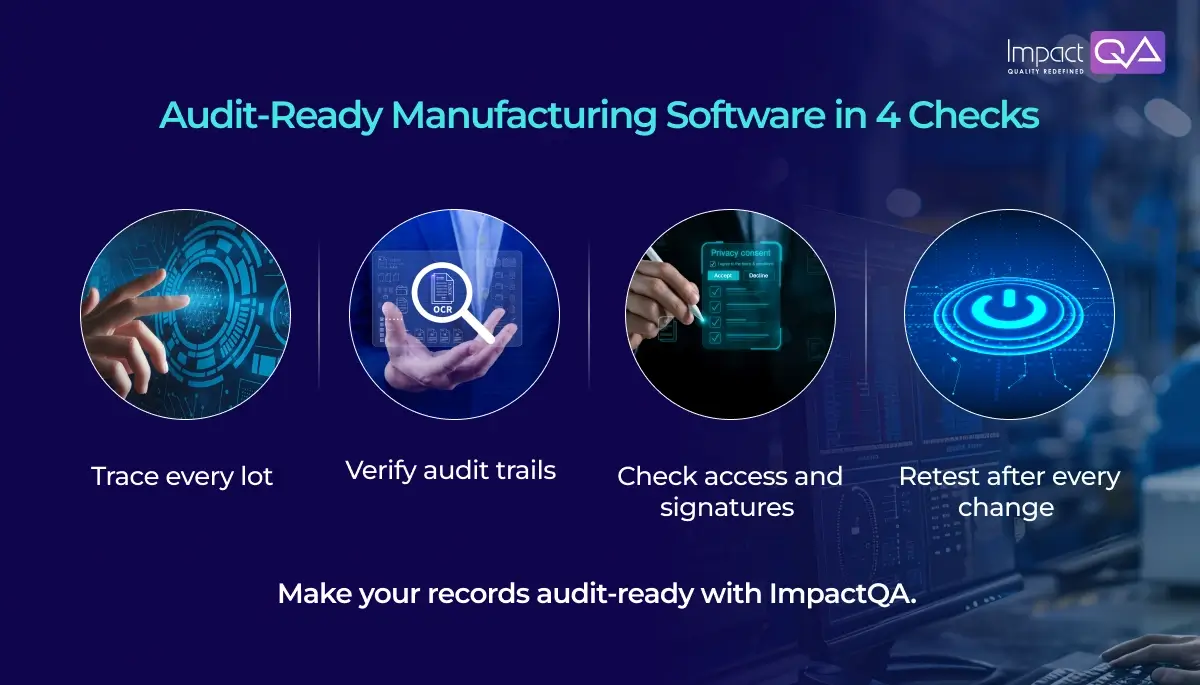
Manufacturing software testing builds traceability by showing that a record made on the shop floor reaches MES and ERP unchanged and keeps its history and ownership along the way. Four test families cover that path. Each one creates evidence.
1. Genealogy Tests Across MES and ERP
A genealogy test follows one lot forward to every finished batch and backward to every supplier, then reconciles the result against both systems. Mismatched unit conversions or delayed interface retries show up here first. Our article on ERP testing for the manufacturing industry explains why ERP and MES workflows deserve validation as one chain.
2. Audit Trail Verification
Testers alter the value. Verify that the system records who changed it, when it was changed, the old value, the new value, and the stated reason. Time stamps receive attention. When a PLC, an MES server and an ERP host disagree on the clock by a second, the event order in the audit trail can change, and a good test catches that drift.
3. Access Control and Electronic Signature Checks
Role-based access tests confirm that an operator, a supervisor and a quality approver each see and do only what their role allows. Signature tests confirm that an approval binds to a named user and a specific record version. Connected equipment adds another layer, and our guide to testing solutions for manufacturing in the era of Industrial IoT covers how device-level behavior feeds these records.
4. Upgrade and Migration Regression
Every patch, release and data migration can touch validated behavior. Regression suites confirm that historical batch records, genealogy links and audit entries survive the change in readable form.
Test Automation Services Keep Evidence Current
Compliance evidence becomes outdated fast. Every patch, configuration update or software release can change how a system behaves. That’s why test automation services automatically rerun traceability and audit-trail checks with every change. They save results with timestamps, so the evidence stays current between audits.
FDA’s guidance from September 2025 promotes a risk-based approach. This idea guides how we plan automation. High-risk functions, like batch release and electronic approvals—get repeatable test scripts. Lower-risk screens get checks. This keeps effort in line with the risk. It also gives auditors a documented reason for every decision.
Strong manufacturing test software saves every result with the build version, the time it was run, and the person who approved it. So a pass in March stays a pass in October. Quality engineering services take this practice further. They build traceability checks into requirements and design reviews. This helps ensure nothing is missed in the process. Our article on agentic AI automation in manufacturing testing shows where AI-assisted scripts add speed to this routine.
What to Expect From a Manufacturing Software Testing Services Partner
A partner providing manufacturing software testing services should demonstrate how their testing process aligns with the regulations, records, and ownership. This includes tests that comply with the requirements, quality engineering processes starting from the design process, and 24/7 availability for maintaining validations alongside the production process.
Useful questions are specific. Which systems does the team test: PLCs and HMIs on the floor, or the MES and ERP layers above them? How does it reconcile one transaction across all of them? Can it show a sample evidence pack with versions and time stamps? These Software testing services questions separate a general QA vendor from a team that understands software testing in manufacturing industry environments.
Results from live programs help too. ImpactQA’s continuous testing and delivery work for a hybrid Oracle EBS and Dynamics 365 environment shows how an evidence-ready pipeline operates day to day.
ImpactQA validates shop-floor and enterprise systems under one engagement, backed by 24x7 testing support.
Final Say
Audit expectations are moving toward live, system-generated evidence, and the FDA, EU and Cyber Resilience Act updates all point the same way. Manufacturers that invest in repeatable test evidence now will meet each new rule with a quick refresh of existing tests.
ImpactQA supports that direction with functional, security, performance and integration testing across plant and enterprise layers, model-based and shift-left methods, IoT-enabled labs and 24×7 support, including its work optimizing Oracle EBS for a Fortune 500 crane manufacturer. Each engagement builds test coverage around the compliance requirements a plant carries.
Frequently Asked Questions (FAQs)
Share this post


Related Posts
Our Case Studies