How Is Gen AI Impacting Business by Driving Innovation in Software Testing Strategies

Quick Summary:
Generative AI (Gen AI) is no longer a distant concept but an active agent of change across multiple business functions. Software testing is reshaping test strategies, speeding up development cycles, and introducing unprecedented accuracy. This blog explores the strategic implications of Gen AI on business innovation in software testing. It breaks down key advances, new roles, and use cases, and outlines how ImpactQA is helping organizations align AI-enabled testing with business outcomes.
Table of Contents:
- Introduction
- Gen AI: A New Catalyst in Software Testing
- Redefining Test Automation with Gen AI
- Intelligent Test Case Generation and Optimization
- Gen AI in Test Data Management and Security
- Continuous Testing at Scale
- The Human-AI Collaboration in QA Teams
- Gen AI Impact on Business
- Strategic Challenges in Adopting Gen AI
- Conclusion
Digital enterprises seek faster releases, fewer bugs, and adaptive testing cycles. With increasing code complexity, shorter sprint cycles, and diverse tech stacks, legacy testing methods often fail to keep pace. Generative AI (Gen AI) offers a new trajectory for transformation. It’s not about replacing testers but augmenting them with capabilities that improve efficiency and precision.
Gen AI can parse large datasets, generate test cases, detect anomalies, and even simulate user behaviors without manual scripting. This makes it a strong enabler for QA teams working under tight deadlines. Businesses are beginning to realize the broader implications – not just faster testing, but better decisions, optimized resource use, and fewer post-release defects.
According to a Capgemini report, 82% of organizations have already integrated or plan to integrate AI into their testing operations. Gen AI doesn’t just promise speed; it enables smarter testing strategies that align more closely with business objectives. This blog dives into the breadth and depth of Gen AI’s role in reshaping software testing, offering both a strategic and technical lens.
Talk to ImpactQA for AI-driven automation strategies tailored to your needs.
Gen AI: A New Catalyst in Software Testing
Generative AI introduces transformative automation at every level of software testing. Traditional testing relies on pre-defined scripts and exhaustive manual checks. In contrast, Gen AI introduces adaptive testing logic that can evolve with application updates. It’s dynamic, context-aware, and data-driven.
Key shifts include:
- Scriptless automation using natural language inputs
- Predictive test analytics to identify high-risk areas
- Self-healing test scripts that adapt to UI or API changes
Gen AI helps QA engineers move from reactive test execution to proactive quality governance. It increases test coverage while reducing time spent on repetitive tasks.
Redefining Test Automation with Gen AI
Automation isn’t new, but Gen AI redefines how we perceive and implement it. Traditional automation frameworks require skilled engineers to write and maintain scripts. With Gen AI, testers can describe scenarios in plain language and get executable scripts in return.
It reduces onboarding time for new QA team members by simplifying script development. Even non-technical stakeholders can contribute to automation planning with greater clarity.
Benefits include:
- Automated script generation for UI, API, and integration tests
- Reduced maintenance through auto-healing scripts
- Improved accuracy in identifying flaky tests
These features help QA teams shift left by catching issues early in the development lifecycle. Automation becomes more sustainable, adaptable, and inclusive across cross-functional teams.
Intelligent Test Case Generation and Optimization
Modern QA teams are inundated with scattered documentation, fragmented data, and time-consuming case creation. Gen AI offers a more refined approach by transforming scattered requirements into high-value test cases. Instead of starting from scratch, testers can now rely on AI to interpret existing artifacts and generate meaningful, scenario-based validations.
Auto-generation of test cases based on user stories
→ Gen AI scans requirement documents to produce test cases that reflect real-world workflows and expected user behavior.
Risk-based prioritization
→ AI helps in ranking test cases by identifying which functionalities are more prone to failure or have a high business impact.
Elimination of redundant or low-value test cases
→ By comparing past test results and usage metrics, Gen AI removes repetitive cases, streamlining the test suite for greater efficiency.
Gen AI in Test Data Management and Security
Generating and managing test data remains a bottleneck, especially with increasing regulatory pressure around privacy and compliance. Gen AI enables testers to create datasets that resemble production without risking exposure to sensitive data. It also reduces the manual effort involved in preparing and refreshing data for different test cycles.
Data masking and anonymization
→ Sensitive fields such as personal identifiers are obscured while preserving referential integrity for valid test outcomes.
Synthetic data generation for edge cases
→ AI can simulate extreme, rare, or boundary-case inputs to test how systems behave under less common conditions.
Dynamic test data provisioning for CI/CD pipelines
→ Gen AI supports real-time generation and injection of data. This ensures that pipelines never stall due to unavailable or stale datasets.
Continuous Testing at Scale
In large-scale development environments, continuous testing isn’t optional – it’s essential. Gen AI supports high-volume, rapid regression cycles by offering intelligent triggers, adaptive test selection, and actionable feedback. Its ability to interact with modern DevOps pipelines makes it a dependable ally in scaled QA.
Real-time test feedback
→ Test results are available instantly, helping teams identify failures without waiting for a full cycle to complete.
Dynamic environment provisioning
→ AI assesses the needed environments and sets them up with preloaded test data and configurations.
Smart defect triaging
→ Gen AI categorizes, prioritizes, and suggests root causes for detected defects to accelerate issue resolution.
The Human-AI Collaboration in QA Teams

Gen AI doesn’t replace testers – it reshapes their role. With routine tasks automated, QA professionals move towards strategy, oversight, and AI supervision. This shift gives rise to new titles and responsibilities, bridging domain knowledge with AI fluency.
AI model trainers for QA datasets
→ These professionals curate and refine training data to improve the accuracy of AI models in QA functions.
AI explainability engineers
→ They ensure the AI’s decision-making process in testing is understandable, auditable, and trustworthy.
QA strategists for Gen AI workflows
→ Responsible for integrating Gen AI outputs into practical, scalable testing processes while maintaining coverage goals.
Gen AI Impact on Business
Beyond testing efficiency, Gen AI contributes directly to key business metrics. Faster feedback, quicker resolutions, and fewer post-production errors translate into better user satisfaction and leaner operations. Companies integrating Gen AI into QA are seeing measurable returns in delivery speed and cost reduction.
Faster feedback loops
→ Issues are identified earlier in the cycle, reducing the need for late-stage firefighting.
Higher developer productivity
→ Developers spend less time debugging or rewriting code due to clearer, earlier test results.
Improved risk coverage
→ AI helps uncover critical vulnerabilities that manual prioritization might miss.
Strategic Challenges in Adopting Gen AI
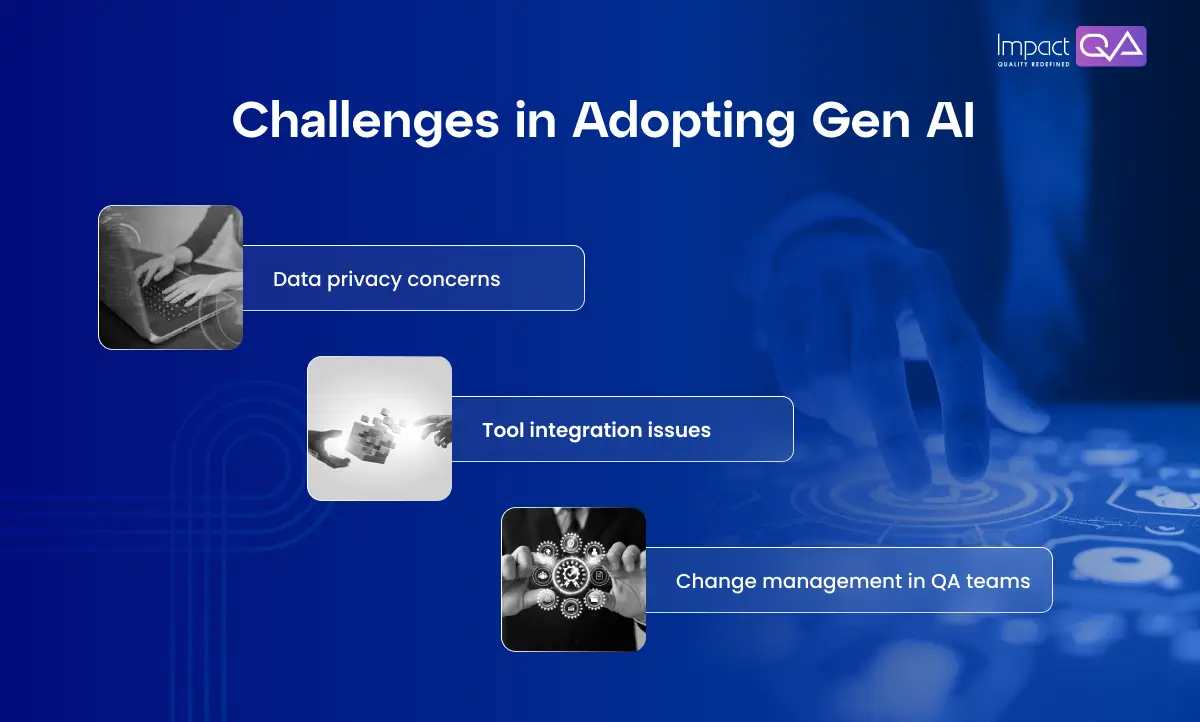
Despite its advantages, implementing Gen AI into QA requires more than just new tools. Organizations must overcome technical, organizational, and ethical challenges. Successful adoption depends on building the right infrastructure, gaining team buy-in, and setting realistic expectations.
Data privacy concerns
→ AI systems often require large data sets, but using sensitive customer information comes with legal and compliance risks.
Tool integration issues
→ Many enterprises use a complex stack of QA tools that don’t always support AI-driven workflows out of the box.
Change management in QA teams
→ Shifting from manual to AI-augmented testing requires training, mindset shifts, and redefined roles.
It’s crucial to start small, measure impact, and iterate. Pilot programs focused on a limited scope often offer more clarity than blanket implementations.
Let ImpactQA help optimize your QA efforts with Gen AI-backed solutions.
Conclusion
Gen AI is reshaping software testing from a process-heavy discipline into a strategic enabler of business goals. What was once a reactive function is now becoming a strategic contributor to product quality and speed of delivery. The changes are structural, touching test planning, data management, execution, and feedback.
From smarter data provisioning to AI-generated test cases, businesses are experiencing tangible benefits like reduced cycle times, increased accuracy, and fewer production incidents. This transformation depends not just on tools, but on a clear strategy and trusted implementation partner.
ImpactQA is leading this shift by helping organizations adopt Gen AI in meaningful, scalable ways. With tailored solutions across testing automation, AI-driven test design, and performance engineering, ImpactQA equips QA teams to deliver faster, with fewer risks. Our experience ensures each initiative aligns with both technical and business outcomes.
Share this post


Related Posts
Our Case Studies