Quality Engineering Trends for 2025 to Boost the Productivity of Your Business

Quick Summary:
The shift from traditional QA to modern Quality Engineering reflects a broader business priority – speed without compromise. In 2025, QE will no longer serve as a support function. It will operate as a key discipline integrated across the software lifecycle, powered by AI, big data, low-code tools, and cloud-native strategies. This blog explores eight distinct QE trends shaping this evolution and offers valuable insights for businesses looking to drive productivity through more innovative quality practices
Table of Contents:
- AI and Machine Learning in Quality Engineering
- Integrating Big Data with QE
- Intelligent Automation in Testing
- DevOps and Shift-Left Testing Integration
- Test Automation with Low-Code/No-Code Solutions
- Cloud-Native Testing Strategies
- Predictive Analytics for Risk-Based Testing
- Autonomous Testing with GenAI and Self-Healing Capabilities
- Final Say
Are businesses treating quality like a checkbox, or are they embedding it across every digital initiative as a shared responsibility? In 2025, this distinction will define the winners. Companies can no longer afford reactive testing strategies. Quality must now be built into each stage of the development cycle – from ideation to deployment. This shift is not driven by industry hype but by the practical need to reduce release timelines, eliminate risks early, and build customer trust through performance and reliability.
Emerging quality engineering trends aren’t just about using new tools but reflect a larger movement toward intelligent decision-making. Businesses are deploying AI to make test cycles smarter, using real-time data for faster feedback and exploring automation that learns from every interaction. These practices allow for higher throughput, less rework, and greater clarity across development workflows. The focus has shifted from testing more to testing wisely – prioritizing insight over volume and eliminating blind spots before they become setbacks.
Switch to intelligent automation and low-code tools with ImpactQA’s custom automation suites.
AI and Machine Learning in Quality Engineering
The infusion of AI and Machine Learning into QE continues to reshape testing workflows and decision-making models. These technologies help predict failures, recommend test cases, and even generate scripts dynamically. AI algorithms analyze historical test execution data and application logs to identify risk-prone areas that require targeted testing. This helps in focusing test resources where they matter most.
Machine Learning models also improve over time by learning from real-world user behavior. This adaptive intelligence strengthens regression testing, functional validation, and test coverage. Additionally, techniques like Natural Language Processing (NLP) are being used to convert business requirements directly into executable test cases, reducing human intervention and accelerating test design cycles.
Enterprises that integrate AI in quality assurance are already reporting reductions in defect leakage and time-to-release. As data maturity increases across organizations, the accuracy and ROI of AI-based testing will continue to grow, redefining what quality means in a modern development pipeline.
Integrating Big Data with QE
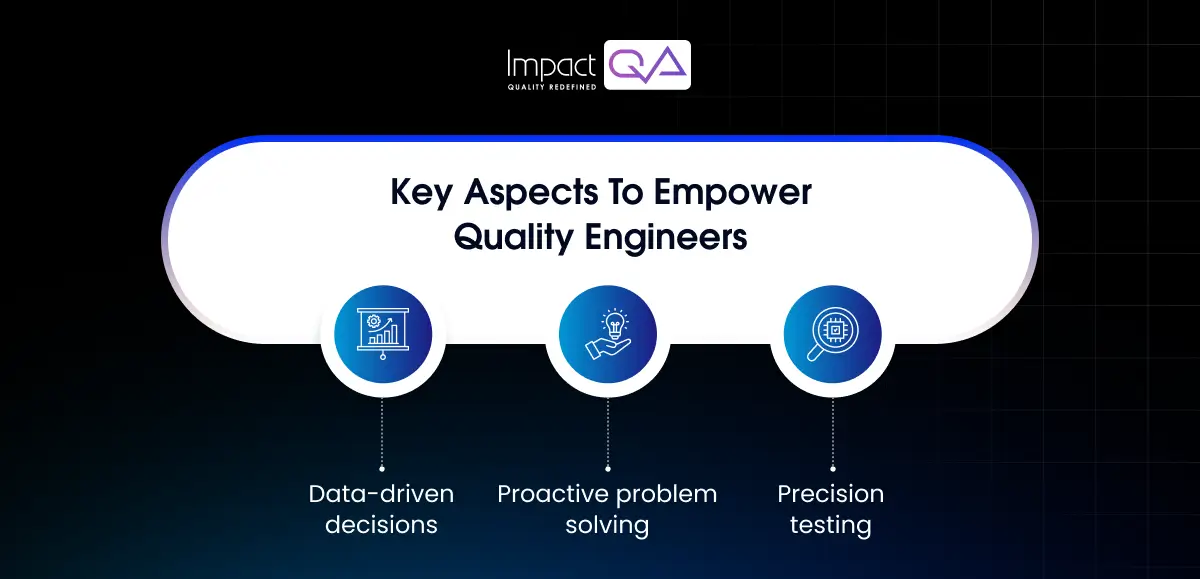
The ever-growing tide of data, fueled by user interactions and connected devices (IoT), is fundamentally reshaping how companies guarantee software quality. This data deluge, combined with advancements in technology, is revolutionizing both software development and testing methodologies.
Big data acts as a powerful tool, offering a granular perspective on user behavior, system metrics, and performance indicators. This comprehensive data empowers quality engineers in several keyways:
- Data-driven decisions: Engineers can pinpoint recurring patterns and uncover potential problems by meticulously analyzing vast datasets. This in-depth analysis allows for informed decision-making, enabling the identification and prioritization of areas requiring improvement.
- Proactive problem solving: Advanced analytics have the potential to predict quality issues before they manifest. Early detection empowers companies to address these concerns proactively, saving both time and financial resources. This preventive approach minimizes the need for reactive bug fixes after product development.
- Precision testing: Big data analytics can refine testing plans by highlighting critical areas that warrant focused attention. This data-centric approach ensures that testing efforts are targeted and yield the most valuable insights, optimizing the software development process.
Intelligent Automation in Testing
Intelligent automation is transforming software testing into a dynamic, decision-driven function. Unlike traditional automation, which relies on pre-programmed instructions, intelligent automation uses contextual awareness powered by AI and cognitive technologies. It adapts test scripts in real time based on application changes and user behavior.
This automation layer enhances test case selection, prioritization, and issue handling. Self-healing test scripts eliminate the need for constant manual updates, especially during rapid UI changes. Integration with monitoring tools allows end-to-end visibility across production environments, reducing MTTR (Mean Time to Repair) and improving reliability.
By implementing intelligent automation, organizations can minimize test maintenance overhead, accelerate feedback loops, and improve software stability. This trend plays a key role in ensuring consistent quality without slowing down development in high-velocity environments such as agile and DevOps.
DevOps and Shift-Left Testing Integration
Implementing DevOps and Shift-Left Testing as a transformational strategy has gained significant traction in modern software development, emphasizing collaboration and efficiency throughout the development process. DevOps drives practical cooperation between development and operations teams, while Shift-Left Testing enables early testing, enhancing the overall testing matrix. This integrated approach facilitates the delivery of top-notch software while ensuring an active and robust testing process.
By combining Shift-Left Testing and DevOps, organizations can detect and address issues early, preventing defects from propagating downstream in the development cycle. Automated testing further accelerates this process, providing developers with prompt and continuous feedback on their code, enabling them to address emerging issues and improve software quality promptly. Consequently, this approach reduces test cycles and enhances team collaboration, resulting in faster release cycles and more reliable products that meet customer requirements.
Test Automation with Low-Code/No-Code Solutions
Low-code and no-code platforms are enabling democratized test automation. These tools allow non-technical stakeholders such as business analysts or QA personnel to build, execute, and maintain test cases using graphical interfaces and reusable components. This shift dramatically reduces dependency on scripting knowledge and shortens development cycles.
Modern no-code automation tools come with features like drag-and-drop test creation, visual dashboards, and AI-based maintenance. They also offer integration with DevOps toolchains, allowing for seamless CI/CD pipeline management. This is particularly beneficial in large enterprises where cross-functional collaboration is essential to achieve release goals.
By lowering the barrier to entry, these platforms enable organizations to scale their testing efforts without increasing headcount. They also support rapid test case updates in fast-changing environments, making them ideal for Agile and SaaS delivery models.
Cloud-Native Testing Strategies
With the surge in multi-cloud and hybrid-cloud architectures, cloud-native testing has become indispensable. Traditional testing environments are not optimized for the ephemeral, distributed, and containerized nature of cloud applications. Cloud-native testing strategies embrace tools and practices tailored for testing in microservices-based and containerized deployments.
This includes testing infrastructure-as-code (IaC), validating API integrations, and conducting service virtualization. Cloud-based test execution also ensures scalable performance testing by simulating thousands of concurrent users without significant on-premise investment.
Moreover, test environments can be provisioned and decommissioned on demand, reducing infrastructure costs and wait times. Container orchestration platforms like Kubernetes can be used to run parallel tests in isolated environments, improving test efficiency. Cloud-native testing also supports continuous delivery, with quality checks embedded throughout the software pipeline.
Predictive Analytics for Risk-Based Testing
Risk-based testing is evolving with the support of predictive analytics. Instead of testing everything uniformly, teams can now identify high-risk areas based on historical defect patterns, code changes, and production incidents. This predictive intelligence ensures that testing efforts are focused where failure impact is highest.
Advanced models analyze test results, requirements traceability, and code complexity to suggest optimized test suites. They also forecast the likelihood of defects, enabling dynamic reallocation of testing resources. This approach enhances both speed and quality by eliminating redundant tests while strengthening coverage in sensitive areas.
Enterprises adopting this strategy can make data-backed decisions about release readiness, reduce testing costs, and improve customer satisfaction by focusing on the most business-critical functionalities.
Autonomous Testing with GenAI and Self-Healing Capabilities
In 2025, autonomous testing has become a critical differentiator for advanced QE teams. Powered by GenAI, this approach transforms how test cases are created, maintained, and executed. Instead of relying on predefined scripts, AI models now learn from past test executions, user journeys, and defect history to dynamically generate test cases tailored to real-world usage patterns. These models prioritize tests based on business impact, risk level, and code changes, ensuring that the most critical paths are always verified.
What sets this approach apart is the self-healing capability. As codebases evolve, conventional tests tend to break due to element changes or updated workflows. GenAI-enabled frameworks automatically detect such shifts and adjust test scripts without human intervention. This significantly reduces downtime caused by broken tests and minimizes manual maintenance efforts.
The outcome is a test ecosystem that evolves alongside the product. Teams benefit from reduced test flakiness, faster regression cycles, and improved release confidence. With AI handling repetitive tasks, quality engineers focus on strategic initiatives – strengthening test architecture and collaborating closely with developers to elevate the product experience.
Tap into ImpactQA’s AI-led quality engineering frameworks designed for smart, scalable testing.
Final Say
Quality Engineering in 2025 demands a sharper focus on intelligence, relevance, and adaptability. Companies that succeed won’t just test software; they’ll engineer resilience, precision, and value in every release. The trends shaping QE today are preparing teams to take decisive action, not wait for post-release failures to expose cracks. Predictive models, low-code platforms, and real-time automation give teams the confidence to move fast without breaking things.
ImpactQA understands this need for precision and scale. Our services are designed for enterprises seeking to rethink how quality works across their digital stack. From AI-led testing to cloud-native strategies and predictive analytics, ImpactQA builds solutions that fit complex development cycles. With platform-agnostic frameworks and deep domain expertise, we help organizations focus on what truly drives product quality.