Quick Summary:
Oracle testing depends on the application layer under test. This blog explains how Fusion Cloud, E-Business Suite and integrations shape your testing approach, where manual testing fits, how automation handles ADF, Forms and REST APIs, and how to divide testing across a two-week update window.
Table of Contents:
- Introduction
- 3 Oracle Layers That Shape Your Testing Approach
- 4 Places Where Manual Testing Earns Its Hours
- 5 Building Blocks of Oracle Test Automation
- Manual vs Automated Oracle Testing: How to Split the Work
- Final Say
- FAQs
Every quarter, Oracle Fusion Cloud customers get a two-week window to test updates before production.
The test environment changes on the first Friday of the update month. Production follows on the third Friday. Everything your enterprise configured must pass in between.
That is the working reality of Oracle testing.
Oracle reported $4.13 billion in cloud applications revenue for the quarter ended May 2026, up 10%, and each customer behind that figure runs its own mix of configuration, extensions and integrations.
So who sits the test, a person or a script?
Both, in the right proportion.
One note on terms first. An oracle in software testing is also the mechanism that decides whether a result is correct, which is why test oracle strategies matter for enterprise teams.
Here, we mean the vendor’s applications.
ImpactQA's manual testing teams help validate critical business workflows.
3 Oracle Layers That Shape Your Testing Approach
Oracle software testing starts with knowing which stack sits under the transaction.
The list runs from the managed cloud to the connections around it:
1. Oracle Fusion Cloud Applications
Release rhythm: Quarterly, in Cohort A, B or C
Oracle controls the Fusion core and updates it on a pre-planned schedule.
Cohort A gets updated in February, May, August and November whereas Cohort B and C get updated one and two months later respectively.
Classic pages run on Application Development Framework (ADF), Oracle’s Java framework for enterprise web pages.
Newer Redwood pages use Oracle’s Redwood UI technology, with Visual Builder Studio supporting application extensions.
Hence, one update can move a field, a flow and a locator together.
Oracle’s Transportation cloud guide ranks expiring opt-ins first, then automatically delivered features, then core processes and integrations. Oracle runs a wide regression of its own, yet your configuration is unique to you.
The same guide says it “strongly encourages” automated tests, which makes Oracle cloud test automation a natural fit for the two-week window.
2. Oracle E-Business Suite
Release rhythm: Customer-managed patching
EBS 12.2 comes with Premier Support till at least 2037 which gives more time for enterprises to expand their investment.
It has professional forms which run as Java-based Oracle Forms windows and can be launched through Java Web Start or browser plugins.
It has self-service pages which are HTML pages provided by Oracle Application Framework (OAF). Patching is done on an online schedule of preparation, application, completion, cutover and cleanup.
In 2026, Oracle started offering Critical Security Patch Updates (CSPUs) in addition to its quarterly Critical Patch Updates.
Oracle asks customers to apply these patches “without delay.”
Therefore, a fast smoke pack is now a monthly need.
3. The Integration Layer
Release rhythm: Whenever either side changes
Oracle ERP testing extends well past Oracle itself.
Bank files, tax engines and warehouse systems exchange data through REST, SOAP and message queues.
Each interface needs three checks: its contract, field mapping and data reconciliation.
A contract check compares status codes and payload schemas against the agreed version.
A reconciliation check compares source and target records after the transfer.
Our guide to an Oracle testing strategy for complex integrations goes deeper on this layer.
4 Places Where Manual Testing Earns Its Hours
Sembi’s 2026 survey of nearly 4,000 quality professionals puts the average at 57% of tests automated.
The remaining share tends to hold the judgment calls, and that is where Manual Testing Services shine.
1. User Acceptance Testing
Method: Scripted and business-led
A finance lead knows what a clean close looks like.
Take a Payables three-way match, which compares the purchase order, the receipt and the invoice.
A script confirms the match status.
A business owner confirms that the tolerance reflects company policy.
2. Configuration Exploration
Method: Session-based exploratory testing
Oracle behavior lives in setup data.
Descriptive flexfields add custom attributes, while cross-validation rules govern which account combinations are valid.
An exploratory tester probes the boundaries of these rules with fresh combinations.
Software manual testing suits this work because each answer shapes the next question.
3. Role and Segregation-of-Duties Review
Method: Persona-based testing
Fusion security stacks job roles, duty roles and data access.
A tester signs in as each persona and walks the flow.
The goal is simple: the person who enters an invoice and the person who approves it stay separate.
4. First Contact With New Pages
Method: Usability and accessibility review
A new Redwood page deserves human eyes first.
Testers check navigation, keyboard use and screen reader output against the Web Content Accessibility Guidelines (WCAG).
Once the page settles, its stable paths move to automation.
Manual software testing services in 2026 cover similar judgment-led work.
5 Building Blocks of Oracle Test Automation
Oracle automation testing rewards engineering discipline.
Each block below answers one technical trait of the platform.
1. Stable Locators for Fusion
Target: ADF pages
ADF can generate IDs such as pt1:r1:0:pt_af1:0:_FOr2:0:_FOtab1:0:pgl2:0:ot3.
These strings reflect page structure, so they shift as layouts change.
Stable suites prefer label-relative XPath, which finds the visible label and then the input beside it.
Oracle names Selenium and TestNG as open-source starting points.
2. Synchronization That Follows the Page
Target: Partial page rendering
ADF refreshes regions of a page without a full reload.
A fixed sleep guesses at that timing.
Inputs can also pair a styled element with a hidden field, so the script must target the real one.
A better script waits for partial-page requests to finish before interacting with the relevant elements.
3. Forms-Aware Scripts
Target: EBS professional forms
Forms windows sit outside the regular browser document.
Among Oracle automated testing tools, Oracle Application Testing Suite records them with dedicated forms and applet commands, using paths such as //forms:textField[(@name=’DIST_LIST_NAME_0′)].
Its Databanks feed each iteration with fresh data.
Check Oracle’s current support roadmap before selecting OATS for a new automation engagement.
FALCON, our agentic platform, reaches Oracle Forms through screenshot-based automation.
4. API-First Business Rules
Target: Fusion REST services
Fusion exposes finance and procurement resources under the fscmRestApi path.
Automated Oracle testing runs fastest here, because a suite can create an invoice and assert the response in seconds.
Reserve UI scripts for critical end-to-end journeys.
5. Data, Tiers and Pipelines
Target: Repeatable runs
Oracle recommends reviewing test data before the update window, with sensitive production data masked in non-production environments.
Then tier the suite: a 30-minute smoke pack, a core regression of a few hours and a full regression each quarter.
Wire those tiers into your continuous integration and continuous delivery (CI/CD) pipeline.
Performance runs need production-sized data, so month-end posting deserves its own load profile.
PractiTest’s 2026 report found 69.6% of testers use AI for test-case creation.
For Oracle teams, AI is changing Oracle ERP testing through impact analysis that maps release notes to affected tests.
Manual vs Automated Oracle Testing: How to Split the Work
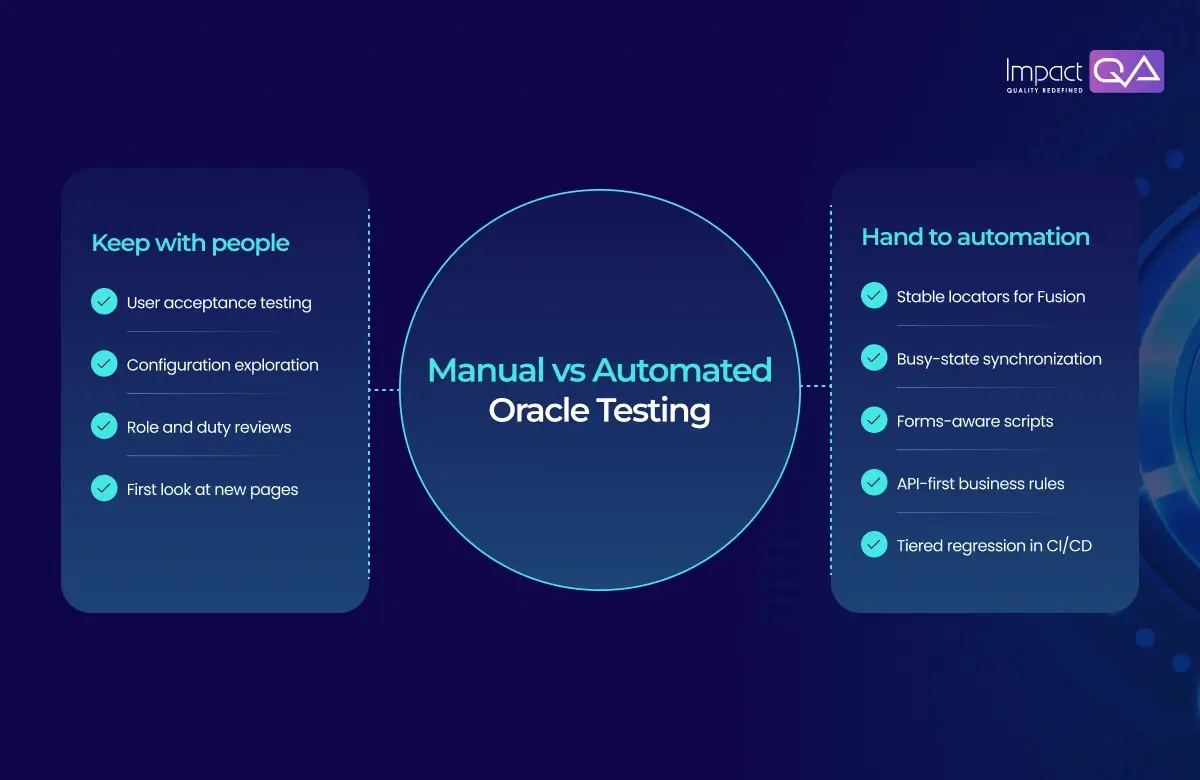
Oracle testing tools and people each own a clear lane.
Factor |
Manual |
Automated |
| Best fit | Judgment and new behavior | Repeatable regression |
| Oracle example | Period-close UAT | Procure-to-pay smoke pack |
| Cycle speed | Days | Minutes to hours |
| Upkeep | Test charters | Locators and data |
| Evidence | Tester notes and sign-off | Logs and screenshots per run |
Your Two-Week Update Plan
Source: Oracle’s Transportation cloud guidance
- Before the update: Read What’s New, refresh test data and update the test plan.
- Day 1: Run automated packs in the first few hours, then log service requests by the end of the business day.
- Days 2 to 10: Triage failures manually, then run UAT and review opt-in features.
- Production day: Oracle applies the update, then run a quick check of core business processes.
ImpactQA helps enterprises manage Oracle testing across applications and release cycles.
Final Say
Oracle says more than 1,000 AI agents are now available across Fusion and its industry applications, and that over two-thirds of its installed base already use agents in some form.
Hence, we can only assume test scope will keep widening, and enterprise budgets will fund both lanes.
ImpactQA’s Oracle testing services cover Fusion, EBS, PeopleSoft and Siebel, supported by accelerators for 1,400+ Oracle business scenarios and a broader ERP library of 2,500+ test scripts. Our Oracle Release Engineering practice aligns with the EBS 12.2 online patching cycle, while ISTQB-certified engineers lead our manual testing work.
Frequently Asked Questions (FAQs)
Share this post


Related Posts
Our Case Studies