
Quick Summary:
Gartner expects 70% of enterprises to have integrated AI-augmented testing tools by 2028, up from about 20% in early 2025. This guide shows how AI reshapes Oracle ERP testing tools and workflows across a five-point update loop, four Oracle modules and Oracle’s new agentic applications, and maps who approves each AI decision along the way.
Table of Contents:
- Introduction
- Three Clocks Now Set the Pace of Oracle ERP Testing
- How AI Changes the Oracle ERP Update Loop
- Where AI Fits Best Across Oracle Modules
- Testing Oracle’s Own AI Agents
- What Oracle ERP Testing Tools Must Do in 2027
- Who Approves What AI Proposes
- Choosing an ERP Testing Service Provider for the Three-Clock Era
- Final Say
- Frequently Asked Questions (FAQs)
Oracle ERP testing teams in 2026 are striking the same bargain John Glenn struck in February 1962, when, with an IBM computer having already plotted his orbit, he asked NASA to have mathematician Katherine Johnson check the numbers by hand before he agreed to fly. A quick machine proposes, and a careful reviewer confirms, and the launch goes ahead on schedule. AI now proposes the test scope and repairs the scripts for every Oracle update.
This guide maps how that partnership works across the update loop, the Oracle modules and Oracle’s own AI agents.
ImpactQA's Oracle test accelerators cover 1,400+ business scenarios, ready before the update window opens.
Three Clocks Now Set the Pace of Oracle ERP Testing
Oracle ERP testing now follows three release clocks, each with a distinct tempo and trigger. AI shortens the distance between a release notice and a verified regression run on every clock. The table below lines them up so test planning follows a single calendar.
Clock |
Cadence |
What Starts |
Source |
| Quarterly Update | Four times a year, with about two weeks on a stage pod before production | Release notes and feature changes | Oracle ERP guidance, May 2025 |
| Security Patch | Monthly critical security patch updates from 28 May 2026, alongside quarterly patch updates | Patch advisories | Oracle Security Blog, May 202 |
| Agent Release | Rolling, with 75 agentic applications in the portfolio by 29 Sept 2026 | New agent capabilities | Oracle Newsroom, 2026 |
The platform justifies this emphasis. According to Apps Run the Worlds 2024 data Oracle leads in ERP application revenue with $8.77 billion slightly ahead of SAPs around $8.69 billion. Gartner points out that, then 30 percent of new ERP projects are expected to fully meet their business goals by 2027. That makes thorough ERP software testing one of the things a delivery team can truly control.
How AI Changes the Oracle ERP Update Loop
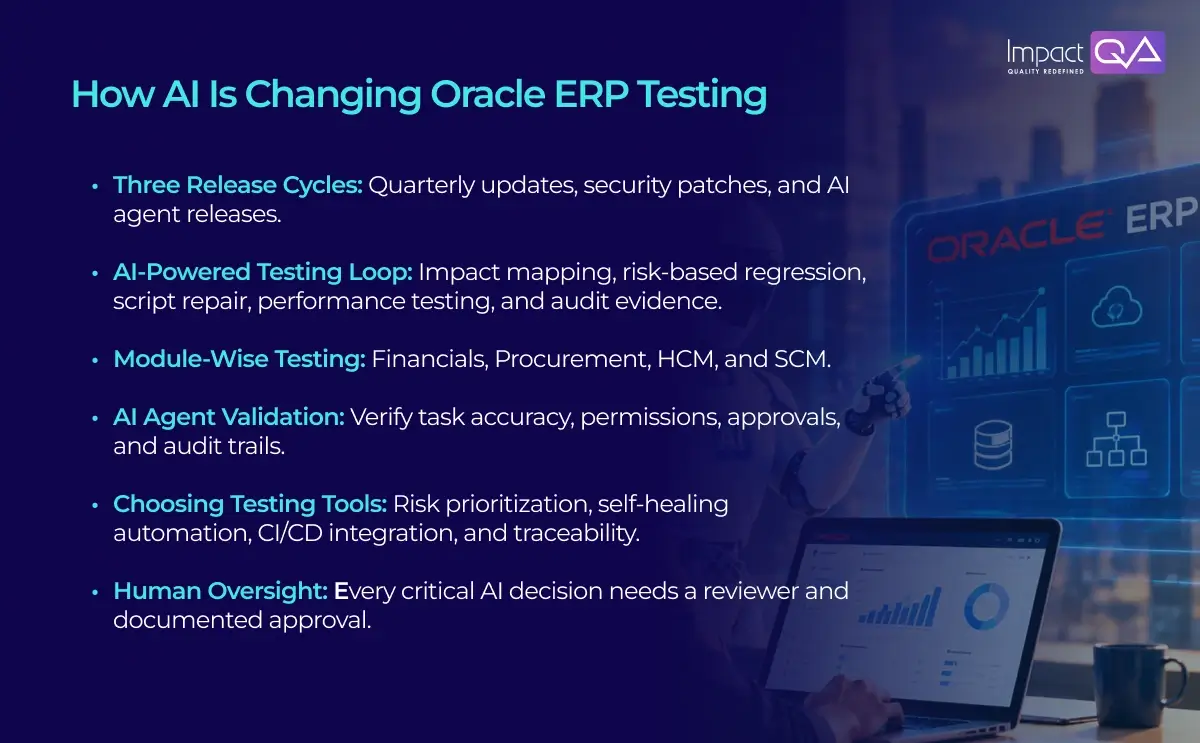
AI reshapes the Oracle update loop at five points starting with the release notes and ending with the audit record. At each point, there is a checkpoint. This ensures that speed and accountability go hand in hand across ERP testing services and internal teams.
1. Impact Mapping From Release Notes
Oracle publishes release notes for each quarterly update, and a language model can go through them quickly. It connects each changed feature to the business processes and test cases it may affect, creating an impact map that the functional lead checks before tests are run.
2. Risk-Ranked Regression Scope
With about two weeks on a stage pod, order matters. AI ranks regression candidates by change proximity, defect history and business usage, so payables runs and journal postings execute in the first hours. The QA lead approves the prioritized list and the rest of the tests happen in order of priority. Gartner’s October 2025 Magic Quadrant on AI-augmented testing tools shows the path with the industry moving toward more advanced capabilities.
3. Building and Repairing Tests
ERP test automation starts with building. Business analysts explain a process in words, and the tool writes the steps for an engineer to improve. Fixing issues uses the idea. When a Redwood screen moves a field, self-healing scoring looks at the elements details and matches it with its stored information then updates the script, to the possible place. Engineers review each repair in a change log. ImpactQA has already written about automated testing for Oracle applications and where AI extends it.
4. Running and Diagnosing at Load
ERP performance testing matters most at quarter-end, when posting volumes climb and approval queues lengthen. AI studies production patterns to shape load profiles that resemble real closing weeks, then clusters failures so a single root cause surfaces as one ticket. ImpactQA’s view of AI in performance testing goes deeper on the method.
5. Audit-Ready Evidence
Every test run records the scenarios tested, expected results, actual results, and supporting evidence. It includes screenshots and the name of the person who approved the results. This creates a reconstructable trail for every release. It also matches the logged actions that Oracle builds into its agentic applications.
Where AI Fits Best Across Oracle Modules
AI delivers the quickest gains in Oracle modules by using repeatable workflows and consistent data. Financials and Procurement see the gains here while HCM benefits from AI’s ability to detect anomalies in payroll data and employee records. SCM relies on how standardized each plant or warehouse process.
Module |
Workflow Nature |
Where AI Helps Most |
Human Focus |
| Financials | Repeatable postings and close steps | Regression selection and data-driven journal tests | Accounting policy decisions |
| Procurement | Structured requisition-to-pay flows | Script repair and test data generation | Supplier and approval rule |
| HCM | Records-heavy payroll and employee data | Anomaly detection in records | Payroll rules and privacy |
| SCM | Varies by plant and warehouse | Impact mapping across integrations | Site-specific process variations |
Directionally, AI performs best where business logic is standardized and data is consistent, so teams often pilot in Financials and widen from there. That phased path keeps ERP application testing measurable at every step.
Testing Oracle’s Own AI Agents
Oracle’s agentic applications act through business objects, workflows and approvals, with every action logged under Fusion security. Testing them means validating the action taken and the approval path that authorized it, with the audit entry as evidence. That gives ERP testing a new layer above screens and APIs.
Test design follows the agent’s job. Scenario tests give the agent a realistic task, such as drafting a journal entry, and check the outcome against policy. Approval tests confirm the proposal reaches the right approver. Permission tests confirm the agent acts within the role it inherited. Finally, reviewers verify the audit record, which provides evidence of the agent’s actions and the approvals involved.
What Oracle ERP Testing Tools Must Do in 2027
The right Oracle ERP testing tools should support the full update loop, from impact analysis to audit evidence, while integrating with existing development workflows.
Four questions turn a demo into a decision. Does the tool read release notes and map changes to tests? Does it rank risk using your own defect history? Does it repair scripts and show the change log? Does it produce evidence an auditor can follow? Add capacity for ERP performance testing during closing weeks, and the shortlist of ERP testing tools becomes short.
The same job-based view applies to Oracle ERP testing tools inside a CI/CD pipeline, where each run feeds the evidence trail automatically. ImpactQA has also covered how a focused plan can reduce Oracle testing time by 70%, which pairs naturally with the selection questions above.
Who Approves What AI Proposes
Every AI output in the Oracle update loop needs a named approver and a saved record. A decision-rights map assigns each proposal to the role that owns the business risk, which keeps AI speed and finance accountability working together.
AI Proposal |
Approver |
Evidence Kept |
| Impact map from release notes | Functional lead | Reviewed map with timestamp |
| Ranked regression scope | QA lead and process owner | Approved scope list |
| Repaired test script | Automation engineer | Change log with before and after locator |
| Agent action under test | Finance or HR process owner | Run record with approval path |
| Go-live decision | Business owner | Signed test summary |
Glenn asked for Johnson by name. An Oracle update loop benefits from the same clarity: a named person for each AI proposal and a saved record of what that person approved.
Choosing an ERP Testing Service Provider for the Three-Clock Era
A strong ERP testing service provider shows its work on all three clocks. Ask how the team maps release notes to scope, repairs scripts after UI changes and tests Oracle agents, then ask for evidence from a comparable Oracle landscape.
Four questions help when comparing ERP testing companies:
- Which clock does the team handle best, and what evidence supports that?
- How does the team map release notes to scope?
- What happens after a UI change moves a field?
- How will the team test Oracle’s agents?
An ERP testing company with Oracle-specific accelerators shortens the first cycle, and ERP testing services that include human review keep every AI decision accountable. ImpactQA’s article on continuous testing and delivery in a hybrid Oracle EBS and Dynamics 365 environment shows what that looks like in practice.
ImpactQA builds customized test automation frameworks for Oracle ERP environments.
Final Say
We expect that by the end of 2026, 40% of enterprise applications will be using task‑specific AI agents. Oracle ERP testing is moving toward a schedule in which releases come out all the time and testing keeps up by using AI.
ImpactQA is backing that move. We offer Oracle system testing for EBS and Fusion regression coverage for HRMS and Finance and AI‑driven test prioritization and impact analysis. These tools are supported by accelerators for than 1400 business scenarios. As a result, every release on every clock will have a test plan and a named approver.
Download the full case study and see how it works in action.
Frequently Asked Questions (FAQs)
Share this post


Related Posts
Our Case Studies
