Quick Summary:
Deploying robust QA automation services reduces software release costs and improves product quality by replacing manual verification with repeatable scripts. This structural shift optimizes expenditure and accelerates validation cycles. By leveraging modern test automation tools, engineering teams optimize operational delivery systems to build highly resilient digital ecosystems. Ultimately, this blog explores how modern automated infrastructure seamlessly safeguards software integrity during rapid enterprise delivery.
Table of Contents:
- Introduction
- Architectural Mechanisms of Quality Assurance Automation
- Structural Cost Reductions and Release Optimization
- Systematic Product Quality and Defect Prevention
- Advanced Scalability via Next-Generation Frameworks
- Final Thought
- Frequently Asked Questions (FAQs)
Achieving rapid software deployment without compromising operational stability requires a fundamental shift in how development teams approach quality engineering. Traditional manual verification introduces significant deployment delays and high human capital costs that scale linearly with application complexity. By transitioning toward comprehensive software testing automation, modern engineering organizations can establish deterministic validation pipelines that run continuously alongside development cycles.
Implementing structured automation changes quality assurance from a reactive, slow process into a proactive asset. When engineering groups deploy an optimized test automation framework, they eliminate human verification limits and ensure deep validation across complex cloud systems. This blog outlines the specific architectural, financial, and operational mechanisms that enable test automation services to protect system performance while cutting release expenses.
We provide cutting-edge test automation services to accelerate releases and secure product quality.
Architectural Mechanisms of Quality Assurance Automation
Modern software validation depends on decoupling repetitive regression testing execution from manual intervention. By implementing structured software testing automation, engineering teams establish a programmatic infrastructure capable of executing thousands of deterministic test scripts simultaneously.
According to industry trackers, this rapid shift toward automated testing infrastructure is driving substantial efficiency gains, with projections highlighting an anticipated 80% market adoption of AI-driven testing platforms by 2027. This shift demonstrates why picking the best test automation services provider is essential to establishing a resilient continuous integration pipeline.
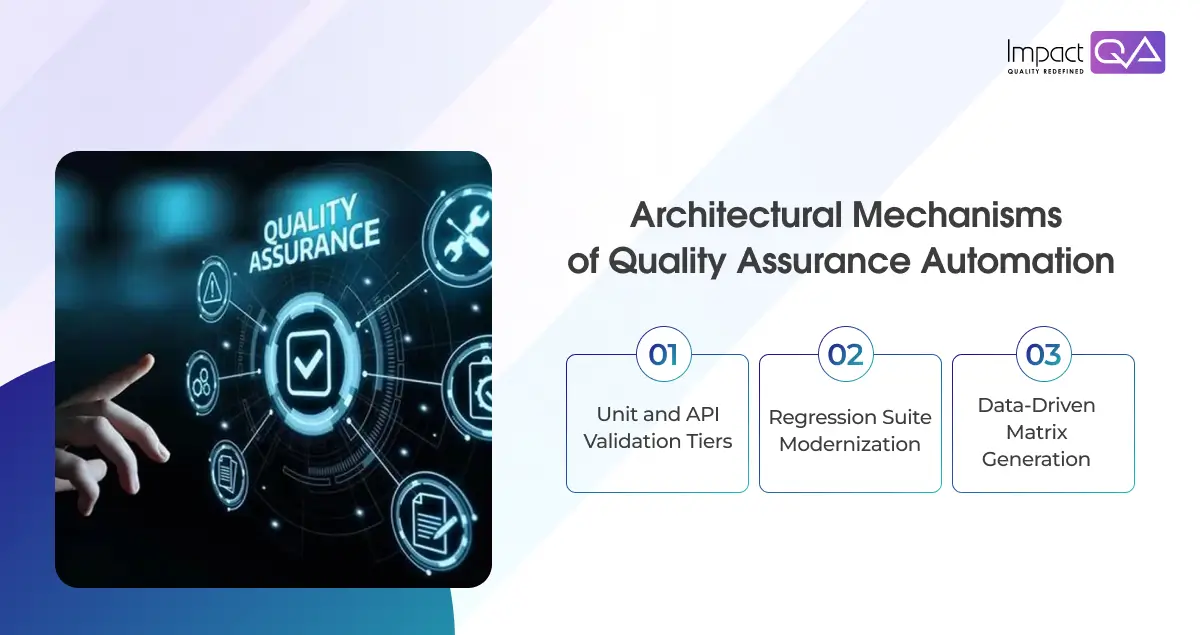
Unit and API Validation Tiers: Running small, focused programmatic checks at the code level eliminates bugs early in the delivery lifecycle before compilation occurs. These scripts run inside the build pipeline to catch syntax and logic discrepancies immediately.
Regression Suite Modernization: Building comprehensive, cross-functional testing validation scripts ensures that new code updates do not break pre-existing software features. This structured approach allows teams to deploy code multiple times daily with total certainty.
Data-Driven Matrix Generation: Injecting dynamic datasets into automated validation workflows tests software performance under varied configurations without modifying underlying test logic. This mechanism broadens coverage metrics across multiple business variables.
Structural Cost Reductions and Release Optimization
The financial benefits of integrating specialized test automation services become clear when analyzing long-term engineering resource allocation. By shifting to specialized software testing automation, companies change a linear cost curve into a flat operational model where the marginal expense of running an extra test is near zero. These robust QA automation services eliminate the need for extensive human validation teams during night shifts and weekend release cycles.
Validation Tie |
Discovery Point |
Relative Fix Cost |
| Unit / API Test | IDE / Code Commit | 1x (Baseline) |
| Regression Run | CI / CD Staging | 10x Cost Increase |
| Manual Audit | Pre-Release Window | 30x Cost Increase |
| Production Error | Post-Launch Deployment | 100x Cost Increase |
Lower Production Fix Costs: Fixing an active application breakdown in production requires extensive emergency developer hours, system downtime mitigation, and patching protocols. Automated validation scripts catch these issues in staging environments, where resolving them costs a fraction of the price.
Optimizing Delivery Pipeline Infrastructure: Integrating repeatable test steps directly into automated build tracks drops deployment timelines from weeks to minutes. This operational speedup helps businesses ship updates without maintaining large, manual review groups.
Eliminating Script Maintenance Overhead: Utilizing self-healing test scripts reduces the engineering hours spent rewriting automation assets when user interfaces change. This capability keeps test automation tools working efficiently without draining human engineering resources.
Systematic Product Quality and Defect Prevention
Utilizing comprehensive automation testing services allows teams to run complex user journeys with perfect precision across every runtime environment. Implementing a flexible test automation framework enables cross-browser, multi-platform verification that tracks subtle visual glitches and backend performance drops. Furthermore, teams that integrate mobile test automation services can systematically track erratic interface layouts and memory issues across diverse devices and operating system profiles.
Expanding Functional Test Coverage: Programmatic scripts can validate hundreds of edge cases, negative data inputs, and boundary security situations that human testers might miss during tight release timelines. This broad coverage reduces the hidden errors that often slip into final software builds.
Executing Parallel Cross-Platform Matrixes: Running automated suites simultaneously across different web engines and device versions identifies layout issues early. This process guarantees that every customer experiences a uniform interface, protecting digital engagement metrics.
Enforcing Strict Compliance Verification: Automated testing scripts create unalterable execution logs and audit trails for every build. This detailed documentation makes it easier to prove adherence to strict security standards and data handling regulations during external reviews.
Advanced Scalability via Next-Generation Frameworks
Deploying large-scale software testing automation requires moving past simple record-and-playback utilities. Modern initiatives use AI-powered test automation to adjust validation boundaries automatically when application elements shift, keeping automated testing services functional without manual script rewrites. To maximize returns, enterprises must combine advanced test automation tools with specialized talent trained in continuous deployment integration and script optimization.
Deploying Scalable Hybrid Frameworks: Mixing behavior-driven design rules with clean object repository patterns isolates script logic from user interface elements. This smart separation ensures that minor front-end redesigns do not break deep end-to-end testing structures.
Utilizing Intelligent Failure Categorization: Applying advanced analytics tools to test run results separates actual product defects from minor network timeouts or test environment drops. This automated parsing saves QA managers from wasting hours reviewing false alarms.
Unifying Quality Assurance with Delivery Pipelines: Embedding automated test triggers directly into deployment workflows establishes a reliable quality gate. This setup automatically blocks unstable code updates from moving forward, keeping production environments safe.
We deliver intelligent automated testing services to eliminate execution bottlenecks.
Final Thought
Achieving faster product delivery while keeping software release budgets under control requires moving away from slow, error-prone manual testing approaches. Modern software initiatives need the speed and precision that only mature test automation services can deliver to stay competitive. Implementing a tailored test automation framework alongside smart, adaptive test automation tools allows development organizations to turn quality control from a delivery roadblock into a scalable operational advantage.
Enterprises aiming to optimize their quality assurance pipelines can leverage our advanced technical capabilities at ImpactQA. As a provider of comprehensive QA automation services, we deliver specialized testing options, including cutting-edge AI-powered test automation and dedicated mobile test automation services. Partnering with us as your automation testing company allows your business to reduce production errors, eliminate execution delays, and lower engineering costs. Our deep technical expertise ensures your testing infrastructure remains resilient, scalable, and perfectly aligned with continuous delivery goals.
Frequently Asked Questions (FAQs)
Share this post


Related Posts
Our Case Studies