Quick Summary:
Poorly tested enterprise chatbots can deliver inconsistent responses, misunderstand user intent, expose sensitive information, and erode customer trust. As conversational AI becomes central to business operations, organizations need structured validation strategies that go beyond functional testing. This article explores chatbot testing best practices, key enterprise considerations, governance requirements, security validation, LLM testing challenges, and approaches for maintaining reliable chatbot performance at scale.
Table of Contents:
- Introduction
- Why Enterprise Chatbot Testing Requires a Different Approach
- Best Practices for Effective Chatbot Testing
- Key Considerations for Long-Term Enterprise Success
- Conclusion
Enterprise chatbots have moved far beyond answering simple customer queries. They are now embedded within customer service operations, employee support systems, knowledge management platforms, and business process automation initiatives. As organizations increasingly rely on conversational AI to handle critical interactions, the quality of chatbot responses directly influences customer satisfaction, operational efficiency, compliance, and business outcomes. Unlike conventional applications that operate within predefined logic, chatbots generate responses based on learned patterns, making their behavior less predictable and more susceptible to contextual variations.
This shift has elevated AI testing from a supplementary validation activity to a critical component of enterprise AI governance. Organizations must verify not only functional accuracy but also contextual relevance, response consistency, fairness, security, and resilience under real-world conditions. As conversational systems become more sophisticated, structured testing approaches are necessary to identify risks before deployment and maintain reliable performance throughout the chatbot lifecycle.
At ImpactQA, we help organizations validate conversational AI performance, contextual accuracy, and compliance through AI testing services.
Why Enterprise Chatbot Testing Requires a Different Approach
Traditional software testing focuses on validating deterministic outcomes. Given a specific input, the application is expected to produce a predefined result. Chatbots operate differently. Their responses may vary depending on context, conversation history, user intent, and model interpretation.
This introduces several testing complexities:
Response Variability
The same question can produce multiple acceptable responses. Testing teams must evaluate quality, relevance, and contextual appropriateness rather than relying solely on pass-fail outcomes. This requires carefully designed validation frameworks that assess conversational effectiveness from multiple dimensions.
Context Retention and Multi-Turn Conversations
Enterprise chatbots often support lengthy conversations involving multiple topics and follow-up questions. Testing must verify whether the chatbot retains context accurately and delivers responses that remain aligned with earlier interactions. Failures in context management frequently result in confusing user experiences and reduced trust.
Domain-Specific Knowledge Validation
Organizations operating in sectors such as banking, healthcare, energy, and manufacturing require chatbots to provide accurate information within specific business domains. Testing must validate factual consistency against approved knowledge sources while identifying instances where the system generates unsupported information.
Continuous Learning and Updates
Many conversational AI systems undergo frequent updates. New data sources, model refinements, and workflow changes can introduce unexpected behaviors. Consequently, testing becomes an ongoing activity rather than a one-time validation exercise.
Best Practices for Effective Chatbot Testing
Successful enterprise chatbot programs require a structured methodology that addresses both technical and business risks. Several practices consistently contribute to stronger testing outcomes.
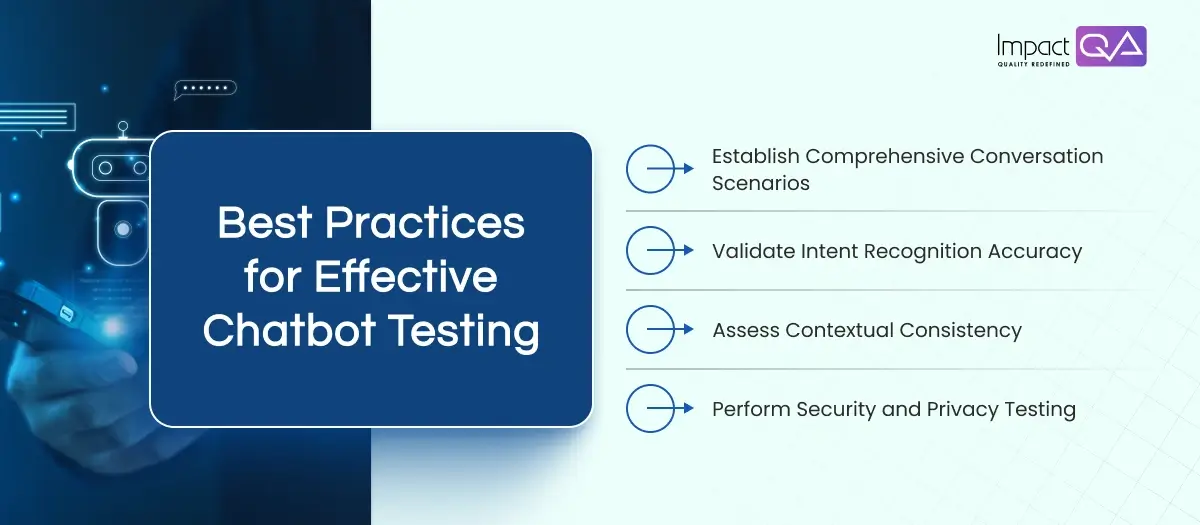
Establish Comprehensive Conversation Scenarios
Testing should extend beyond common user queries. Teams must create extensive conversation datasets that include routine interactions, ambiguous questions, incomplete requests, spelling errors, multilingual inputs, and edge cases. This broader coverage provides greater visibility into chatbot behavior under realistic operating conditions.
Validate Intent Recognition Accuracy
Intent classification remains a foundational capability for conversational systems. Testing should measure how accurately the chatbot identifies user objectives across varying sentence structures and linguistic patterns. Misclassification often creates downstream response errors that impact overall effectiveness.
Assess Contextual Consistency
Responses should remain coherent throughout extended interactions. Test cases must evaluate topic transitions, follow-up questions, reference handling, and conversational memory. Maintaining consistency across multiple dialogue turns is often more challenging than answering isolated questions correctly.
Perform Security and Privacy Testing
Enterprise chatbots frequently process sensitive information. Testing should identify vulnerabilities such as unauthorized data disclosure, prompt manipulation attempts, privilege escalation scenarios, and insecure integrations with backend systems. Security validation becomes particularly important when conversational interfaces connect directly to enterprise applications.
Implement Continuous Regression Testing
Each chatbot update carries the risk of introducing unintended behavior. Automated regression suites help validate existing capabilities while reducing the effort required to support continuous improvement initiatives. This is where AI in software testing is increasingly being adopted to accelerate validation cycles and improve coverage.
Key Considerations for Long-Term Enterprise Success
Beyond technical validation, organizations must address broader operational and governance considerations that influence chatbot effectiveness over time.
1. Building Trust Through Responsible AI Practices
Enterprise adoption depends heavily on user trust. Organizations should establish clear governance mechanisms to monitor chatbot behavior, document testing outcomes, and address unintended responses. Implementing an ethical AI framework helps create accountability while supporting regulatory compliance and responsible AI adoption.
2. Monitoring Real-World Performance
Testing does not end after deployment. Production monitoring provides valuable insights into emerging failure patterns, user frustrations, and knowledge gaps. Continuous feedback loops allow organizations to refine conversational models using actual user interactions.
3. Preparing for Advanced AI Architectures
Many enterprises are moving beyond standalone chatbots toward intelligent systems that perform actions, retrieve information, and support decision-making workflows. As organizations introduce AI agents for automation and AI automation agents, testing strategies must expand to validate task execution, workflow accuracy, and system interoperability.
4.Addressing Large Language Model Risks
Modern enterprise chatbots increasingly rely on generative AI technologies. As a result, LLM testing has become an important component of validation programs. Organizations must evaluate hallucination risks, factual accuracy, bias, consistency, and prompt sensitivity to maintain acceptable performance standards.
5.Leveraging Specialized Testing Expertise
Many enterprises choose external AI testing services to accelerate implementation and strengthen quality assurance practices. Experienced testing teams bring established frameworks, automation capabilities, domain expertise, and independent validation processes that help identify issues that internal teams may overlook.
At ImpactQA, we help organizations deploy reliable enterprise chatbots through comprehensive chatbot testing and quality engineering services.
Conclusion
Enterprise chatbots are increasingly becoming business-critical systems rather than experimental technology initiatives. Their ability to influence customer interactions, employee productivity, and operational processes means organizations cannot rely on traditional testing approaches alone. Effective AI testing requires structured evaluation of conversational accuracy, contextual understanding, security, compliance, and long-term performance. As chatbot capabilities continue to expand, testing programs must evolve accordingly to address growing technical and governance requirements.
At ImpactQA, we recognize that successful chatbot deployments depend on rigorous validation across every stage of the AI lifecycle. Our expertise in AI testing, AI testing services, and advanced AI testing solution development helps organizations assess conversational quality, identify operational risks, and establish sustainable quality assurance practices. By combining deep testing expertise with enterprise-grade methodologies, we help businesses deploy AI-powered systems that deliver consistent, reliable, and trustworthy user experiences at scale.
Frequently Asked Questions (FAQs)
Share this post


Related Posts
Our Case Studies