How Can Hyperautomation with Low-Code Streamline Complex Business Processes and Boost Productivity?

Quick Summary:
Organizations nowadays are under constant pressure to optimize their operations while reducing costs. Hyperautomation with low-code is a powerful solution for achieving this goal. By integrating advanced automation with intuitive low-code platforms, organizations can streamline complex workflows and empower faster decision-making. This blog explores the synergy between hyperautomation and low-code platforms and how they can transform business processes to increase productivity and drive business success.
Table of Contents
- Introduction
- What is Hyperautomation with Low-Code?
- How Hyperautomation with Low-Code Streamlines Complex Business Processes
- The Role of Low-Code in Simplifying Automation
- Key Benefits of Hyperautomation with Low-Code
- Challenges and Considerations in Implementing Hyperautomation with Low-Code
- How Hyperautomation with Low-Code Impacts Specific Industries
- Conclusion
Is your organization still challenged by a convoluted process, perhaps due to cost considerations or limitations of your technology? In a world that demands speed and efficiency, outdated methods simply don’t cut it anymore. Organizations are constantly seeking ways to improve productivity and drive better decision-making. This is where hyperautomation with low-code is changing the nature of work and how organizations are organized.
Hyperautomation leverages advanced technologies like Robotic Process Automation (RPA), artificial intelligence (AI), and machine learning (ML) to automate complex workflows. When combined with low-code platforms, which allow users to create applications with minimal coding effort, this synergy drives seamless process automation across organizations. This approach not only reduces manual intervention but also accelerates application development, bringing transformative results to businesses of all sizes.
ImpactQA can deliver custom solutions.
What is Hyperautomation with Low-Code?
Hyperautomation is the process of automating a wide range of business operations by leveraging advanced technologies such as Robotic Process Automation (RPA), Artificial Intelligence (AI), and Machine Learning (ML). Unlike traditional automation, which focuses on automating repetitive tasks, hyperautomation goes a step further by enabling intelligent process automation (IPA). This allows systems to not only automate tasks but also adapt to changing conditions and inputs, making decisions and improving over time without human intervention.
Low-code platforms complement hyperautomation by simplifying the app development process. These platforms provide users with intuitive interfaces, pre-built components, and drag-and-drop features, allowing individuals with minimal coding knowledge to build applications quickly and efficiently. This drastically reduces the time and cost associated with traditional software development while maintaining the flexibility to customize workflows and processes.
When combined, hyperautomation and low-code platforms create a powerful solution that enables businesses to automate complex workflows, integrate disparate systems, and rapidly develop scalable solutions. The synergy between these technologies allows organizations to reduce manual work and build custom automation solutions tailored to their unique needs, without the requirement for deep technical expertise or extensive coding resources.
How Hyperautomation with Low-Code Streamlines Complex Business Processes
Implementing hyperautomation with low-code allows businesses to streamline and simplify their workflows. This approach helps eliminate inefficiencies and manual interventions, creating smoother processes and higher productivity.
Automating Repetitive Tasks
Repetitive tasks are a significant drain on employee time. With hyperautomation, tasks that once required constant manual efforts like data entry, report generation, and invoice processing can now be automated. Low-code platforms facilitate the creation of automation workflows without the need for extensive technical expertise. This helps business teams to configure and deploy automation quickly.
For example, an employee can use a low-code platform to set up an automated process that automatically imports data from external systems, performs calculations, and generates reports – all without any manual input.
Reducing Manual Errors
Manual processes are prone to errors, leading to costly mistakes and delays. By automating tasks with hyperautomation and low-code, businesses can minimize human errors. Automation systems ensure tasks are completed accurately and consistently every time, with no risk of overlooking crucial details.
Moreover, low-code platforms can easily integrate validation rules and exception handling, ensuring that the automation process remains reliable even in the face of unexpected inputs.
Enhancing Decision-Making
Hyperautomation with low-code doesn’t just automate tasks but can also improve decision-making. With built-in AI and machine learning capabilities, hyperautomation systems can analyze vast amounts of data, recognize patterns, and provide valuable insights in real time. Low-code platforms can display this data in dashboards to ensure decision-makers make informed choices based on up-to-date information.
In turn, this can help businesses respond quickly to changing market conditions, customer demands, or operational issues.
The Role of Low-Code in Simplifying Automation
Low-code platforms play a crucial role in simplifying the deployment of hyperautomation initiatives. They provide an accessible interface for creating, deploying, and managing automation workflows, making it possible for non-technical users to participate in the development process.
Low-Code vs. Traditional Development
Traditional development typically requires highly skilled software developers and a significant amount of time to create applications. However, low-code platforms lower the technical barrier, enabling business analysts or even subject matter experts to create solutions without extensive programming knowledge. This results in faster development cycles, reduced costs, and greater innovation across teams.
For instance, a marketing team can develop an automation solution to manage email campaigns, track responses, and segment customer data using a low-code platform without waiting for IT support.
Speed and Flexibility with Low-Code Platforms
One of the primary advantages of low-code platforms is the speed at which applications can be developed and deployed. By drastically reducing development time, businesses can implement automation solutions in a fraction of the time it would take with traditional methods.
Additionally, low-code platforms offer a high degree of flexibility. They allow for rapid prototyping, easy modification of workflows, and swift scaling to meet changing business needs. This makes it easier for businesses to adapt their automation efforts as the market or internal priorities evolve.
Key Benefits of Hyperautomation with Low-Code
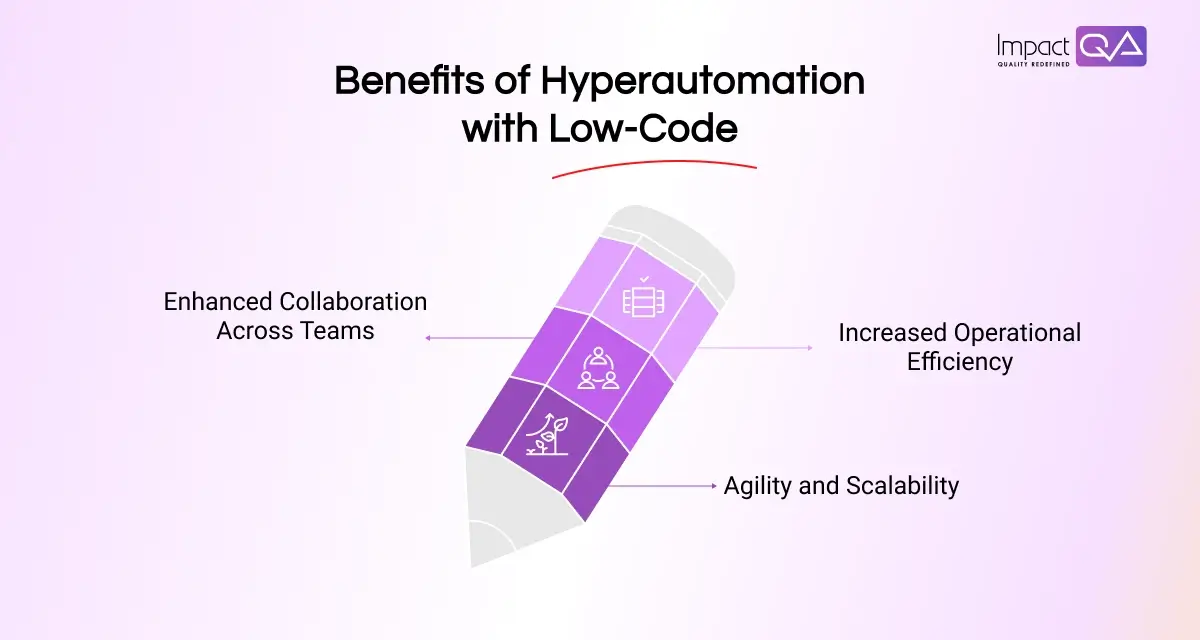
When combined, hyperautomation and low-code platforms offer significant benefits that can drive business growth.
Increased Operational Efficiency
Hyperautomation helps businesses automate end-to-end workflows to remove bottlenecks, reduce the need for human intervention, and enhance the flow of information – all of which can lead to significantly increased overall operational efficiency. In addition, low-code platforms simplify the automation development process to achieve solutions in an effective and timely manner.
Enhanced Collaboration Across Teams
By providing a visual interface and pre-built components, low-code platforms encourage collaboration between different business teams, such as IT, marketing, and operations. Everyone involved can contribute to the design, development, and execution of automation solutions, reducing silos and improving cross-functional teamwork.
Agility and Scalability
As businesses grow, they need solutions that can scale. Low-code platforms make it easy to adjust automation workflows, add new functionality, and scale automation efforts to meet increased demand. The agility of low-code development enables organizations to stay ahead of competitors and quickly respond to market changes.
Challenges and Considerations in Implementing Hyperautomation with Low-Code
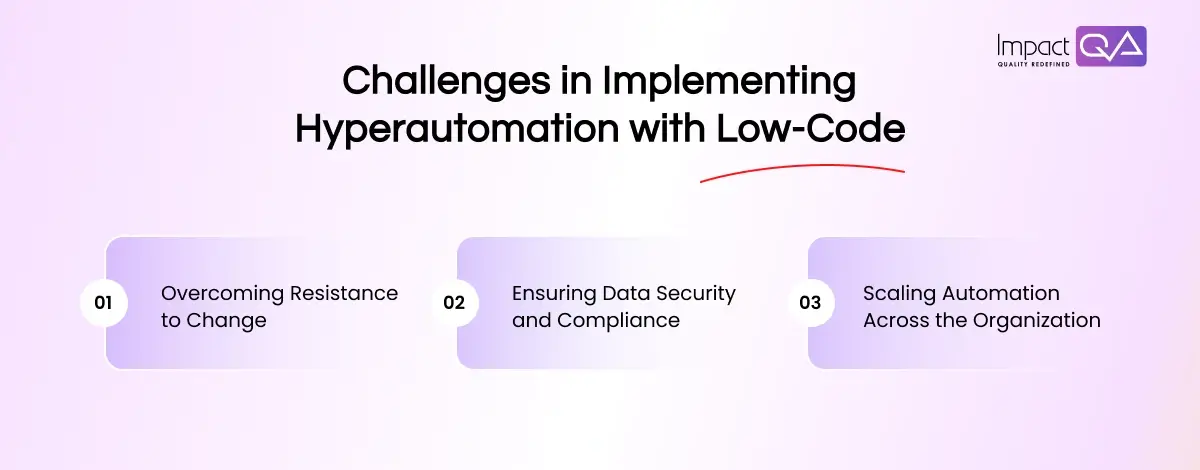
While hyperautomation with low-code offers significant benefits, organizations must address certain challenges during implementation.
Overcoming Resistance to Change
Employees may be resistant to adopting new technologies or fear that automation will replace their jobs. Effective change management and clear communication about the benefits of automation are crucial to overcoming this resistance.
Ensuring Data Security and Compliance
Automating processes that involve sensitive data requires an increased focus on data security. Low-code platforms should meet specific compliance requirements within an industry so that the automation solutions are both secure and compliant.
Scaling Automation Across the Organization
As businesses scale their automation efforts, it’s important to ensure that automation solutions remain flexible and adaptable. Organizations should invest in platforms that offer scalability, allowing for the addition of new processes as needed.
How Hyperautomation with Low-Code Impacts Specific Industries
Hyperautomation with low-code is particularly transformative for industries that rely on complex workflows and operational efficiency. Here’s how hyperautomation is changing specific sectors:
BFSI (Banking, Financial Services, and Insurance)
In BFSI, automation is critical for reducing the time spent on manual tasks, such as loan processing, fraud detection, and regulatory compliance. With low-code platforms, businesses can automate processes like transaction monitoring, risk assessment, and client onboarding without heavy technical involvement. This leads to faster service delivery, better compliance management, and a reduction in operational costs.
Energy & Utilities
Energy and utility companies manage vast amounts of data and must deal with complex processes like asset management, compliance reporting, and customer service. By implementing hyperautomation with low-code, these companies can automate tasks such as monitoring energy usage, processing service requests, and analyzing data for predictive maintenance.
Retail
Retail businesses deal with a variety of processes, from inventory management to customer service. By implementing hyperautomation with low-code solutions, retailers can automate tasks like order processing, inventory updates, and customer support ticket management. This not only improves customer satisfaction by providing quick responses but also helps manage operations efficiently as the business scales.
In these industries and beyond, hyperautomation can help streamline workflows, reduce costs, and enhance service quality, positioning businesses to thrive in a competitive environment.
ImpactQA can help with seamless low-code solutions.
Conclusion
Hyperautomation with low-code has the potential to transform the way businesses operate. It simplifies complex workflows, reduces inefficiencies, and boosts productivity by enabling organizations to automate end-to-end processes quickly and cost-effectively. By embracing this combination, businesses can respond to changing market demands and stay competitive.
However, to fully realize the benefits of hyperautomation with low-code, businesses must carefully consider implementation strategies and select the right platforms.
If you’re looking for expert assistance in implementing hyperautomation, ImpactQA offers a range of services that align with your automation goals. ImpactQA specializes in helping businesses optimize their workflows using cutting-edge technologies, including low-code platforms and RPA while ensuring robust security and compliance.
FAQs
Share this post


Related Posts
Our Case Studies