How Blockchain Testing is Redefining Quality Benchmarks in Digital Transactions

Quick Summary:
Blockchain is transforming digital transactions with secure, decentralized, tamper-proof operations – but it adds complexity to quality assurance. This blog explores how blockchain testing raises QA benchmarks, focusing on smart contract integrity, network resilience, and real-time performance. It covers key framework components, major QA challenges, and emerging trends. Finally, it explains how ImpactQA provides specialized blockchain testing services to help businesses scale confidently in decentralized environments.
Table of Contents:
- Introduction
- Understanding Blockchain and the New Quality Benchmarks in Digital Transactions
- The Rise of Blockchain Testing Frameworks
- Components of an Effective Blockchain Testing Framework
- Challenges That Disrupt Testing Efficiency
- Future Trends in Blockchain QA
- Why Custom Blockchain QA Matters with ImpactQA
As digital transactions surge and decentralization becomes mainstream, the margin for error shrinks dramatically. Blockchain isn’t just another database – it’s the infrastructure behind token transfers, identity validation, and autonomous contracts. But how do you test something that’s immutable and runs across distributed nodes?
Traditional QA methods don’t cut it. Blockchain demands new benchmarks focused on smart contract integrity, security under attack, and network-wide reliability. This is where blockchain testing evolves from optional to essential.
Let’s explore how it’s reshaping quality standards and why enterprises must rethink their testing strategies to stay ahead.
Understanding Blockchain and the New Quality Benchmarks in Digital Transactions
Blockchain has emerged as a foundational technology for digital transactions, enabling decentralized, tamper-proof exchanges without the need for intermediaries. At its core, it operates on a distributed ledger system where every transaction is cryptographically recorded in a block and linked to the one before it. Once validated, these blocks are nearly impossible to alter, creating an immutable chain of records that ensures transparency and trust.
However, this decentralized structure brings its own set of challenges, especially when it comes to quality assurance. Unlike traditional systems, blockchain networks involve multiple nodes working in sync, consensus mechanisms to validate transactions, and smart contracts that must be executed with precision. When these systems are used to transfer real-world assets like money, identity credentials, or legal agreements – any failure in execution can lead to irreversible consequences.
This is why rigorous testing is essential. Blockchain systems must function flawlessly across distributed environments, maintain data integrity at every step, and perform reliably under varying loads and edge cases. To achieve this, enterprises must adhere to a new set of quality benchmarks tailored to the unique nature of blockchain ecosystems.
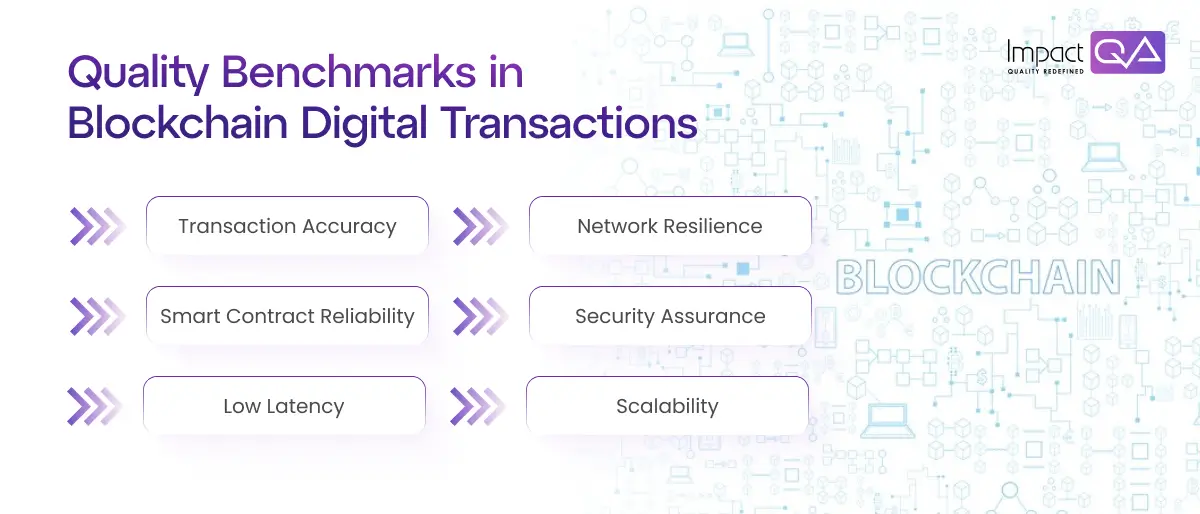
Here are the key quality benchmarks every blockchain network must meet:
- Transaction Accuracy: Every transaction must be correctly validated and recorded without discrepancies.
- Network Resilience: The system should maintain uptime and consistency with no single point of failure.
- Smart Contract Reliability: Contracts should be executed autonomously, with no bugs, logic errors, or vulnerabilities.
- Security Assurance: The network must withstand threats such as hacking, spoofing, and data manipulation.
- Low Latency: Transactions should be confirmed quickly and consistently, even across global nodes.
- Scalability: The platform must support increased transaction volume without compromising performance.
The Rise of Blockchain Testing Frameworks
Traditional testing models fall short when applied to decentralized architecture. Blockchain testing frameworks are purpose-built to validate consensus mechanisms, cryptographic transactions, and smart contract behavior across distributed nodes.
These frameworks bring order to fragmented QA efforts by merging automated and manual testing across permissioned and permissionless environments. They’re tailored to platforms like Ethereum, Hyperledger, and Solana – aligning testing strategies with the underlying protocol.
Beyond structure, they provide consistency. As networks fork or evolve, a robust framework ensures traceable, repeatable testing – mitigating the risks of protocol upgrades and integration failures.
Well-designed frameworks also enable:
- Simulation of real-world threats like malicious node behavior
- Validation of cross-chain interoperability in multi-network ecosystems
- Continuous testing through CI/CD pipelines, tailored for decentralized workflows
Components of an Effective Blockchain Testing Framework
Building and deploying a reliable blockchain solution requires more than just solid code. It demands a well-structured testing framework that covers the unique complexities of distributed systems. Unlike conventional applications, blockchain systems rely on consensus mechanisms, cryptographic validation, and smart contract logic – all of which must work together seamlessly. A comprehensive testing approach ensures each layer of the ecosystem is validated under real-world conditions.
A strong blockchain testing framework typically includes the following:
- Node Simulation: Creating mock peer environments
- Smart Contract Testing: Automated verification of contract functions
- Security Assessment: Checks for reentrancy, overflow, and injection attacks
- Transaction Lifecycle Testing: Validating the full flow from trigger to block recording
- Consensus Verification: Ensuring agreement algorithms function correctly
- Performance Analysis: Measuring throughput, block confirmation speed, and gas usage
- Integration Testing: Validating interaction with wallets, oracles, and third-party APIs
ImpactQA delivers domain-specific blockchain QA frameworks designed for your ecosystem.
Challenges That Disrupt Testing Efficiency
As blockchain adoption scales, so do the testing complexities. From immutable smart contracts to unpredictable consensus behaviors, the margin for QA error is razor-thin. Enterprises need to navigate these challenges with precision to avoid costly deployment failures.
Blockchain testing is resource-intensive and technically complex. The main blockers include:
Lack of Standardized Tools
Many test suites are custom-built or project-specific. Unlike traditional software environments where tools are mature and well-integrated, blockchain lacks universal testing frameworks. This results in fragmented testing efforts that are harder to scale or replicate across projects.
Testing Smart Contracts
Once deployed, smart contracts become immutable. This immutability makes pre-deployment testing critical, but a lack of version control, inadequate simulation tools, and gaps in developer-QA collaboration often hinder it. Moreover, auditing contract logic for functional and security flaws demands deep domain expertise.
Real-Time Validation
Simulating actual network conditions in test environments is challenging. Variables such as node latency, consensus delays, and fluctuating gas prices are difficult to replicate accurately. This limits the reliability of test results when migrating from sandbox to live networks.
Chain Forks and Upgrades
Forks, protocol changes, or upgrades often break backward compatibility. Test cases must be rewritten or adapted, consuming both time and resources. In multi-chain ecosystems, this becomes a continuous process, especially when dealing with heterogeneous consensus protocols.
Cost Factors
Executing tests on live blockchains, particularly public mainnets, incurs real gas fees. This limits the scope of testing under realistic conditions and deters frequent end-to-end validations. While testnets offer some relief, they often lack parity with mainnet dynamics.
Despite these hurdles, skipping deep validation is riskier. Firms need robust tooling and an expert QA partner.
Future Trends in Blockchain QA
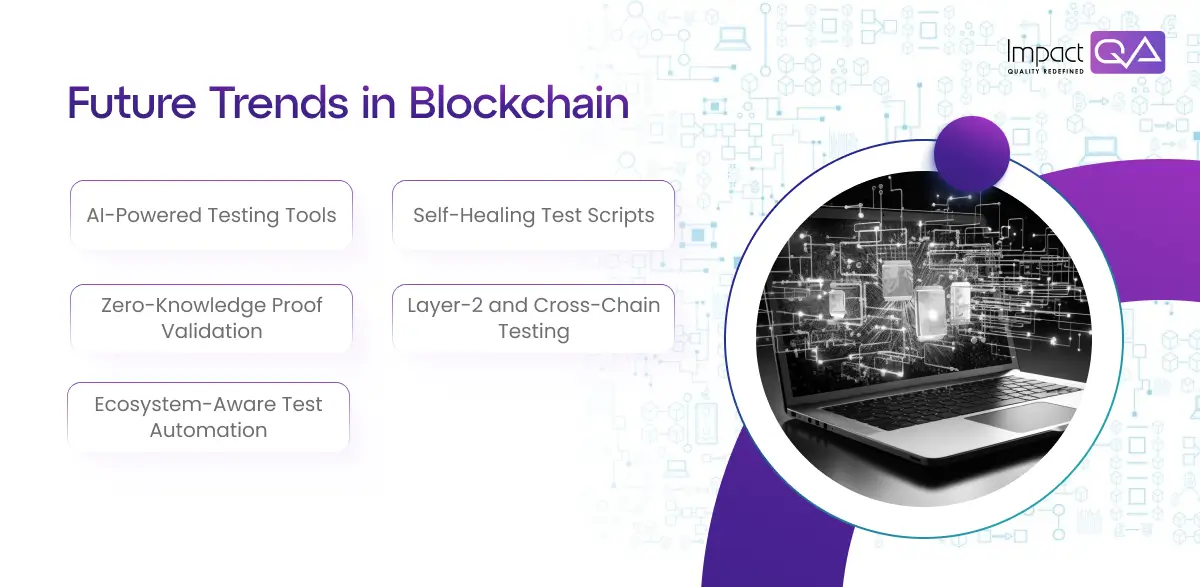
As blockchain networks mature, the scope of Quality Assurance must expand beyond basic validations. QA is no longer limited to single-chain environments or smart contract audits. It’s shifting toward a more dynamic, interconnected, and intelligent approach that aligns with the decentralized and multi-layered nature of blockchain ecosystems. The following trends will shape the future of blockchain QA:
1. AI-Powered Testing Tools
Machine learning and predictive analytics will be used to detect anomalies, identify fault-prone code paths, and optimize test coverage. This automation reduces manual workload and helps surface issues that traditional methods might overlook.
2. Self-Healing Test Scripts
With frequent protocol upgrades and hard forks, QA teams will rely on scripts that automatically adjust to underlying changes. These self-healing scripts ensure continuous testing without the need for constant manual updates.
3. Zero-Knowledge Proof Validation
As privacy becomes a core feature in blockchain systems, especially with ZKPs, QA practices must adapt. Specialized methods will be needed to verify the integrity of these privacy-preserving technologies without exposing confidential data.
4. Layer-2 and Cross-Chain Testing
With the rise of rollups, sidechains, and bridges, QA will focus on validating seamless interoperability across multiple layers and networks—ensuring consistent performance, security, and consensus.
5. Ecosystem-Aware Test Automation
Future QA environments will simulate real-world multi-protocol ecosystems, validating everything from node interactions to third-party integrations. Testing will reflect the true complexity of decentralized applications.
Let ImpactQA streamline your QA process with proven blockchain testing methodologies
Why Custom Blockchain QA Matters with ImpactQA
Standard QA models no longer meet the requirements of decentralized networks. Blockchain transactions must be fast, secure, and traceable. Smart contracts should function predictably across all user cases. Node interactions must stay in sync even during network upgrades or token migrations.
A custom blockchain testing framework aligns directly with these needs. It accommodates consensus models, cryptographic verifications, and smart contract constraints. But more importantly, it builds user trust without compromising speed or scalability.
This is where ImpactQA stands apart. We provide structured blockchain QA services built for scale. Our experts create sandboxed environments for smart contract testing. We simulate node interactions and validate multi-chain integrations. Whether it’s public, private, or hybrid chains, our testing services are tailored to our business logic and tech stack.
ImpactQA also blends automation and manual testing. We evaluate performance across load-heavy scenarios. Our continuous testing approach keeps your blockchain project release-ready, no matter how frequently it updates.
Share this post


Related Posts
Our Case Studies