Quick Summary:
The SaaSpocalypse moved software value toward outcomes, and quality work is following. AI now writes more code than testing teams can absorb, while agents act behind the interface. QE answers with quality built in at the requirement, tests chosen by risk, assets that repair themselves and AI systems held to measurable thresholds. Enterprises in 2027 need new ownership, an Ethical AI Framework in the pipeline and partners who sign up to shared metrics.
Table of Contents:
- Introduction
- 4 Lessons From the SaaSpocalypse for Software Quality
- 5 Shifts That Explain Why QE Is Replacing QA
- 4 Moves Enterprises Should Make in 2027
- Final Say
- FAQs
In February 2026, roughly $285 billion left software stocks in about two days.
Jefferies analysts used the term ‘SaaSpocalypse’ to describe the selloff. Investors had looked at a wave of new AI agents and asked a blunt question: If software can do the work, who needs the seat?
Gartner’s George Brocklehurst offered a calmer reading.
“This is less an apocalypse and more of a metamorphosis,” he said. “SaaS will not be destroyed; it will emerge in a different form.”
Now look at software testing, and you will see the same metamorphosis.
AI in quality engineering is changing what teams test, how they test it and what buyers pay for. The old word for that work was QA. The new word is QE.
ImpactQA helps teams scale test coverage through AI-led quality engineering.
Here is why the name is changing in 2027.
4 Lessons From the SaaSpocalypse for Software Quality
The selloff was about pricing and stock valuations, yet each of its lessons reaches the testing team.
The list is in no particular order:
1. Outcomes Are Replacing Seats
Research lead: Gartner
Gartner says up to $234 billion of enterprise application software spending is exposed to AI agents by 2030.
Agentic AI, says Brocklehurst, “breaks the link between user growth and revenue growth.”
Buyers will lean toward measurable results.
The same logic now reaches quality engineering and testing services. Testing hours reveal effort. Change failure rate provides a clearer measure of delivery quality.
2. Agents Now Work Behind the Interface
Research lead: Gartner and KPMG
Gartner calls it agentic arbitrage: an agent completes work across several systems, so a person skips each application’s screen.
KPMG’s Q3 2026 AI Pulse found that 62% of surveyed US organizations are building or deploying AI agents. A quarter earlier, that figure was 53%.
Multi-agent work moved faster still. It held at 6% for two straight quarters, then jumped to 25%.
Gartner sees the same curve inside software itself. By the end of 2026, it expects 40% of enterprise applications to carry task-specific agents, up from under 5% in 2025.
A test suite built around screens covers part of that journey.
The rest runs through APIs, permissions and handoffs between agents.
3. Code Supply Has Outgrown Test Capacity
Research lead: Sembi and Forrester
Sembi’s 2026 Software Quality Pulse found that AI had touched 53% of respondents’ code.
Some 61% of respondents report rising testing demand as a result.
Forrester’s 2027 predictions go further, stating that AI-assisted development and patching “will outstrip testing capacity.”
It expects an AI-generated bug or regression to cause a global outage across several industries. Hence, AI and software testing now share a single capacity plan.
4. Verification Is Becoming the Valuable Part
Research lead: Forrester
Forrester expects AI to account for 20% of business technology spending in 2027. When generating an output gets cheap, proving it correct gains value. Quality moves closer to the boardroom as a result.
5 Shifts That Explain Why QE Is Replacing QA
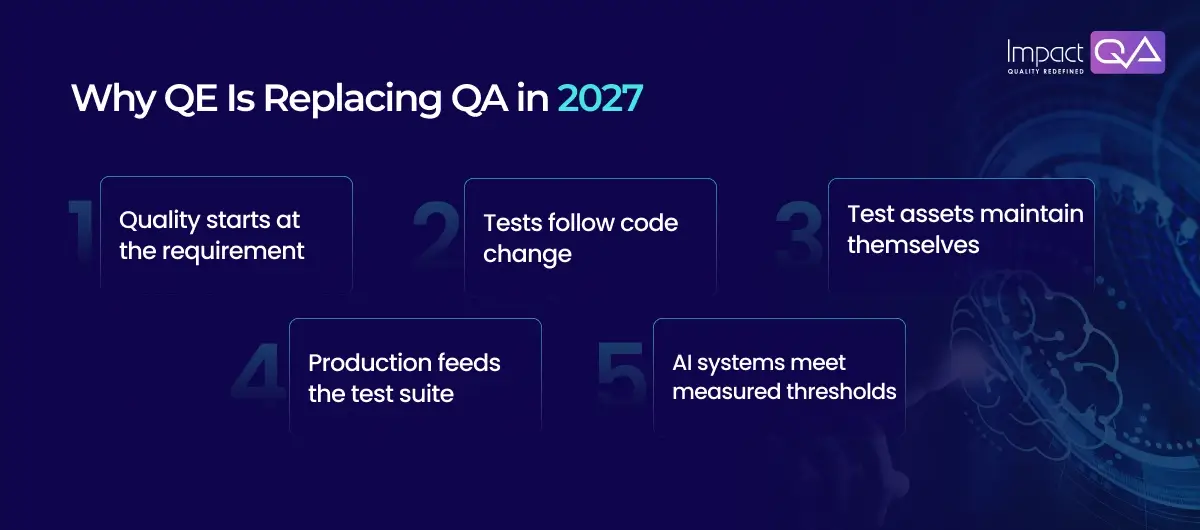
QA established the practices teams use to verify software quality. QE extends those practices across the delivery lifecycle. It keeps that discipline and widens the job, as AI-led quality engineering services vs traditional QA sets out in detail.
Even the analysts have redrawn the category.
Gartner’s October 2026 Magic Quadrant for Agentic Software Quality Assurance Platforms moves beyond AI-augmented testing tools to assess platforms that use agents across the software lifecycle.
Five shifts drive the change in language.
1. Quality Starts at the Requirement
Discipline: Shift-left engineering
A quality engineer joins the conversation before the first commit. AI reads a user story, flags ambiguous acceptance criteria and drafts test scenarios for review. Defects surface as requirements questions, which are the cheapest ones to answer.
2. Test Selection Follows Code Change
Discipline: Change-impact analysis
Running every test on every build burns pipeline hours. Change-impact analysis maps a commit to the code paths and business flows it touches.
A risk model then ranks tests by defect history and usage. The pipeline runs the tests that matter for that change, and a full regression follows on schedule.
3. Test Assets Maintain Themselves
Discipline: Self-healing automation
Scripts once broke whenever a locator changed. Self-healing logic can use multiple element attributes to identify changed locators and suggest repairs for engineer review. Test automation to autonomous QA agents is the natural next stage, with AI automation agents planning and running tests toward a stated goal.
4. Production Feeds the Test Suite
Discipline: Quality observability
QE treats release as the start of a feedback loop.
Logs, traces and user behavior show where real risk lives. Confirmed production defects can become regression tests once their causes and expected behavior are established.
Metrics change too.
PractiTest’s State of Testing report found 56.4% of respondents track test coverage as a KPI, while 8.6% are measured on business impact. QE aims to close that distance with deployment frequency, change failure rate and recovery time.
5. Probabilistic Systems Enter the Scope
Discipline: AI Testing
Deterministic software generally produces consistent outputs for the same inputs and system state
A large language model may return several valid answers.
AI testing adds evaluation methods such as golden datasets, scoring rubrics and pass thresholds alongside conventional assertions
Testers measure accuracy, hallucination rate, drift and resistance to prompt injection.
Forrester predicts that 35% of organizations will add automated testing across probabilistic and deterministic code in 2027.
4 Moves Enterprises Should Make in 2027
Here is how the shift turns into a plan.
1. Redraw Quality Ownership
Quality now sits with the whole delivery team.
Quality engineers set strategy, build the frameworks and coach developers on test design.
Skills deserve early attention, since the World Quality Report found 50% of organizations lack AI and machine learning expertise.
The same report puts the average productivity gain from generative AI in quality engineering at 19%.
2. Put an Ethical AI Framework Into the Pipeline
An Ethical AI Framework works best as a set of testable controls.
Fairness requires bias testing across user groups. Transparency requires traceable decisions. Accountability requires human oversight of high-impact actions.
KPMG found 49% of organizations have defined high-risk use cases where agents need a human decision.
Under the revised EU AI Act timetable, requirements for high-risk AI systems classified under Article 6(2) and Annex III apply from 2 December 2027.
3. Test the Agents You Buy and Build
Gartner predicts over 40% of agentic AI projects will be canceled by the end of 2027, citing cost, unclear value and weak risk controls.
Testing addresses that last factor directly.
Before scaling agentic AI services, validate tool permissions, workflow handoffs, escalation controls and audit trails.
Those checks apply equally to ai agent services from a vendor and to agents your own team builds.
Our guide to agentic AI services, risks and governance covers the controls in more depth.
4. Choose Partners by Outcome
A strong quality engineering company will agree to shared metrics before signing.
Ask how its AI-driven quality engineering services address your technology stack, data security and compliance requirements.
Then ask for a live run on your own application.
ImpactQA tests agent permissions, execution paths and workflow reliability.
Final Say
The SaaSpocalypse showed how quickly the value of software can attach itself to outcomes.
Quality engineering is following the same shift, as enterprises seek to validate more software without proportionally increasing testing effort.
ImpactQA is a pure-play software testing firm, and our AI-led quality engineering services now run on predictive analytics and autonomous testing. Our own numbers show up to 45% faster test creation and 35% fewer production incidents. Models and agents go through our AI Testing services. FALCON, our agentic platform, lets teams write those tests in plain English.
Brocklehurst’s word fits testing too.
The name moved to QE because the work moved first.
Frequently Asked Questions (FAQs)
Share this post


Related Posts
Our Case Studies