Quick Summary:
Software testing is growing into quality engineering, and every core testing practice comes along. This article shows what testing built and what quality engineering adds on top of it. It then covers how US enterprises are adjusting their budgets and partner models to match.
Table of Contents:
- Introduction
- What Software Testing Built
- The Metamorphosis: 6 Ways Quality Engineering Is Reshaping Software Testing
- How Businesses Evolve Alongside Quality Engineering
- Final Say
- FAQs
Evolution rarely announces itself. It happens in the background as systems become more connected and the way people build and use technology changes around them. Software has followed that trajectory for decades. Quality has had to evolve with the same momentum.
Software testing established the discipline of verification and gave engineering teams the methods to release with confidence. Quality Engineering takes those foundations further by bringing quality into requirements, development, delivery, operations, and continuous improvement. So when the industry says software testing is giving way to QE, the more accurate interpretation is that testing is expanding into a broader engineering discipline.
The U.S. Bureau of Labor Statistics counted about 201,700 software quality assurance analysts and testers in 2024 and projects employment in the occupation to grow 10% through 2034. Gartner, meanwhile, projects that about 70% of enterprises will integrate AI-augmented software testing tools into their software engineering toolchains by 2028, compared with approximately 20% in early 2025. Together, these signals point to a profession that is expanding in scope rather than disappearing.
ImpactQA helps enterprises build scalable quality practices across requirements, automation, performance, security, and production feedback.
What Software Testing Built
Every quality engineering practice in use today stands on techniques that testers refined over decades. Boundary-value analysis and equivalence partitioning gave teams a way to design fewer tests that catch more defects. The defect lifecycle gave engineering leaders a shared language for severity and priority. Regression suites turned past failures into permanent safeguards, and independent verification gave business owners an objective view of release readiness.
Test automation extended that foundation. Scripted frameworks moved repeatable checks into code and into nightly builds, which gave teams the confidence to release more often. ImpactQA has documented how enterprises carried those scripts forward into intelligent test automation.
The stakes explain why the discipline kept expanding. The Consortium for Information & Software Quality puts the cost of poor software quality in the US at $2.41 trillion, and its report identifies finding and fixing defects as the largest single expense in the software lifecycle. Quality had become too valuable to hold to one phase near the end of a project.
The Metamorphosis: 6 Ways Quality Engineering Is Reshaping Software Testing
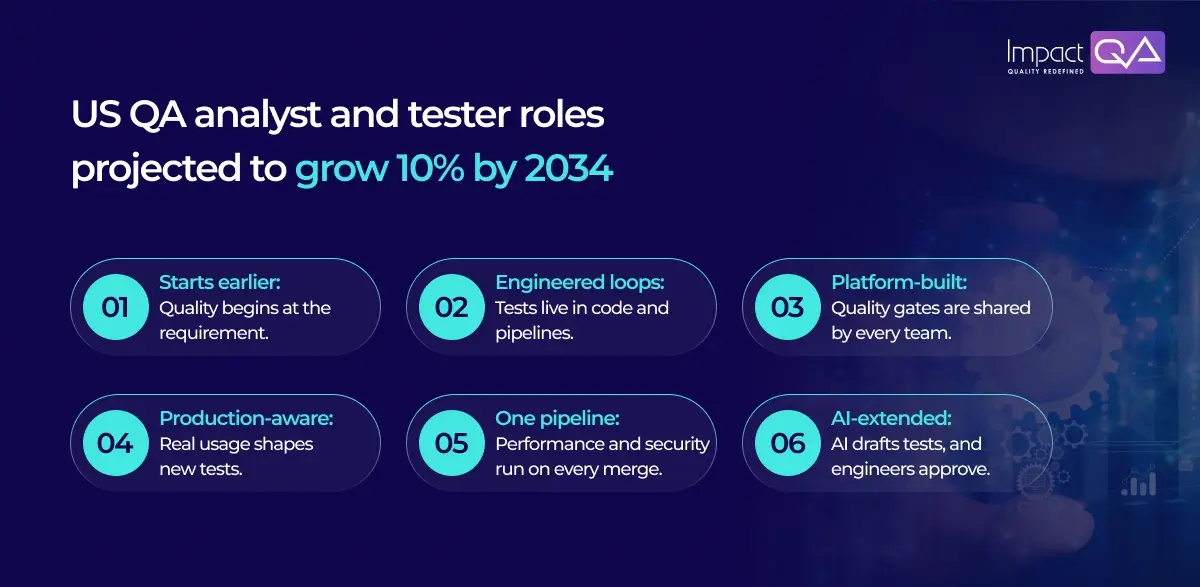
Quality engineering keeps every one of those practices and changes where they run and who owns them. Six shifts define the change.
1. Quality Starts at the Requirement
During backlog refinement, quality engineers now write acceptance criteria in testable form and apply risk-based test design before coding begins. A login story, for example, arrives with its boundary cases and lockout rules already specified, so developers build against known expectations. Equivalence partitioning still does the work. It simply happens earlier, when changes cost the least. ImpactQA explores this in an article about why functional testing is evolving into continuous quality engineering.
2. Testers Become Engineers of Feedback Loops
Test code now lives in the same repository as application code and moves through the same pull request reviews. Quality engineers build the frameworks and per-branch test environments that give every change feedback within minutes. Test automation becomes an engineering product with its own architecture and maintenance plan, and automated software testing services increasingly deliver that product alongside the tests themselves.
3. Quality Becomes a Platform Capability
Google’s DORA research found that 90% of organizations use an internal developer platform and 76% have dedicated platform teams. DORA also found that a high-quality platform strengthens the effect of AI adoption on organizational performance. Quality engineering plugs into that platform. Quality gates and test data services become shared capabilities that every product team inherits, so standards travel with the pipeline.
4. Production Becomes a Source of Test Insight
Testing has always looked ahead of release, and quality engineering adds a view from production. Canary releases expose a change to a small share of traffic while observability data shows how it behaves under real conditions. When an incident traces back to an untested path, that path joins the regression suite, which closes the loop between operations and test design.
5. Non-Functional Quality Shares the Same Pipeline
Performance and security checks traditionally ran as dedicated projects before major launches. In a quality engineering model, they also run as automated gates on each merge, with full-scale tests scheduled ahead of major releases. Software performance testing services now deliver short load profiles inside CI/CD and compare each build against a latency budget, an approach ImpactQA details in how continuous performance testing prevents production failures.
6. AI Extends the Reach of Every Quality Engineer
Forrester’s interviews with enterprise customers of autonomous testing platforms found that AI raised automation levels by 21% to 30% over traditional tools, and Gartner projects that about 70% of enterprises will use AI-augmented testing tools by 2028. AI drafts tests and maintains locators, while quality engineers set risk priorities and approve what ships. Demand for that judgment is rising, and IEEE-USA links part of the projected growth in QA roles to vetting AI-assisted code.
How Businesses Evolve Alongside Quality Engineering
When quality moves across the lifecycle, the business side of software moves with it. US enterprises are adjusting in four areas.
1. Quality Budgets Shift Toward Product Investment
Testing budgets were traditionally scoped per project and approved near release. Quality engineering budgets attach to products and platforms, funding frameworks and test data services that serve every release on the roadmap. Finance leaders can then track quality spend against outcomes such as escaped defects and release frequency, which turns a cost line into an investment case.
2. Quality Ownership Spreads Across Teams
Quality engineers increasingly sit inside product teams, pairing with developers on test design during each sprint. A central QE center of excellence sets the standards and tooling those embedded engineers share. This structure keeps independent verification wherever regulation requires it, as in financial reporting or healthcare workflows, while daily quality work moves closer to the code.
3. Executives Read Quality Through Delivery Metrics
Boards and CIOs now ask quality questions in delivery terms. Change failure rate shows how often a release needs remediation, and recovery time shows how quickly teams restore service. Quality engineering connects those metrics to their causes, linking a rise in change failures to a specific gap in test coverage. Reporting becomes a business conversation about risk and speed.
4. Partner Models Move Toward Outcomes
Many US enterprises first bought software testing and QA services as staff augmentation, measured in tester hours. Quality engineering contracts increasingly define outcomes such as regression cycle time or defect escape rate, with the partner owning frameworks and pipelines. When evaluating the best software testing companies, buyers now weigh engineering depth and platform experience alongside testing coverage. ImpactQA’s view of quality engineering trends outlines how these partnerships are maturing.
With ImpactQA, build a QE model that connects engineering discipline with delivery outcomes.
Final Say
So, is “software testing” still the right term? For the craft, yes. Test design and verification remain the core skills of every quality engineer, and the Bureau of Labor Statistics still counts the profession under that name. Quality engineering is the right term for the system that craft now lives in, one that spans the full lifecycle and reports in business terms. Enterprises that fund and measure quality this way gain release speed and predictability together.
ImpactQA has supported this metamorphosis for more than a decade as a leading software testing company headquartered in New York, serving Fortune 500 and Global 1000 organizations. Our AI-powered quality engineering services combine agentic testing with deep platform expertise across SAP and E/CTRM transformations. Partnerships with Tricentis and OpenText extend the enterprise tooling clients already run, while Falcon, our no-code agentic automation platform, and NeX-AI, our AI test generation engine, bring AI into everyday test automation.
Frequently Asked Questions (FAQs)
Share this post


Related Posts
Our Case Studies