Quick Summary:
Traditional QA centers on planned test cycles. Quality engineering moves quality work earlier into development and throughout delivery. AI-led quality engineering adds AI to generate scenarios, prioritize tests, maintain automation, and analyze failures. The goal is not to remove human judgment, but to focus it where enterprise risk is highest.
Table of Contents:
- Introduction
- What Is Traditional QA?
- What Are AI-Led Quality Engineering Services?
- AI-Led Quality Engineering vs Traditional QA: A Quick Comparison
- So, Why the Difference Matters?
- Key Parts of AI-Led Quality Engineering
- AI Testing: When the Software Itself Uses AI
- How to Begin the Move
- Final Say
- Frequently Asked Questions (FAQs)
How often does your phone let you know that an app needs updating? You probably see these pop-ups all the time and sometimes don’t even consider updating. Before you know it, the app that you didn’t think needed updating has features that you’ve been waiting for. Someone was probably testing that update. For many years that someone was a QA team, checking the finished software ahead of release, and the method has served businesses well.
Today, updates arrive every week, and AI helps developers write code faster than ever. DORA’s 2025 research found that 90% of technology professionals use AI at work.
Testing is growing in the same direction. AI-led quality engineering services bring testing into every step of building software, with AI helping along the way. Here is how that compares with traditional QA.
Explore ImpactQA's AI-led quality engineering services and build a quality model that fits your business.
What Is Traditional QA?
Traditional QA, short for quality assurance, is the practice of testing software once it has been built. A dedicated team receives the finished version and checks it against the requirements. The team then shares its findings ahead of release.
It is a clear and proven method. It suits projects with a few planned releases each year.
What Are AI-Led Quality Engineering Services?
Quality engineering, or QE, builds on that base. Testing begins on day one and continues at every step, so issues are found while they are still small and easy to fix.
AI-led quality engineering services add artificial intelligence to this approach. Using AI, software engineers can rely on the technology to help them write tests and select the best tests to run. AI also helps keep the tests up to date as the software is modified and changed.
Software engineers are ultimately in charge. AI helps provide suggestions, but engineers ultimately decide the priorities.
Think of this in terms of preparing a meal. Traditionally, the quality assurance (QA) department tastes the dish at the end to determine if it’s ready to be served. Quality engineering, with the assistance of AI, “tastes” the dish at every stage of preparation.
AI-Led Quality Engineering vs Traditional QA: A Quick Comparison
Area |
Traditional QA |
AI-Led Quality Engineering |
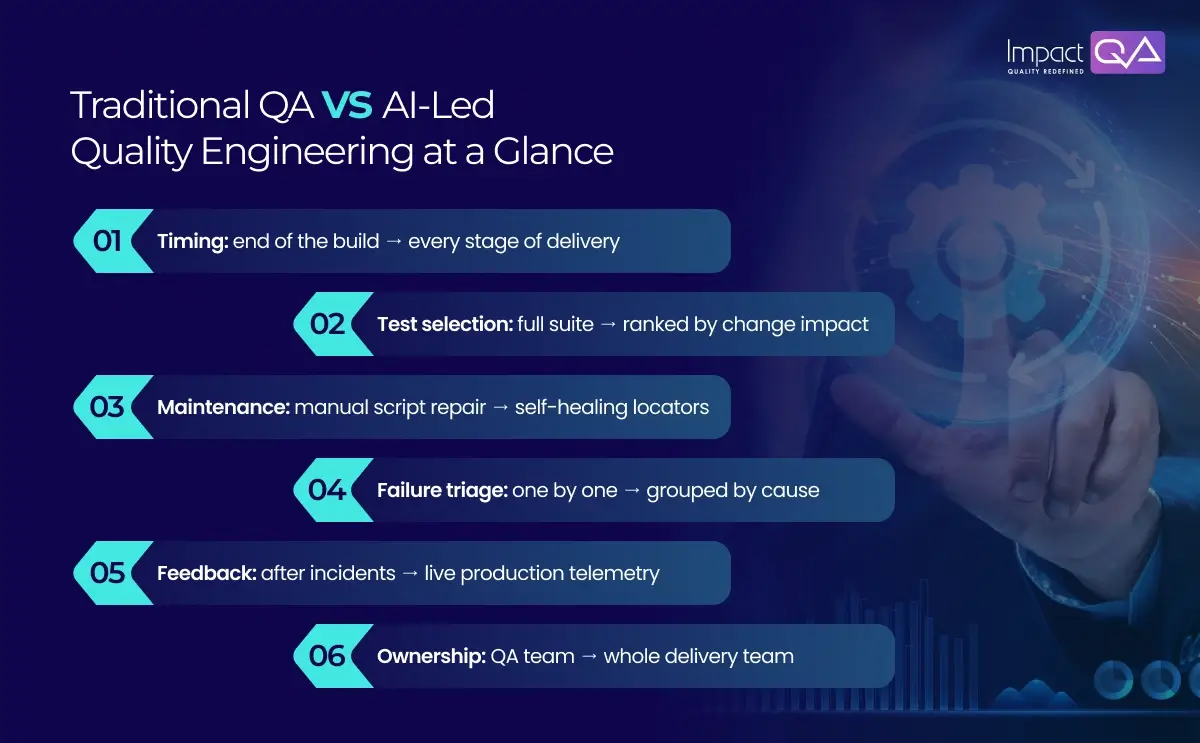
| When testing happens | After the software is built | From day one, through to release and beyond |
| Who owns quality | The QA team | The whole delivery team |
| How tests are written | By hand, from requirement documents | Drafted by AI, reviewed by engineers |
| Which tests run | The full set, every cycle | The tests most relevant to each change |
| Keeping tests updated | Manual updates | Self-healing automation |
| Speed of feedback | Days | Minutes |
| Best suited to | A few planned releases a year | Weekly or daily releases |
The stats show the pace of this trend. Enterprises used to automate around 25% of their tests. In Forrester’s 2026 study of 37 enterprises using AI in testing, that number rose to 51% to 60%.
So, Why the Difference Matters?
Releases Move Faster
Automating tests means developers can get feedback in minutes. This enables teams to confidently release code as often as they want, whether that be daily or weekly.
Earlier Fixes Cost Less
Tests run automatically as code is changed. This makes feedback immediate, which means issues are found while code is still fresh, and therefore simpler and easier to correct.
Teams Can Do More
With traditional QA, more features mean more manual checks and therefore, a larger team. With AI, the same amount of work can be covered with less people, freeing the team to do higher order work like thinking about how a feature will be used and interacted with, the way a real person would.
Key Parts of AI-Led Quality Engineering
This is where AI in quality engineering does its best work.
1. AI-Assisted Test Design
AI reads a requirement and suggests test cases in seconds. An engineer then decides which cases are relevant to the business.
2. Smart Test Selection
Every change is different. A change to a payment page deserves more testing than a change to a button color. AI looks at what changed and runs the most relevant tests first.
3. Self-Healing Automation
Automated tests find buttons and fields on a screen using small markers called locators. When a screen is redesigned, AI finds the new marker and updates the test for an engineer to approve.
4. AI Automation Agents
A regular test script follows fixed steps. AI automation agents are given a goal and plan the steps themselves. Teams that use autonomous QA agents in testing spend more of their day on planning and review.
Many providers offer this as AI agent services or agentic AI services. At ImpactQA, agents work inside clear limits. Each one has set permissions, and an engineer approves its changes.
AI Testing: When the Software Itself Uses AI
AI and software testing meet in a second way. Many products now include AI features such as chatbots, and these need testing too. This is called AI Testing.
AI features can give different answers to the same question. Most chatbots run on large language models, or LLMs. Enterprise LLM testing for accuracy means checking many sample answers for correctness and fairness.
An ethical AI Framework supports this work. It is a written set of rules for how a quality engineering company uses AI fairly and openly, and it names who is responsible for the results.
How to Begin the Move
Checklist 1: Start With One Team
Pick one product team and one application. A small start shows results quickly and gives other teams a model to follow.
Checklist 2: Strengthen the Basics
Clear test cases and good test data form the right foundation for test automation. DORA’s research describes AI as an amplifier, meaning it multiplies the strengths a team already has.
Checklist 3: Add Tests to the Pipeline
A CI/CD pipeline is the automated route code takes from a developer’s desk to release. Adding tests to it means every change is checked on its way.
Checklist 4: Bring In AI Step by Step
Begin with AI-assisted test design, then add smart test selection. Measure progress with simple numbers, such as how often you release.
ImpactQA's AI Testing services check accuracy and consistency ahead of go-live.
Final Say
Traditional QA gave software teams a strong testing discipline, and that discipline remains the base of everything described here. AI-led quality engineering services build on it by starting earlier and running continuously, with AI handling the repetitive work. Enterprise investment is moving steadily in this direction, and Forrester’s numbers show automation rising quickly.
In the coming years, AI agents will take on more routine testing while engineers focus on risk and customer experience. Teams that begin now will be well placed to benefit.
ImpactQA supports enterprises through each step of this move. Its quality engineering and testing services combine proven functional and performance testing with AI-driven risk analysis and intelligent test selection. For AI-powered products, a dedicated team tests LLM applications and autonomous agents. With AI-driven quality engineering services in place, enterprises release faster and with greater confidence.
Frequently Asked Questions (FAQs)
Share this post


Related Posts
Our Case Studies