What Is AI Agent as a Service and Why It’s Key to Next-Gen Automation?

Quick Summary:
Enterprises face complex, error-prone workflows and massive data volumes that strain traditional automation. AI agent as a service (AaaS) deploys intelligent, autonomous agents capable of context-aware decision-making and adaptive task execution. This blog explains what an AI agent as a service is, how it works, its frameworks, deployment strategies, and why agentic AI automation is crucial for modern enterprises.
Table of Contents:
- What Is AI Agent as a Service?
- What Are the Key Components of Agentic AI Services?
- What Are Agentic AI Frameworks and How Do They Work?
- Difference Between Traditional Automation and Agentic AI Automation
- How Enterprises Deploy Agentic AI Services Effectively
- Challenges and Best Practices in Agentic AI Automation
- Next-Gen Automation with Agentic AI Services
- Conclusion
What Is AI Agent as a Service?
AI agent as a service (AaaS) provides enterprises with cloud-hosted, autonomous agents capable of performing tasks without continuous human intervention. Unlike traditional automation that executes pre-programmed scripts, AI agents can reason, learn, and adapt to changing circumstances.
Key Characteristics:
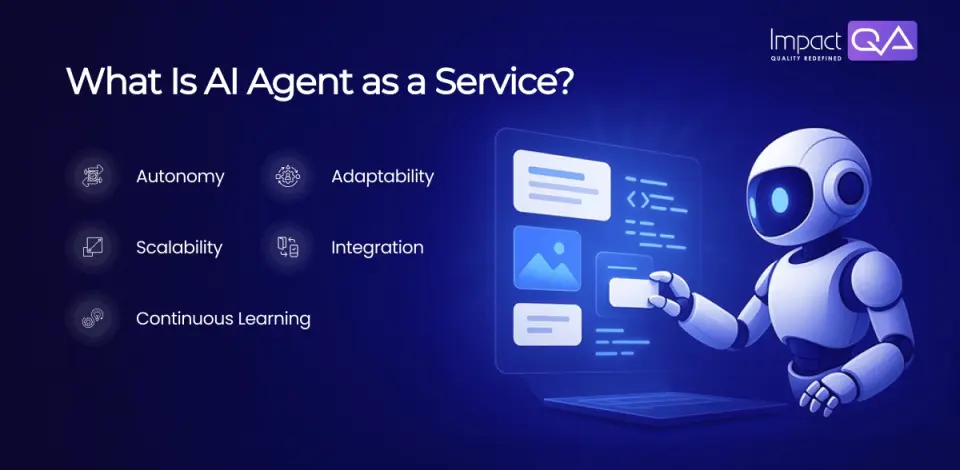
- Autonomy: Agents make independent decisions within defined operational limits.
- Adaptability: Actions evolve based on environment feedback and past performance.
- Scalability: Services scale dynamically with workload and business requirements.
- Integration: Connects seamlessly with enterprise systems, APIs, and external data sources.
- Continuous Learning: Agents use machine learning to refine performance and decision-making over time.
Benefits:
- Accelerates operational efficiency and reduces manual errors.
- Optimizes repetitive or knowledge-intensive workflows.
- Provides predictive insights and better risk management.
- Improves compliance by tracking and adhering to enterprise rules.
Enterprises adopting agentic AI services witness measurable performance gains, especially in areas where tasks are complex, data-intensive, or susceptible to frequent change. AI agent-driven automation solutions allow these organizations to achieve faster cycle times, minimize human error, and enhance operational precision.
What Are the Key Components of Agentic AI Services?
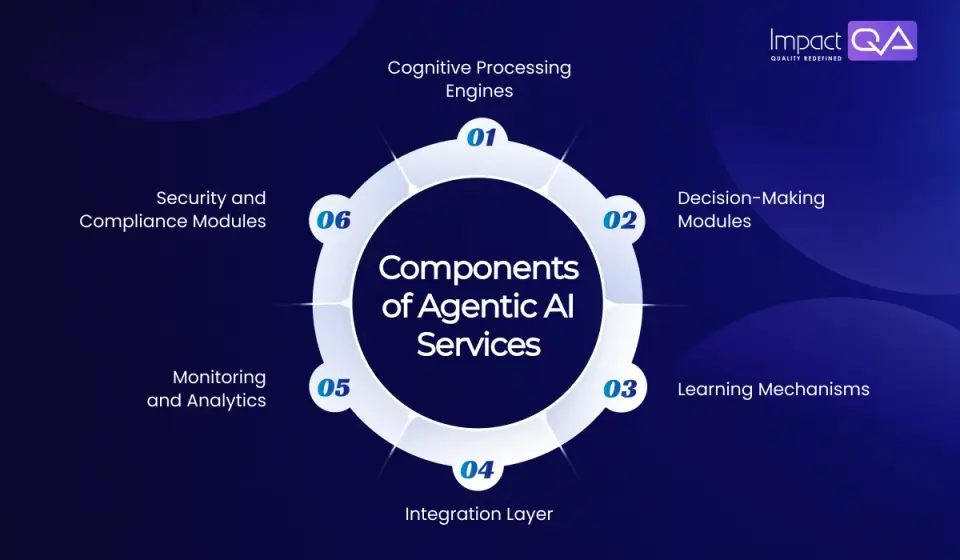
The power of agentic AI services lies in the interplay of multiple components that define their intelligence and operational capabilities. Each component contributes to the overall effectiveness of AI agents.
Core Components:
- Cognitive Processing Engines: Responsible for reasoning, natural language understanding, and situational awareness.
- Decision-Making Modules: Use machine learning models to determine optimal actions autonomously.
- Learning Mechanisms: Incorporate supervised, unsupervised, and reinforcement learning for continuous improvement.
- Integration Layer: Connects agents to databases, APIs, and other enterprise systems for real-time operation.
- Monitoring and Analytics: Tracks agent decisions, performance metrics, and generates actionable insights.
- Security and Compliance Modules: Ensures all actions adhere to regulatory and organizational policies.
Operational Benefits:
Adopting AI agent-driven automation solutions ensures enterprises can achieve robust and repeatable results while optimizing resource allocation and reducing operational overhead. Here is a list of a few key operational benefits:
- Handles repetitive tasks efficiently.
- Reduces manual intervention and operational errors.
- Provides predictive insights for risk and resource management.
- Improves adaptability in dynamic workflows.
- Supports enterprise-wide scalability with minimal infrastructure overhead.
Learn how ImpactQA’s agentic AI automation services can optimize your operations.
What Are Agentic AI Frameworks and How Do They Work?
Agentic AI frameworks provide the backbone for deploying, managing, and scaling autonomous AI agents. These frameworks offer standardized structures, best practices, and reusable modules to implement agentic AI automation effectively.
Top Agentic AI Frameworks:
Sr. No. |
Framework |
Core Function |
Ideal Application |
| 1. | LangChain | Coordinates LLM-powered agents | Customer service bots |
| 2. | AutoGPT | Autonomous multi-step task execution | Workflow automation |
| 3. | BabyAGI | Task planning and prioritization | Project management |
| 4. | AgenticAI | Modular AI services | Enterprise task automation |
| 5. | OpenAI Plugins | Extends LLM capabilities | API-driven integrations |
| 6. | Microsoft Semantic Kernel | Knowledge-driven AI | Data analysis and decisions |
| 7. | REACT | Reasoning and action | Interactive simulations |
| 8. | MetaGPT | Multi-agent collaboration | Complex operational tasks |
| 9. | Jarvis AI | Workflow orchestration | HR and finance operations |
How Frameworks Enable Agentic AI Services:
- Simplify agent creation with reusable modules.
- Provide pre-built models for natural language understanding and decision-making.
- Support secure integration with enterprise data systems.
- Allow multi-agent collaboration for complex operations.
- Enable monitoring, debugging, and performance evaluation at scale.
Companies using agentic AI services leverage these frameworks to deploy reliable, adaptive agents rapidly, reducing development time and improving operational consistency across enterprise systems.
Difference Between Traditional Automation and Agentic AI Automation
Traditional automation relies on static scripts that collapse under dynamic conditions, leaving critical workflows exposed to inefficiencies and errors. Agentic AI frameworks introduce adaptive decision models that enable agents to respond to real-time variables, learn from outcomes, and maintain operational reliability. This structured intelligence transforms automation from rigid task execution into a context-aware, resilient system capable of scaling across enterprise functions.
Sr. No. |
Feature |
Traditional Automation |
Agentic AI Automation |
| 1. | Decision-making | Script-based, static | Adaptive and autonomous |
| 2. | Learning | Manual updates required | Continuous self-improvement |
| 3. | Complexity Handling | Limited | Handles dynamic, uncertain environments |
| 4. | Integration | Partial, rigid | Seamless, flexible across systems |
| 5. | Scalability | Constrained by scripts | Cloud-scalable and modular |
| 6. | Error Management | Human intervention needed | Predictive and corrective |
How Enterprises Deploy Agentic AI Services Effectively
Enterprises cannot approach autonomous agents with an ad-hoc mindset; fragmented rollouts often create integration gaps and unreliable outcomes. A disciplined deployment of an AI agent as a service requires aligning business-critical workflows with adaptive intelligence so that agents operate as dependable extensions of enterprise systems rather than isolated automation tools.
Deployment Strategy:
- Assess Workflow Suitability: Identify processes that are repetitive, knowledge-intensive, or error-prone.
- Select Appropriate Frameworks: Choose agentic AI frameworks that fit enterprise needs.
- Data Preparation: High-quality, structured data ensures accurate agent decisions.
- Integration Planning: Align agents with ERP, CRM, and other enterprise systems.
- Monitoring & Analytics: Continuously track agent performance and decision outcomes.
- Iterative Refinement: Agents improve through machine learning models and real-time feedback loops.
Benefits of Effective Deployment:
- Operational acceleration across departments.
- Reduced human error and dependency on manual intervention.
- Improved compliance through structured workflows.
- Predictive capabilities that anticipate issues before they occur.
- Scalable solutions adaptable to changing enterprise requirements.
Challenges and Best Practices in Agentic AI Automation
The transition to agentic AI automation introduces new layers of complexity that extend beyond algorithm accuracy. Autonomous agents interact with sensitive data, external APIs, and dynamic workflows, which makes their reliability susceptible to hidden risks. To sustain performance at scale, enterprises must anticipate these challenges early and apply structured practices that preserve both adaptability and control.
Challenges:
- Poor-quality data can skew agent decisions.
- Security risks if agents interact with sensitive systems.
- Integration complexity across heterogeneous environments.
- Regulatory compliance adherence.
- Monitoring autonomous decisions to avoid operational failures.
Best Practices:
- Employ robust, diverse datasets for training.
- Implement strong security protocols and continuous monitoring.
- Choose scalable and modular agentic AI frameworks.
- Align agent behaviors with clear business rules.
- Establish feedback loops for continuous learning and improvement.
Next-Gen Automation with Agentic AI Services
Agentic AI services represent the next stage of enterprise automation, where autonomous agents operate with adaptive intelligence across complex workflows. With AI agent as a service, businesses can achieve multi-agent collaboration, seamless cross-system interoperability, and advanced reasoning – capabilities that define the foundation of next-generation deployments.
Strategic Advantages:
- Significant reductions in labor-intensive tasks.
- Predictive, autonomous capabilities enhance operational speed and accuracy.
- Continuous learning agents adapt to business changes, reducing susceptibility to errors.
- Multi-agent systems distribute workloads intelligently, reducing processing delays.
- Real-time decision loops improve compliance and audit readiness.
- Integration flexibility supports enterprise-wide transformation across diverse functions.
Explore ImpactQA’s AI agent as a service solution to drive faster, accurate, and adaptive business processes.
Conclusion
The adoption of an AI agent as a service is a transformative step toward fully autonomous enterprise operations. With agentic AI services, organizations move from reactive workflows to adaptive systems where agents interpret data contextually, apply reasoning models, and self-correct in real time. Supported by agentic AI frameworks, this approach transforms automation from static rule execution into scalable intelligence capable of handling volatile and data-intensive processes.
ImpactQA drives this transformation by delivering agentic AI automation strategies that integrate seamlessly with enterprise ecosystems. From validating multi-agent deployments to ensuring compliance and operational reliability, we design automation solutions tailored to business-critical workflows. Enterprises working with companies using agentic AI like ImpactQA can gain scalable automation models that reinforce system accuracy – positioning them ahead in the next wave of autonomous enterprise systems.
Share this post


Related Posts
Our Case Studies