How Agentic AI Frameworks Are Changing the Way We Build Test Automation
Quick Summary:
Agentic AI frameworks are reshaping how organizations design, execute, and scale test automation. By bringing autonomy, adaptability, and intelligence into testing, these frameworks reduce manual overhead while increasing precision. This article explores the function of agentic AI frameworks, the advantages they bring to QA teams, and the top agentic AI frameworks available in both commercial and open-source ecosystems. It also outlines strategies to integrate them into enterprise-grade automation pipelines.
Table of Contents:
- Introduction
- What Makes Agentic AI Frameworks Distinct?
- Why QA Leaders Are Turning to AI Agent Frameworks
- Top Agentic AI Frameworks Reshaping Test Automation
- Role of Open-Source Agentic AI Frameworks
- Architecture of Agentic AI in Test Automation
- Challenges and Considerations Before Adoption
- Final Say
The demand for intelligent automation is surging. According to Statista, the global AI market size is projected to reach $826.7 billion by 2030. Within this bourgeoning market, agentic AI frameworks are making a noticeable entry into the testing domain. Unlike traditional automation tools that depend heavily on static scripts, these frameworks bring dynamic decision-making into testing workflows.
But what exactly does this mean for enterprises and QA teams? It means testing will no longer be bound to pre-written scripts or manual oversight. Instead, autonomous AI agents can evaluate environments, decide execution paths, and remediate failures in real time. This shift is not just a technical improvement but a strategic rethinking of test automation.
What Makes Agentic AI Frameworks Distinct?
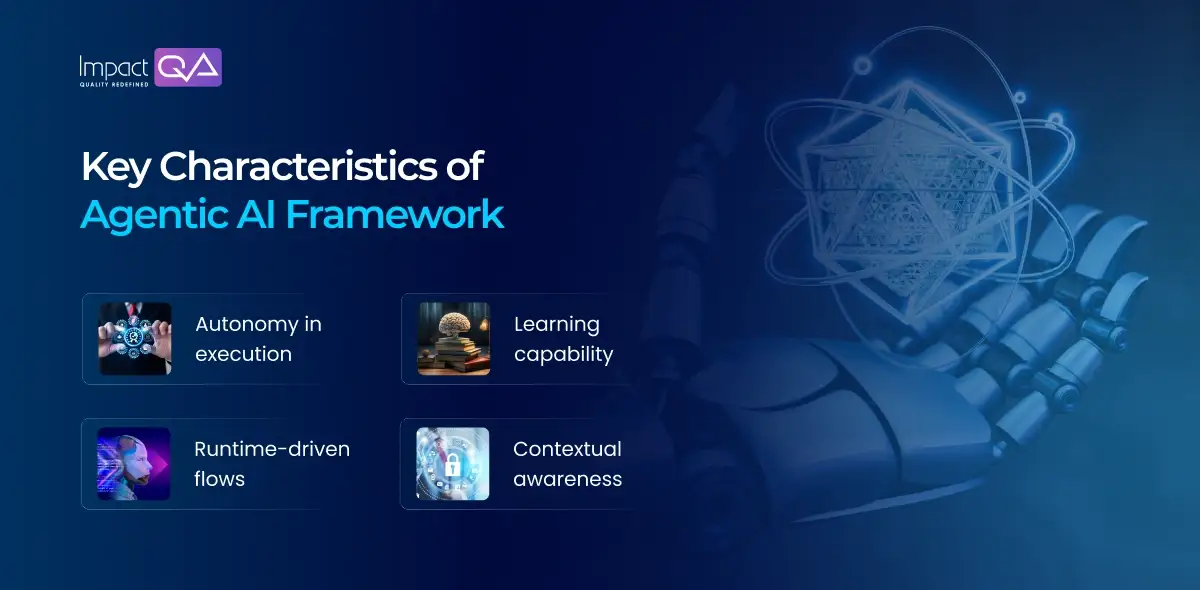
Agentic AI frameworks introduce autonomy and proactivity into test automation. Traditional automation is deterministic, meaning it runs based on predefined inputs and expected outcomes. Agentic systems, on the other hand, are adaptive and self-directed.
Key Characteristics:
- Autonomy in execution: AI agents can select test cases, determine priority, and adapt flow during execution.
- Learning capability: Continuous training from logs and prior outcomes improves accuracy.
- Runtime-driven flows: AI agents design execution paths dynamically, replacing rigid step-by-step processes.
- Contextual awareness: They interpret system behavior, not just surface-level outputs.
ImpactQA delivers CI/CD-aligned automation testing tailored for complex mobile ecosystems.
Why QA Leaders Are Turning to AI Agent Frameworks
The bourgeoning complexity of enterprise applications has exposed the limitations of scripted automation. QA leaders are exploring agentic AI frameworks because they address the following concerns:
Pain Points with Traditional Automation
- High maintenance: Frequent script updates when UI or APIs change.
- Limited scalability: Difficult to expand beyond regression testing.
- Reactive debugging: Errors discovered late, delaying releases.
Advantages of AI Agent Frameworks
- Reduced maintenance burden through self-healing test scripts.
- Scalable intelligence to manage parallel test executions across distributed environments.
- Faster decision cycles as AI agents learn from defect patterns.
- Proactive issue detection before critical failures escalate.
In essence, AI agent frameworks are not just automating test execution; they are also transforming testing into a predictive and self-managed function.
Top Agentic AI Frameworks Reshaping Test Automation
As enterprises push toward greater automation maturity, specific frameworks are emerging as frontrunners in redefining testing workflows. These platforms are not just enhancing efficiency but also making test execution smarter and more adaptive.
Several frameworks stand out as leaders in driving autonomous testing practices. Below are the top agentic AI frameworks being adopted globally:
1. LangChain
- Specialized in natural language-driven task management.
- Integrates well with QA workflows requiring test design and reporting.
2. AutoGen
- Provides multi-agent collaboration for testing scenarios.
- Supports debugging through conversational prompts.
3. CrewAI
- Focused on distributed agents for enterprise-level tasks.
- Useful for simulating large-scale testing environments.
4. MetaGPT
- Employs role-based agent delegation, ensuring modular test responsibilities.
- Enables precise coordination across agents, reducing overlaps and improving test coverage.
Framework |
Core Strength |
Best Use Case |
Scalability Level |
| LangChain | Natural language prompts | Test design and reporting | Medium |
| AutoGen | Multi-agent collaboration | Debugging and exploratory testing | High |
| CrewAI | Distributed agents | Enterprise-scale testing | High |
| MetaGPT | Modular delegation | Functional and unit testing | Medium |
ImpactQA provides AI-driven testing strategies powered by agentic frameworks.
Role of Open-Source Agentic AI Frameworks
The appeal of open-source agentic AI frameworks lies in their accessibility and customization. Enterprises experimenting with AI in QA find it ideal for proof-of-concept projects.
Key Open-Source Options
- LangChain (Open-Source Edition) – rich plugin ecosystem.
- AutoGen (Microsoft Research) – active community-driven development.
- Haystack AI – suitable for NLP-driven testing flows.
Benefits for QA Teams
- Low entry cost with community support.
- Customization freedom to align with existing CI/CD pipelines.
- Transparency in algorithms that allows debugging AI behavior.
However, open-source agentic AI frameworks can be susceptible to security gaps if not properly vetted. Enterprises must balance flexibility with compliance standards before adoption.
Architecture of Agentic AI in Test Automation
Agentic AI frameworks are designed with a layered architecture that mirrors the way testing ecosystems operate. Instead of functioning as a monolithic engine, these systems divide responsibilities into specialized agents and feedback loops. This structure makes automation more adaptive and allows enterprises to scale individual components without disrupting the entire workflow.
At the core, the architecture begins with structured test inputs, moves through planning and execution by AI agents, and ends with continuous learning from results. Each layer plays an important role in ensuring that tests are relevant, execution is accurate, and outcomes are actionable.

Breakdown of the Architecture
- Planner Agent: Evaluates requirements and selects the most relevant test cases from the repository.
- Executor Agent: Runs these tests across multiple environments and adapts based on runtime variables.
- Logs & Observability Layer: Records execution details, anomalies, and performance data for traceability.
- Self-Learning Engine: Processes logs, identifies patterns, and refines future test selection.
Challenges and Considerations Before Adoption
Adopting agentic AI frameworks demands structured preparation across data, processes, and governance. Enterprises must build reliable pipelines for training and monitoring, while also keeping AI-driven actions traceable and auditable. Clear accountability ensures that autonomous agents remain aligned with business objectives.
Challenges:
- Data Dependency: AI performance is as good as the training data.
- Bias in decision-making: Poorly trained models may misclassify defects.
- Integration hurdles: Legacy test management tools may resist seamless adoption.
Best Practices for QA Leaders:
- Begin with hybrid adoption – use AI agents for high-maintenance test areas first.
- Prioritize observability tools to monitor AI-driven outcomes.
- Build continuous feedback loops to refine models regularly.
- Enforce compliance and security reviews before scaling across the enterprise.
ImpactQA’s automation experts help enterprises deploy reliable and scalable test ecosystems.
Conclusion
Agentic AI frameworks are shaping a paradigm where testing becomes self-reliant and predictive. By embedding decision-making into automation, enterprises can now move beyond reactive QA and create resilient pipelines that evolve with business needs.
ImpactQA stands at the forefront of this shift. Through its AI & ML Testing Services and Test Automation Solutions, ImpactQA is empowering enterprises to experiment, implement, and scale agentic AI-driven automation. Our approach combines avant-garde frameworks with practical QA expertise to ensure that businesses gain value without inflating complexity.
As agentic AI frameworks mature, organizations that invest early will redefine how automation contributes to reliability, scalability, and quality. This is not about replacing human testers but about augmenting their work with autonomous agents capable of managing scale and complexity. ImpactQA is uniquely positioned to guide enterprises in this journey, while ensuring automation transforms into an intelligent backbone for digital resilience.
Share this post


Related Posts
Our Case Studies